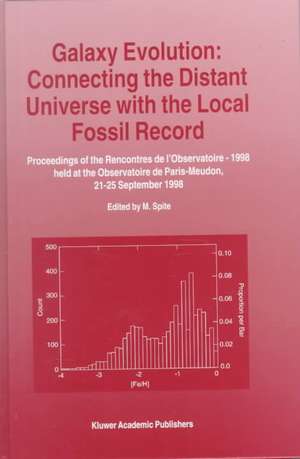
Galaxy Evolution
Editat de Monique Spiteen Limba Engleză Hardback – 29 feb 2000
Preț: 591.08 lei
Preț vechi: 695.38 lei
-15%
Puncte Express: 887
Carte tipărită la comandă
Livrare economică 14-28 noiembrie
Livrare prin curier în România Termenul estimat este afișat lângă disponibilitate.
Transport gratuit pentru acest produs Plată online sau ramburs, în funcție de opțiunile comenzii.
Retur gratuit în 14 zile Comandă securizată și suport în română.
Specificații
ISBN-13: 9780792359432
ISBN-10: 0792359437
Pagini: 600
Dimensiuni: 160 x 241 x 38 mm
Greutate: 1.06 kg
Ediția:Em> edition
Editura: Springer
Locul publicării:Dordrecht, Netherlands
ISBN-10: 0792359437
Pagini: 600
Dimensiuni: 160 x 241 x 38 mm
Greutate: 1.06 kg
Ediția:Em> edition
Editura: Springer
Locul publicării:Dordrecht, Netherlands
V-ar putea interesa
-
 The Hidden RealityBrian GreenePreț: 92.26 lei
 -
 Spectroscopy: The Key to the StarsKeith RobinsonPreț: 271.84 lei
 -
 Life of Super-EarthsDimitar SasselovPreț: 193.92 lei
 -
 Extreme StarsJames B. KalerPreț: 276.91 lei
 -
 The Cambridge Star AtlasWil TirionPreț: 226.86 lei
 -
 Galactic AstronomyJames Binney-19%Preț: 729.58 lei900.72 lei
 -
 Stellar Evolution PhysicsIcko Iben-11%Preț: 709.19 lei796.85 lei
 -
 An Introduction to Star FormationDerek Ward-ThompsonPreț: 444.17 lei
 -
 Astronomical Spectroscopy for AmateursKen M. HarrisonPreț: 280.36 lei
 -
 Galaxies: Evolution, Morphology & DynamicsAbran Guerrera Sanchez-27%Preț: 1249.67 lei1702.65 lei
 -
 Cataclysmic Variable Stars - How and Why they VaryCoel Hellier-8%Preț: 426.13 lei463.18 lei
 -
 Understanding the UniverseDon LincolnPreț: 242.12 lei
Public țintă
ResearchCuprins
Foreword. Preface. List of Participants. I. Introduction. II. The pregalactic evolution and the nucleosynthesis of the elements. III. The old Halo populations. IV. The old Disk population. V. The Bulges. VI. Evolution of the Milky Way. VII. Evolution of the external galaxies. VIII. Future prospects and Conclusions.
Descriere
This up-to-date review of the basic elements directly connected to the evolution of galaxies links data about remote galaxies to the observation of very old populations in our own galaxy. Young researchers and well-known specialists discuss the difficulties and remaining uncertainties of the problem.