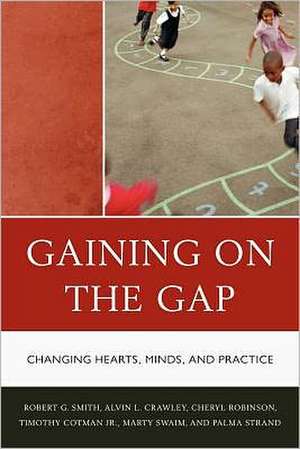
Gaining on the Gap: Changing Hearts, Minds, and Practice
Autor Palma Strand, Robert G. Smith, Tim Cotman, Cheryl Robinson, Martha Swaim, Alvin Crawleyen Limba Engleză Paperback – sep 2011
Preț: 284.39 lei
Preț vechi: 370.52 lei
-23%
Puncte Express: 427
Carte tipărită la comandă
Livrare economică 30 noiembrie-14 decembrie
Livrare prin curier în România Termenul estimat este afișat lângă disponibilitate.
Transport gratuit de la 400.00 lei Plată online sau ramburs, în funcție de opțiunile comenzii.
Retur gratuit în 14 zile Comandă securizată și suport în română.
Specificații
ISBN-13: 9781610482899
ISBN-10: 1610482891
Pagini: 204
Dimensiuni: 148 x 226 x 16 mm
Greutate: 0.32 kg
Ediția:New.
Editura: Bloomsbury Publishing
Colecția R&L Education
Locul publicării:New York, United States
ISBN-10: 1610482891
Pagini: 204
Dimensiuni: 148 x 226 x 16 mm
Greutate: 0.32 kg
Ediția:New.
Editura: Bloomsbury Publishing
Colecția R&L Education
Locul publicării:New York, United States
Cuprins
Foreword
Preface
Introduction
Chapter One: The Context
Chapter Two: Creating Organization Conditions to Close Achievement Gaps
Chapter Three: Can Schools Eliminate Gaps?
Chapter Four: Fixing the System, Not the Kids
Chapter Five: The Perfect Storm: Capitalizing on Synergy
Chapter Six: Facilitating Conversations About Race
Chapter Seven: Teaching Across Cultures
Chapter Eight: System-Level Buy-In: A Case Study
Chapter Nine: Gaining on the Gap: Progress, Themes, and Lessons Learned
Afterword
Preface
Introduction
Chapter One: The Context
Chapter Two: Creating Organization Conditions to Close Achievement Gaps
Chapter Three: Can Schools Eliminate Gaps?
Chapter Four: Fixing the System, Not the Kids
Chapter Five: The Perfect Storm: Capitalizing on Synergy
Chapter Six: Facilitating Conversations About Race
Chapter Seven: Teaching Across Cultures
Chapter Eight: System-Level Buy-In: A Case Study
Chapter Nine: Gaining on the Gap: Progress, Themes, and Lessons Learned
Afterword
Recenzii
The achievement gap plagues schools and school divisions around the country. In this compelling book, four staff members and a parent from the Arlington Public Schools (VA), along with former APS Superintendent, Rob Smith, have chronicled the district's more than 12 year attempt to grapple with the difficult issues and move toward the heart of the problem. Looking back over their journey, the APS team believes that solutions to the gap challenge must come from a real awareness of the systemic nature of the problem, the effective and intentional use of data, and a shared responsibility for the development of solutions. There is much to learn from their thoughtfully told stories.
The strength of the book is in how a school board, superintendent, and determined staff including teachers tackled a thorny and wicked problem and built slowly an infrastructure that permitted the entire APS staff to deal openly with issues usually left untouched-that of the relationship between race and the achievement gap.
This is an important story of a school district systematically and systemically diminishing its racial, socio-economic and linguistic achievement gaps. It presents a forthright blueprint for mobilizing schools and the community to make the structural changes necessary to improve the fortunes of its most low performing students.
Reducing and, ultimately, eliminating achievement gaps is a critical task for public school systems today and, indeed, for the nation. The story told by Gaining on the Gap provides valuable insights for School Board members and others who are committed to this task.
Gaining on the Gap provides powerful insights into one school district's efforts to eliminate the achievement gap. The collective and varied experiences of the authors reveal the complexities of this issue. Their experiences also give us hope that through honest conversations, sustained professional development, accountability, and use of effective strategies, all students can be successful.
For many years I have been telling administrators, 'If you want to lose your job, place the education of poor and minority students first.' Fortunately, the authors of this volume have totally ignored me and sought to find practical and powerful ways to insure that all students receive a first class education. Rather than bemoan the legislative mandates and testing schemes, these authors point us in clear directions for making what historian David Tyack called 'the one best system' a reality in the lives of children and families who most need it to be just that.
Closing the gap is the very tip of the iceberg that Rob Smith and his talented team undertook in the Arlington Public Schools. Tackling institutional, societal and personal racism as part of the strategy to achieve this goal became a joint venture of the school board, teachers, staff, students and community. A heroic effort and a powerful story unfold. All of us in education need to read this book.
The study offers important lessons for both education practitioners and policymakers. It gives practitioners a new perspective on understanding the achievement gap and ways of narrowing it. For policymakers, it provides insight into what states and the federal government may do to help schools in their reform efforts.
The strength of the book is in how a school board, superintendent, and determined staff including teachers tackled a thorny and wicked problem and built slowly an infrastructure that permitted the entire APS staff to deal openly with issues usually left untouched-that of the relationship between race and the achievement gap.
This is an important story of a school district systematically and systemically diminishing its racial, socio-economic and linguistic achievement gaps. It presents a forthright blueprint for mobilizing schools and the community to make the structural changes necessary to improve the fortunes of its most low performing students.
Reducing and, ultimately, eliminating achievement gaps is a critical task for public school systems today and, indeed, for the nation. The story told by Gaining on the Gap provides valuable insights for School Board members and others who are committed to this task.
Gaining on the Gap provides powerful insights into one school district's efforts to eliminate the achievement gap. The collective and varied experiences of the authors reveal the complexities of this issue. Their experiences also give us hope that through honest conversations, sustained professional development, accountability, and use of effective strategies, all students can be successful.
For many years I have been telling administrators, 'If you want to lose your job, place the education of poor and minority students first.' Fortunately, the authors of this volume have totally ignored me and sought to find practical and powerful ways to insure that all students receive a first class education. Rather than bemoan the legislative mandates and testing schemes, these authors point us in clear directions for making what historian David Tyack called 'the one best system' a reality in the lives of children and families who most need it to be just that.
Closing the gap is the very tip of the iceberg that Rob Smith and his talented team undertook in the Arlington Public Schools. Tackling institutional, societal and personal racism as part of the strategy to achieve this goal became a joint venture of the school board, teachers, staff, students and community. A heroic effort and a powerful story unfold. All of us in education need to read this book.
The study offers important lessons for both education practitioners and policymakers. It gives practitioners a new perspective on understanding the achievement gap and ways of narrowing it. For policymakers, it provides insight into what states and the federal government may do to help schools in their reform efforts.