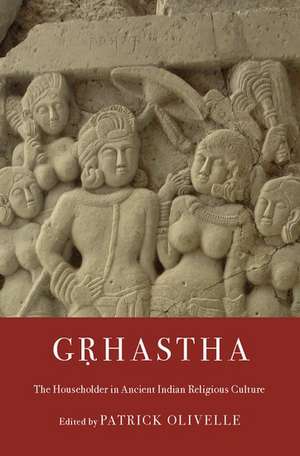
Gṛhastha: The Householder in Ancient Indian Religious Culture
Editat de Patrick Olivelleen Limba Engleză Hardback – 24 sep 2019
Preț: 702.35 lei
Preț vechi: 1024.41 lei
-31%
Puncte Express: 1054
Carte disponibilă
Livrare economică 19-25 noiembrie
Livrare prin curier în România Termenul estimat este afișat lângă disponibilitate.
Transport gratuit pentru acest produs Plată online sau ramburs, în funcție de opțiunile comenzii.
Retur gratuit în 14 zile Comandă securizată și suport în română.
Specificații
ISBN-13: 9780190696153
ISBN-10: 019069615X
Pagini: 288
Dimensiuni: 236 x 163 x 31 mm
Greutate: 0.57 kg
Editura: Oxford University Press
Colecția OUP USA
Locul publicării:New York, United States
ISBN-10: 019069615X
Pagini: 288
Dimensiuni: 236 x 163 x 31 mm
Greutate: 0.57 kg
Editura: Oxford University Press
Colecția OUP USA
Locul publicării:New York, United States
Recenzii
Patrick Olivelle has put together a collection of fine essays on a figure we thought we knew well: the gṛhastha. Clearly we did not. The scholars featured here will change the way we think.
This groundbreaking volume develops Stephanie Jamison's singular, stunning discovery -- that the gṛhastha ("stay-at-home") in his foundational context is not identifiable with the Vedic married householder, but rather a non-peripatetic religious specialist. Eleven essays following hers extend Jamison's philological study of this social institution to classical Hinduism, Jainism, and Buddhism. Simply put, Gṛhastha offers a paradigmatic model for the collaborative, scholarly examination of history through philology.
For centuries the figure who evoked India to the West has been the ascetic, the yogi, the religious loner, the person who renounced home and family. Yet through all those years it has actually been householders who set most of the tone and terms of Hindu life. This book gets at the roots of the concept "householder," and we are guided, appropriately enough, not by a lone scholar but by a team -- members of the distinguished academic family gathered around Stephanie Jamison and Patrick Olivelle.
This groundbreaking volume develops Stephanie Jamison's singular, stunning discovery -- that the gṛhastha ("stay-at-home") in his foundational context is not identifiable with the Vedic married householder, but rather a non-peripatetic religious specialist. Eleven essays following hers extend Jamison's philological study of this social institution to classical Hinduism, Jainism, and Buddhism. Simply put, Gṛhastha offers a paradigmatic model for the collaborative, scholarly examination of history through philology.
For centuries the figure who evoked India to the West has been the ascetic, the yogi, the religious loner, the person who renounced home and family. Yet through all those years it has actually been householders who set most of the tone and terms of Hindu life. This book gets at the roots of the concept "householder," and we are guided, appropriately enough, not by a lone scholar but by a team -- members of the distinguished academic family gathered around Stephanie Jamison and Patrick Olivelle.
Notă biografică
Patrick Olivelle is Professor Emeritus, University of Texas at Austin. He was President of the American Oriental Society. The author of over 30 books and 50 articles, his books have won awards from American Academy of Religion and Association of Asian Studies. His major publications include: Yajñavalkya: A Treatise on Dharma; Hindu Law: A New History of Dharmasastra; Reader on Dharma: Classical Indian Law; King, Governance, and Law in Ancient India; Visnu's Code of Law; The Life of the Buddha; Manu's Code of Law; Upanisads; and Asrama System.