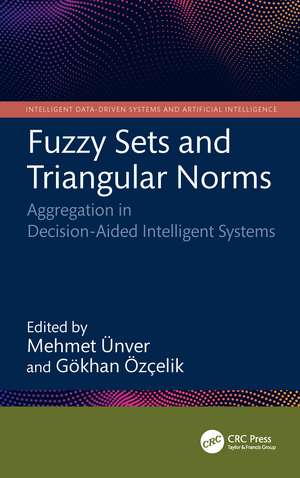
Fuzzy Sets and Triangular Norms: Aggregation in Decision-Aided Intelligent Systems: Intelligent Data-Driven Systems and Artificial Intelligence
Editat de Mehmet Ünver, Gökhan Özçeliken Limba Engleză Hardback – 11 aug 2026
- New aggregation operators, entropy measures, t-norm, and t-conorm structures are developed across multiple fuzzy set extensions to better model uncertainty and hesitation in decision-making.
- A wide range of real-world applications, including, tourism planning, smart cities, urban mobility, water security, smart campus automation, energy facility siting, and firefighting helicopter selection, are addressed using advanced multi-criteria decision making methods.
- The chapters collectively emphasize sustainable, data-driven, and uncertainty-aware decision support, contributing solutions in areas such as environmental protection, resource optimization, public services, and technological infrastructure.
- Innovative techniques, such as Lambert W–based aggregation operators, Choquet integral–based entropy, confidence-level aggregation, and fuzzy–machine learning hybrid models, improve the representation of interaction, ambiguity, and complexity in multi-criteria decision problems.
Din seria Intelligent Data-Driven Systems and Artificial Intelligence
- 9%
 Preț: 1454.27 lei
 - 15%
 Preț: 422.47 lei
 - 15%
 Preț: 440.53 lei
 - 15%
 Preț: 490.02 lei
 -
 Preț: 472.07 lei
 - 15%
 Preț: 453.61 lei
 - 15%
 Preț: 450.72 lei
 - 15%
 Preț: 539.05 lei
 - 21%
 Preț: 390.54 lei
 - 21%
 Preț: 378.07 lei
 - 20%
 Preț: 500.75 lei
 - 20%
 Preț: 446.82 lei
 - 15%
 Preț: 557.40 lei
 - 15%
 Preț: 435.82 lei
 - 21%
 Preț: 384.36 lei
 - 15%
 Preț: 455.11 lei
 - 18%
 Preț: 717.53 lei
 - 18%
 Preț: 1063.36 lei
 - 18%
 Preț: 963.90 lei
 - 18%
 Preț: 906.51 lei
 - 18%
 Preț: 1432.19 lei
 - 18%
 Preț: 715.44 lei
 - 18%
 Preț: 1392.12 lei
 - 18%
 Preț: 1440.25 lei
Preț: 1154.96 lei
Preț vechi: 1408.48 lei
-18% Nou
Puncte Express: 1732
Carte tipărită la comandă
Livrare economică 05-19 decembrie
Livrare prin curier în România Termenul estimat este afișat lângă disponibilitate.
Transport gratuit pentru acest produs Plată online sau ramburs, în funcție de opțiunile comenzii.
Retur gratuit în 14 zile Comandă securizată și suport în română.
Specificații
ISBN-13: 9781032867670
ISBN-10: 1032867671
Pagini: 320
Ilustrații: 90
Dimensiuni: 156 x 234 mm
Greutate: 0.58 kg
Ediția:1
Editura: CRC Press
Colecția CRC Press
Seria Intelligent Data-Driven Systems and Artificial Intelligence
ISBN-10: 1032867671
Pagini: 320
Ilustrații: 90
Dimensiuni: 156 x 234 mm
Greutate: 0.58 kg
Ediția:1
Editura: CRC Press
Colecția CRC Press
Seria Intelligent Data-Driven Systems and Artificial Intelligence
V-ar putea interesa
-
 Oh's Intensive Care ManualJonathan M. Handy-28%Preț: 697.98 lei971.29 leiRecomandat
 -
 Sabiston Textbook of Surgery: The Biological Basis of Modern Surgical PracticeDouglas Scott Tyler-29%Preț: 1169.15 lei1645.26 leiRecomandat
 -
 Soft Computing for Smart Environments: Techniques and ApplicationsMohamed Abdel-Basset-20%Preț: 370.01 lei462.50 lei
 -
 -38%Preț: 456.35 lei742.01 lei
 -
 Agentic AI For DummiesPam Baker-20%Preț: 145.95 lei182.44 lei
 -
 Running the RiskDavid Burrett ReidPreț: 140.40 lei
 -
 Intelligent and Fuzzy Techniques: Smart and Innovative SolutionsCengiz Kahraman-20%Preț: 1291.11 lei1613.88 lei
 -
 -20%Preț: 1217.76 lei1522.20 lei
 -
 -20%Preț: 1201.20 lei1501.50 lei
 -
 Rough SetsMengjun Hu-20%Preț: 489.19 lei611.49 lei
 -
 Advances in Smart Medical, IoT & Artificial IntelligenceMohammed Serrhini-20%Preț: 1497.03 lei1871.29 lei
 -
 Modeling Decisions for Artificial IntelligenceVicenç Torra-20%Preț: 390.39 lei487.98 lei
 -
 Fuzzy Sets-Based Methods and Techniques for Modern AnalyticsAli Ebrahimnejad-20%Preț: 676.55 lei845.69 lei
 -
 Advances in Intelligent Decision TechnologiesGloria Phillips-Wren-18%Preț: 1845.71 lei2250.86 lei
 -
 Recent Advances in Artificial Intelligence and Smart ApplicationsJyotsna K. Mandal-18%Preț: 1017.19 lei1240.48 lei
 -
 Advances in Intelligent Data Analysis and ApplicationsShu-Chuan Chu-18%Preț: 1446.49 lei1764.01 lei
 -
 Applied Fuzzy MathematicsManoranjan Kumar Singh-15%Preț: 531.90 lei625.76 lei
Public țintă
Academic, Postgraduate, and Undergraduate AdvancedCuprins
Preface
About the Editors
List of Contributors
Chapter 1: Lambert Aggregation Operators For Intuitionistic Fuzzy Multi-Criteria Decision Making
Chapter 2: A Group Decision Aggregation-Based IVIF-MARCOS and Goal Programming Approach for Intelligent Decision-Making in Tourism Marketing
Chapter 3: Sustainable Urban Logistics Evaluation in Smart Cities: A Multi-Criteria Group Decision-Making Approach Using the Hesitant Fuzzy Linguistic ARAS Method
Chapter 4: Choquet Integral-Based q-rof Entropy And Its Application
to Information Technologies
Chapter 5: Hybrid Approach using Interval Type-2 Fuzzy TOPSIS and Unsupervised Machine Learning for Water Security and Water Source Area Challenges
Chapter 6: A Group Decision Making by Hesitant Fuzzy Set: Determination of Criterion Weights in Biomass Power Plant Investment
Chapter 7: Fuzzy Set Theory Applications in Smart Cities and IoT
Chapter 8: Smart Campus Process Automation: Process Prioritization through Triangular Fuzzy AHP
Chapter 9: Dombi t-norm and t-conorm Based Aggregation Operators in an
Interval-Valued Fermatean Fuzzy Framework with Confidence Levels
Chapter 10: Evaluation of Heavy Forest Fire Helicopters Using q-rung Orthopair Fuzzy Sets Based TOPSIS Decision Making Model
Chapter 11: Some Interval-Valued Intuitionistic Fuzzy Confidence Level-Based
Aggregation Operators Using Frank t-norm and t-conorms
About the Editors
List of Contributors
Chapter 1: Lambert Aggregation Operators For Intuitionistic Fuzzy Multi-Criteria Decision Making
Chapter 2: A Group Decision Aggregation-Based IVIF-MARCOS and Goal Programming Approach for Intelligent Decision-Making in Tourism Marketing
Chapter 3: Sustainable Urban Logistics Evaluation in Smart Cities: A Multi-Criteria Group Decision-Making Approach Using the Hesitant Fuzzy Linguistic ARAS Method
Chapter 4: Choquet Integral-Based q-rof Entropy And Its Application
to Information Technologies
Chapter 5: Hybrid Approach using Interval Type-2 Fuzzy TOPSIS and Unsupervised Machine Learning for Water Security and Water Source Area Challenges
Chapter 6: A Group Decision Making by Hesitant Fuzzy Set: Determination of Criterion Weights in Biomass Power Plant Investment
Chapter 7: Fuzzy Set Theory Applications in Smart Cities and IoT
Chapter 8: Smart Campus Process Automation: Process Prioritization through Triangular Fuzzy AHP
Chapter 9: Dombi t-norm and t-conorm Based Aggregation Operators in an
Interval-Valued Fermatean Fuzzy Framework with Confidence Levels
Chapter 10: Evaluation of Heavy Forest Fire Helicopters Using q-rung Orthopair Fuzzy Sets Based TOPSIS Decision Making Model
Chapter 11: Some Interval-Valued Intuitionistic Fuzzy Confidence Level-Based
Aggregation Operators Using Frank t-norm and t-conorms
Notă biografică
Mehmet Ünver completed his undergraduate studies in the Department of Mathematics at Ankara University (Türkiye) in 2007, followed by his master's degree at the same institution in 2009. During his master's studies, he focused on summability theory and Korovkin-type approximation theory. He earned his PhD in Mathematics from Ankara University in 2013, continuing his research in summability theory and Korovkin-type approximation theory. He served as a research assistant at the Department of Mathematics, Ankara University, from 2009 to 2015, and later as an assistant professor from 2015 to 2017. He has held the position of Associate Professor at the Department of Mathematics, at Ankara University. He is currently working as a full time professor at the same instutition. His current research pursuits encompass fuzzy measure and fuzzy set theory, multi-criteria decision-making, Korovkin-type approximation theory, and summability theory, resulting in numerous published papers in highly cited journals on topics including summability theory and the applications of fuzzy set theory in multi-criteria decision-making, pattern recognition, aggregation operators, and classification.
Gökhan Özçelik obtained his bachelor's degree from the Department of Industrial Engineering at Gazi University (Türkiye) in 2009. He completed his master's degree in the same department in 2011 and subsequently received his PhD in Industrial Engineering from Gazi University in 2016. Presently, he serves as an Associate Professor at Karadeniz Technical University (Türkiye). His research primarily focuses on optimization, multi-criteria decision-making, and fuzzy sets and systems. He has an extensive publication record in reputable journals such as the European Journal of Operational Research, Transportation Research Part E, Expert Systems with Applications, International Journal of Production Research, and Journal of Cleaner Production, among others.
Gökhan Özçelik obtained his bachelor's degree from the Department of Industrial Engineering at Gazi University (Türkiye) in 2009. He completed his master's degree in the same department in 2011 and subsequently received his PhD in Industrial Engineering from Gazi University in 2016. Presently, he serves as an Associate Professor at Karadeniz Technical University (Türkiye). His research primarily focuses on optimization, multi-criteria decision-making, and fuzzy sets and systems. He has an extensive publication record in reputable journals such as the European Journal of Operational Research, Transportation Research Part E, Expert Systems with Applications, International Journal of Production Research, and Journal of Cleaner Production, among others.
Descriere
The book focuses on decision-aided intelligent systems, showing readers how fuzzy sets and t-norms enhance decision-making amidst uncertainty and incomplete information. It further presents a decision support model for medical diagnosis and treatment planning and evaluation of smart mega cities under a Pythagorean fuzzy environment.