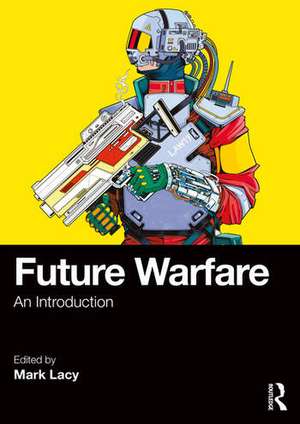
Future Warfare: An Introduction
Editat de Mark Lacyen Limba Engleză Paperback – 11 ian 2027
Taking an interdisciplinary approach that combines the work of academic researchers and security analysts, the book is divided into three thematic sections – Transformation of Modern War; Emergence of Postmodern War; Exploring the Fog of Future War. The chapters offer an accessible introduction to challenging topics such as quantum warfare, war in the space domain, environmental (in)security and climate change, drone war, airpower, maritime security, psychological warfare, AI and wargaming. Each chapter includes future scenarios to stimulate open and creative thinking about future warfare, setting out a variety of paths through which the student can explore ‘the fog of future war.’ In so doing, the book encourages readers to consider the range of possible futures and to think critically about the solutions proposed to manage future challenges of security and war. The book concludes with a chapter on how innovative approaches to wargaming are being used to understand the future of warfare, and ends with a project that will enable readers to develop their own future wargame.
This book will be of great interest to students of future warfare, security studies, defence studies and International Relations.
Preț: 348.11 lei
Preț vechi: 388.31 lei
-10% Precomandă
Puncte Express: 522
Carte nepublicată încă
Livrare prin curier în România Precomanda se expediază când titlul devine disponibil.
Transport gratuit de la 400.00 lei Plată online sau ramburs, în funcție de opțiunile comenzii.
Retur gratuit în 14 zile Comandă securizată și suport în română.
Doresc să fiu notificat când acest titlu va fi disponibil:
Se trimite...
Specificații
ISBN-13: 9781032985879
ISBN-10: 1032985879
Pagini: 290
Dimensiuni: 174 x 246 mm
Ediția:1
Editura: Taylor & Francis
Colecția Routledge
Locul publicării:Oxford, United Kingdom
ISBN-10: 1032985879
Pagini: 290
Dimensiuni: 174 x 246 mm
Ediția:1
Editura: Taylor & Francis
Colecția Routledge
Locul publicării:Oxford, United Kingdom
Public țintă
Postgraduate, Professional Reference, and Undergraduate AdvancedRecenzii
“Future war demands imagination as much as analysis. This provocative book equips the military professional with both, helping to understand — not predict — the future of conflict.”
Colonel Perry Bishop, British Army Concepts
‘Future Warfare provides a rich in-depth study of the many ‘future machines’ that shape war, ranging from subjects as diverse as state militaries, space, and science fiction. In so doing, Mark Lacy and his fellow authors are in good company. Nearly two centuries ago, Carl von Clausewitz emphasized in On War the need to leave room for extraneous matters when approaching future war, listing inconsistencies, ideas, and the varying conditions of the time. What better way to trace and unpack future war today than to focus on the messy realities that condition war in our time, including emerging defense technology, drone saturated battlefields, cyber armies, and AI-enabled wargaming. A unique and highly relevant book for everyone from undergraduate students interested in studying war to defense professionals, policymakers, and strategists involved in its conduct.’
Dan Öberg, Swedish Defence University
'Future Warfare: An Introduction is a beguiling book that quickly engages. While the future of war is often discussed, this book stands out in the way it orients the reader, giving them new ideas and concepts with which to navigate the uncertain future environment they will live in. Future Warfare does not try to predict what might happen but rather provides ways to understand the major changes emerging in this time of considerable technological and societal turbulence. The book’s three areas of modern war, postmodern war and the fog of future war skillfully position the reader to discern the key aspects likely to impact the waging of wars in the unpredictable, but rapidly approaching, tomorrow.’
Peter Layton, Royal United Services Institute, London, UK
'Future Warfare: An Introduction is an accessible and essential guide to the changing dimensions of war. It equips students with practical heuristic tools to trace transformations in warfighting, account for persistent uncertainty driven by emerging technologies, and map the complex interplay of cultural, economic, environmental, and political forces shaping conflict. Each chapter, written by leading global experts, pairs rigorous analysis with provocative future scenarios designed to engage students and sharpen critical thinking. This book teaches students how to think critically about the questions that matter for the wars of today and for the wars of tomorrow.'
Kyle Grayson, University of Newcastle, UK
‘This is a really helpful resource for students thinking about the way war, technology and violence will change in the future. The diversity of viewpoints from academics, practitioners and strategists all share the same starting point: the future is radically uncertain, but it will certainly be shaped by forces in our current moment. From battlefields and GPS maps to technology labs and science fiction series, Future Warfare: An Introduction offers a comprehensive and practical guide to making sense of tomorrow’s likely conflicts.‘
Debbie Lisle, Queen's University, Belfast
‘The future’, said the great Yogi Berra, ‘ain’t what it used to be’. Nor is war: both are increasingly defined by paradox and uncertainty. Mark Lacy and a remarkable assemblage of critical thinkers go where few IR scholars have gone before, to the cutting edge of what we know, what we do not know and what we need to know about the future of warfare. Best strap in: it’s quite a trip.'
James Der Derian, Michael Hintze Professor of International Security Studies, The University of Sydney
Colonel Perry Bishop, British Army Concepts
‘Future Warfare provides a rich in-depth study of the many ‘future machines’ that shape war, ranging from subjects as diverse as state militaries, space, and science fiction. In so doing, Mark Lacy and his fellow authors are in good company. Nearly two centuries ago, Carl von Clausewitz emphasized in On War the need to leave room for extraneous matters when approaching future war, listing inconsistencies, ideas, and the varying conditions of the time. What better way to trace and unpack future war today than to focus on the messy realities that condition war in our time, including emerging defense technology, drone saturated battlefields, cyber armies, and AI-enabled wargaming. A unique and highly relevant book for everyone from undergraduate students interested in studying war to defense professionals, policymakers, and strategists involved in its conduct.’
Dan Öberg, Swedish Defence University
'Future Warfare: An Introduction is a beguiling book that quickly engages. While the future of war is often discussed, this book stands out in the way it orients the reader, giving them new ideas and concepts with which to navigate the uncertain future environment they will live in. Future Warfare does not try to predict what might happen but rather provides ways to understand the major changes emerging in this time of considerable technological and societal turbulence. The book’s three areas of modern war, postmodern war and the fog of future war skillfully position the reader to discern the key aspects likely to impact the waging of wars in the unpredictable, but rapidly approaching, tomorrow.’
Peter Layton, Royal United Services Institute, London, UK
'Future Warfare: An Introduction is an accessible and essential guide to the changing dimensions of war. It equips students with practical heuristic tools to trace transformations in warfighting, account for persistent uncertainty driven by emerging technologies, and map the complex interplay of cultural, economic, environmental, and political forces shaping conflict. Each chapter, written by leading global experts, pairs rigorous analysis with provocative future scenarios designed to engage students and sharpen critical thinking. This book teaches students how to think critically about the questions that matter for the wars of today and for the wars of tomorrow.'
Kyle Grayson, University of Newcastle, UK
‘This is a really helpful resource for students thinking about the way war, technology and violence will change in the future. The diversity of viewpoints from academics, practitioners and strategists all share the same starting point: the future is radically uncertain, but it will certainly be shaped by forces in our current moment. From battlefields and GPS maps to technology labs and science fiction series, Future Warfare: An Introduction offers a comprehensive and practical guide to making sense of tomorrow’s likely conflicts.‘
Debbie Lisle, Queen's University, Belfast
‘The future’, said the great Yogi Berra, ‘ain’t what it used to be’. Nor is war: both are increasingly defined by paradox and uncertainty. Mark Lacy and a remarkable assemblage of critical thinkers go where few IR scholars have gone before, to the cutting edge of what we know, what we do not know and what we need to know about the future of warfare. Best strap in: it’s quite a trip.'
James Der Derian, Michael Hintze Professor of International Security Studies, The University of Sydney
Cuprins
On the Future of Warfare: An Introduction, Mark Lacy Part I: The Transformation of Modern War Chapter 1. The Future Super Warfighter, Łukasz Kamieński Chapter 2. Emerging Dynamics in Maritime Security, Konstantinos Chouzouris Chapter 3. Redesigning Air Power: Reshaping Air Forces for the Future Joint Fight, Charlie Bradbury Chapter 4. The Political Ecology of Urbicide: Spatial Violence, Climate Conflict, and the Weaponization of Infrastructure, Nikolina Bobic Chapter 5. Psychological War, Armin Krishnan Chapter 6. The Military Race for AI-Enabled Wargaming: Superhuman Decision-making to Predict the Future, Aggie Hirst Part II: The Emergence of Postmodern War Chapter 7. Who Designs the Future of Warfare in the West? Technology Companies and the Weaponization of Artificial Intelligence, Marijn Hoijtink and Robin Vanderborght Chapter 8. War at the Human-Machine Nexus: Drones, Robots, and the Rise of Cyber-Physical Conflict, Anna Dyson Chapter 9. The Privatization of Warfare: From Mercenaries to Cyber Armies, Elke Krahmann Chaper 10. Future Operating Environments, Climate-Induced Conflict and the New Era of Environmental (in)Security, Ella Taylor Chapter 11. The Militarisation of the Space Domain: Future Strategic and Technological Challenges. Ben Zweibelson Part III: Exploring the Fog of Future War Chapter 12. Strategic Superposition: The Quantum Disruption of Future Conflicts?, Ben Zweibelson Chapter 13. Using Science Fictions To Understand the Futures of Conflict, Will Slocombe Chapter 14. Transformative Game Design for Future Warfare, Oliver Jones, Kassie Miedema, and Philippe Beaulieu-Brossard
Notă biografică
Mark Lacy is a Senior Lecturer in the School of Global Affairs at the University of Lancaster, UK, and author of several books, including Theorising Future Conflict: War Out to 2049 (2023).
Descriere
This book introduces a range of key topics and trends that are changing the character of war and international relations.