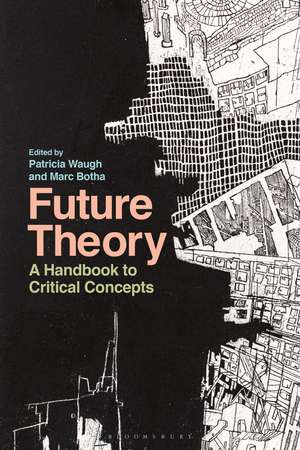
Future Theory: A Handbook to Critical Concepts
Editat de Patricia Waugh, Marc Bothaen Limba Engleză Paperback – 20 apr 2023
Organized into five clusters of concepts - change, boundaries, ruptures, assemblages, horizons - by leading and emerging thinkers in the arts, humanities and social sciences, and spanning fields including geography, literary studies, cultural theory, philosophy, and politics.
Preț: 306.30 lei
Preț vechi: 400.09 lei
-23%
Puncte Express: 459
Carte tipărită la comandă
Livrare economică 07-21 decembrie
Livrare prin curier în România Termenul estimat este afișat lângă disponibilitate.
Transport gratuit de la 400.00 lei Plată online sau ramburs, în funcție de opțiunile comenzii.
Retur gratuit în 14 zile Comandă securizată și suport în română.
Specificații
ISBN-13: 9781472567345
ISBN-10: 147256734X
Pagini: 480
Ilustrații: 5 mono images
Dimensiuni: 152 x 232 x 26 mm
Greutate: 0.66 kg
Editura: Bloomsbury Publishing
Colecția Bloomsbury Academic
Locul publicării:London, United Kingdom
ISBN-10: 147256734X
Pagini: 480
Ilustrații: 5 mono images
Dimensiuni: 152 x 232 x 26 mm
Greutate: 0.66 kg
Editura: Bloomsbury Publishing
Colecția Bloomsbury Academic
Locul publicării:London, United Kingdom
V-ar putea interesa
-
 The Aesthetic Mind: Philosophy and PsychologyElisabeth Schellekens-17%Preț: 370.70 lei443.96 lei
 -
 Arts and MindsGregory Currie-18%Preț: 379.91 lei462.99 lei
 -
 Literary Theory and Criticism: An Oxford GuidePatricia Waugh-9%Preț: 384.36 lei423.31 lei
 -
 -27%Preț: 529.20 lei727.98 lei
 -
 Emotion and ValueSabine Roeser-31%Preț: 577.70 lei836.30 lei
 -
 The Aesthetics of Everyday LifeAndrew LightPreț: 254.51 lei
 -
 Modern Literary Theory: A ReaderPatricia Waugh-22%Preț: 296.21 lei377.86 lei
 -
 Preț: 401.08 lei
 -
 A Companion to the Philosophy of LiteratureGarry L HagbergPreț: 423.92 lei
 -
 Black Is BeautifulPaul C TaylorPreț: 213.62 lei
 -
 -20%Preț: 192.56 lei239.95 lei
 -
 Platform CapitalismNick SrnicekPreț: 482.45 lei
 -
 The Politics of AestheticsGabriel Rockhill-24%Preț: 145.14 lei191.64 lei
 -
 Politics of ModernismRaymond WilliamsPreț: 115.72 lei
Cuprins
Acknowledgements
INTRODUCTION
Change: Patricia Waugh and Marc Botha (University of Durham, UK)
PART ONE: THINKING THE CONDITIONS FOR CHANGE
Climate: Timothy Clark (University of Durham, UK)
Fragility: Marc Botha (University of Durham, UK)
Memory: Enzo Traverso (Cornell University, USA)
Remainder: Andrew Gibson (Royal Holloway, University of London, UK)
Affect: Ankhi Mukherjee (Oxford University, UK)
PART TWO: ORGANZING CHANGE
Institution: Simon Critchley (The New School, USA)
Movement: Esther Leslie (Birkbeck, University of London, UK)
Community: Mick Smith (Queen's University, Canada)
Continuity: Lev Manovich (The City University of New York, USA)
Dissemination: Jon Adams (London School of Economics, UK)
PART THREE: BOUNDARIES AND CROSSINGS
Threshold: Matthew Calarco (California State University, Fullerton, USA)
Periphery: Paulina Aroch Fugellie (Universidad Autonoma Metropolitana, Mexico)
Exception: Justin Clemens (University of Melbourne, Australia)
Migration: Mieke Bal (Amsterdam, The Netherlands)
Privacy: Alexander Garcia Duttmann (University of the Arts, Berlin, Germany)
PART FOUR: RUPTURE AND DISRUPTIONS
Catastrophe: Jean-Michel Rabate (University of Pennsylvania, USA)
Event: Mark Currie (Queen Mary University of London, UK)
Revolution: Bruno Bosteels (Cornell University. USA)
Fragmentation: Maebh Long (The University of the South Pacific, Fiji)
Interference: Emily Apter (New York University, USA)
PART FIVE: ASSEMBLAGES AND REALIGNMENTS
Turns: Christopher Norris (Cardiff University, UK)
Hybrid: Roger Luckhurst (Birkbeck, University of London, UK)
Entanglement: Felicity Callard (University of Durham, UK) and Des Fitzgerald (King's College London, UK)
Emergence: Patricia Waugh (University of Durham, UK)
Network: Graham Harman ( SCI-Arc, Los Angeles, USA)
PART SIX: CHANGING THE FUTURE
Hospitality: Derek Attridge (University of York, UK)
Fidelity: Creston Davis (Global Center for Advanced Studies, USA) and Alain Badiou
Resilience: Sarah Atkinson (University of Durham, UK)
Trust: Alphonso Lingis (Penn State University, USA)
Irreversibility: Claire Colebrook (Penn State University, USA)
Bibliography
Index
INTRODUCTION
Change: Patricia Waugh and Marc Botha (University of Durham, UK)
PART ONE: THINKING THE CONDITIONS FOR CHANGE
Climate: Timothy Clark (University of Durham, UK)
Fragility: Marc Botha (University of Durham, UK)
Memory: Enzo Traverso (Cornell University, USA)
Remainder: Andrew Gibson (Royal Holloway, University of London, UK)
Affect: Ankhi Mukherjee (Oxford University, UK)
PART TWO: ORGANZING CHANGE
Institution: Simon Critchley (The New School, USA)
Movement: Esther Leslie (Birkbeck, University of London, UK)
Community: Mick Smith (Queen's University, Canada)
Continuity: Lev Manovich (The City University of New York, USA)
Dissemination: Jon Adams (London School of Economics, UK)
PART THREE: BOUNDARIES AND CROSSINGS
Threshold: Matthew Calarco (California State University, Fullerton, USA)
Periphery: Paulina Aroch Fugellie (Universidad Autonoma Metropolitana, Mexico)
Exception: Justin Clemens (University of Melbourne, Australia)
Migration: Mieke Bal (Amsterdam, The Netherlands)
Privacy: Alexander Garcia Duttmann (University of the Arts, Berlin, Germany)
PART FOUR: RUPTURE AND DISRUPTIONS
Catastrophe: Jean-Michel Rabate (University of Pennsylvania, USA)
Event: Mark Currie (Queen Mary University of London, UK)
Revolution: Bruno Bosteels (Cornell University. USA)
Fragmentation: Maebh Long (The University of the South Pacific, Fiji)
Interference: Emily Apter (New York University, USA)
PART FIVE: ASSEMBLAGES AND REALIGNMENTS
Turns: Christopher Norris (Cardiff University, UK)
Hybrid: Roger Luckhurst (Birkbeck, University of London, UK)
Entanglement: Felicity Callard (University of Durham, UK) and Des Fitzgerald (King's College London, UK)
Emergence: Patricia Waugh (University of Durham, UK)
Network: Graham Harman ( SCI-Arc, Los Angeles, USA)
PART SIX: CHANGING THE FUTURE
Hospitality: Derek Attridge (University of York, UK)
Fidelity: Creston Davis (Global Center for Advanced Studies, USA) and Alain Badiou
Resilience: Sarah Atkinson (University of Durham, UK)
Trust: Alphonso Lingis (Penn State University, USA)
Irreversibility: Claire Colebrook (Penn State University, USA)
Bibliography
Index
Recenzii
Future Theory is not just a handbook explaining current critical concepts but a series of wide-ranging explorations, by an impressive international group of thinkers, of concepts that are likely to be critical for the future of theory, such as risk, catastrophe, climate, threshold, and, fortunately, hope.