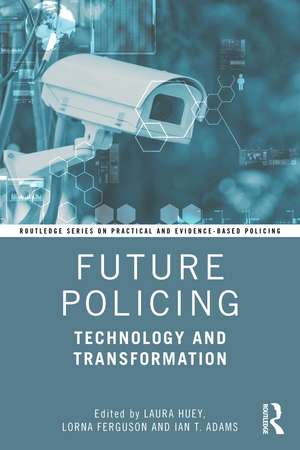
Future Policing: Technology and Transformation: Routledge Series on Practical and Evidence-Based Policing
Editat de Laura Huey, Lorna Ferguson, Ian T. Adamsen Limba Engleză Paperback – 6 oct 2026
Bringing together interdisciplinary scholars from eight countries, this 20-chapter volume offers empirically grounded analyses of how technologies are adopted, implemented, regulated, and experienced in practice. Chapters synthesize research evidence, operational experience, and theoretical debate to evaluate claims of efficiency, objectivity, and innovation, while identifying the social, legal, and ethical consequences that accompany digital transformation. At a critical moment when police agencies are investing heavily in technological solutions while navigating a fast-moving landscape of evolving tools, claims, and expectations, this volume provides a much-needed evidence base for understanding what these systems change in practice and what outcomes they realistically produce. And by bringing sustained critical investigation and scrutiny to rapidly institutionalizing tools, the collection establishes a foundation for the next generation of policing scholarship.
Rigorous and accessible, Future Policing provides students, researchers, practitioners, and policymakers, among others, with the insight required to critically assess technological change and understand how innovation is reshaping what policing is, how it is done, and whom it serves.
Din seria Routledge Series on Practical and Evidence-Based Policing
-
 Preț: 457.83 lei
-
 Preț: 335.86 lei
-
 Preț: 421.30 lei
-
 Preț: 377.01 lei
-
 Preț: 363.31 lei
-
 Preț: 327.03 lei
-
 Preț: 360.32 lei
-
 Preț: 362.58 lei
-
 Preț: 328.40 lei
-
 Preț: 427.32 lei
-
 Preț: 353.85 lei
-
 Preț: 402.94 lei
-
 Preț: 385.69 lei
- 25%
 Preț: 1501.18 lei
Preț: 459.04 lei
Nou
Puncte Express: 689
Carte tipărită la comandă
Livrare economică 28 decembrie 26 - 11 ianuarie 27
Livrare prin curier în România Termenul estimat este afișat lângă disponibilitate.
Transport gratuit pentru acest produs Plată online sau ramburs, în funcție de opțiunile comenzii.
Retur gratuit în 14 zile Comandă securizată și suport în română.
Specificații
ISBN-13: 9781041137481
ISBN-10: 1041137486
Pagini: 380
Ilustrații: 24
Dimensiuni: 152 x 229 mm
Greutate: 0.7 kg
Ediția:1
Editura: Taylor & Francis
Colecția Routledge
Seria Routledge Series on Practical and Evidence-Based Policing
Locul publicării:Oxford, United Kingdom
ISBN-10: 1041137486
Pagini: 380
Ilustrații: 24
Dimensiuni: 152 x 229 mm
Greutate: 0.7 kg
Ediția:1
Editura: Taylor & Francis
Colecția Routledge
Seria Routledge Series on Practical and Evidence-Based Policing
Locul publicării:Oxford, United Kingdom
Public țintă
Professional Practice & Development and Undergraduate AdvancedNotă biografică
Laura Huey is a Professor of Sociology at Western University, Editor of Police Practice & Research, Editor of Evidence Base, alumnus of the College of New Scholars, Artists and Scientists of the Royal Society of Canada (RSC), and a member of the Canadian Council of Academies’ expert panels on Cybercrime and Policing. Her current research focuses on public order policing, critical incident response, police downloading, policing and mental health and missing persons.
Lorna Ferguson is an Assistant Professor of Criminology and Criminal Justice at the University of Regina, the Founder of the Missing Persons Research Hub, and the Senior Managing Editor for Evidence Base. Dr. Ferguson’s specialization is police responses to missing persons. Her broader research program extends to related areas of policing, including incident command, evidence-based policing, technology and innovation, police data and intelligence, cybercrime, responses involving persons with mental illness, and police reform.
Ian T. Adams is an Associate Professor of Criminology and Criminal Justice at the University of South Carolina, where he is a 2025 McCausland Faculty Fellow in recognition of excellence in research and teaching. He has been involved in law enforcement and policing for over 20 years as an officer, a labour executive, and a scholar. Dr. Adams’ research addresses practical police concerns, focusing on technology, policy, and behaviour. He is a leading academic voice in the ongoing development of evidence-based practices in policing.
Cuprins
1. The Future is Now: An Introduction
Laura Huey, Lorna Ferguson, and Ian T. Adams
2. The Algorithmic Beat: Navigating the Double-Edged Sword of AI in Modern Policing
Nahanni Pollard
3. Robot Cops on Patrol: Police Officers’ Views of Humanoid Robots in Operational Policing
Kai Lin, You Zhou, Qiuming Zhang, Marius Hoggenmueller, Wei Wang, and Ivan Y. Sun
4. AI in Policing: A Systematic Review of AI Use in the U.S. Law Enforcement
Ahmet Guler, Kaan Boke, and Sedat Kula
5. Data Integration Across Agencies to Enhance Safety of Persons Living with Dementia
Antonio Miguel Cruz, Christine Daum, Aidan K. Comeau, Anmol Jassal, and Lili Liu
6. Quantum Leap: Strategic and Ethical Dimensions of Next Generation Technologies in Law Enforcement
Mehzeb Chowdhury
7. “We are Not Ready for That”: Police Views on the Use of Generative AI to Create Public Security Threats
Laura Huey, Lorna Ferguson, Cole Heffren, and Meaghan Furlano
8. Cybercrime and Cybersecurity
Naomi Davis-Crane and Simon Davis-Crane
9. The Future of Police Performance Evaluation: Bridging Neuroscience and Policing Through EEG
Nasser AlSabah and Abdulwahab Alasfour
10. Laplace’s Officer: The Future of Predictive Policing
Jordan I. Cline
11. Artificial Intelligence and Suspect Identification
Cassidy B. Haigh and Eric Dlugolenski
12. “The RCMP Trained Killer Horses”: Misinformation in Public Policing
Laura Huey, Cole Heffren, and Lorna Ferguson
13. The Enemy Within – Police Counterintelligence and Insider Prevention
Ardavan M. Khoshnood
14. AI in Policing: Capturing Police Performance (Good and Bad) in Routine, Rare, and Novel Events
Seth Watts, Michael D. White, and Aili Malm
15. The Heart of the Matter: Integrating Physiological Stress Measurement in High-Intensity Virtual Reality Police Scenario Simulations
John E. Muñoz, Jennifer Lavoie, Lisanne Kleygrewe, Lisa Whittingham, and Alan T. Pope
16. About Face: Why the Police May Have Fewer Surveillance Cameras in the Future
Fraser Sampson
17. Co-Creation in Predictive Policing: Cross-Stakeholder Collaboration and Community Engagement
Maria Lungu
18. Large Language Model Technologies in Policing: Early Lessons in Artificial Intelligence from Research and Practice
Alexis R. Fabila, Ian T. Adams, and Kyle McLean
19. The End of Cold Cases—and Genealogists? A Primer on the Future of Investigative Genetic Genealogy
Michael Arntfield and Daniel J. Robinson
20. Facial Recognition Technology in U.S. Policing: Crime Control, Officer Safety, and Racial Equity Implications
Thaddeus L. Johnson and Natasha N. Johnson
Descriere
Future Policing: Technology and Transformation examines how technologies such as facial recognition, quantum computing and others are transforming the practice and governance of contemporary law enforcement.