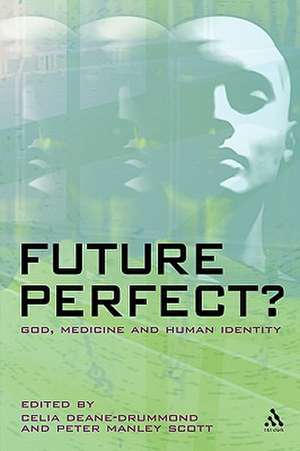
Future Perfect?: God, Medicine and Human Identity
Editat de Dr. Celia Deane-Drummond, Dr Peter Manley Scotten Limba Engleză Paperback – 2 feb 2010
Preț: 282.32 lei
Preț vechi: 375.32 lei
-25%
Puncte Express: 423
Carte tipărită la comandă
Livrare economică 17 noiembrie-01 decembrie
Livrare prin curier în România Termenul estimat este afișat lângă disponibilitate.
Transport gratuit de la 400.00 lei Plată online sau ramburs, în funcție de opțiunile comenzii.
Retur gratuit în 14 zile Comandă securizată și suport în română.
Specificații
ISBN-13: 9780567234018
ISBN-10: 0567234010
Pagini: 240
Ilustrații: 1 illus
Dimensiuni: 156 x 234 x 13 mm
Greutate: 0.35 kg
Editura: Bloomsbury Publishing
Colecția T&T Clark
Locul publicării:London, United Kingdom
ISBN-10: 0567234010
Pagini: 240
Ilustrații: 1 illus
Dimensiuni: 156 x 234 x 13 mm
Greutate: 0.35 kg
Editura: Bloomsbury Publishing
Colecția T&T Clark
Locul publicării:London, United Kingdom
V-ar putea interesa
-
 The Number MysteriesMarcus Du SautoyPreț: 93.07 lei
 -
 -20%Preț: 56.24 lei70.22 lei
 -
 The Secret Life of the Grown-Up BrainBarbara StrauchPreț: 114.32 lei
 -
 The Disappearing SpoonSam KeanPreț: 129.43 lei
 -
 BurstsAlbert-Laszlo BarabasiPreț: 140.13 lei
 -
 The Intelligence ParadoxSatoshi KanazawaPreț: 159.70 lei
 -
 How to Fold ItJoseph O'RourkePreț: 319.01 lei
 -
 The Living CosmosChris ImpeyPreț: 264.96 lei
 -
 Eruptions that Shook the WorldClive OppenheimerPreț: 263.04 lei
 -
 How Many Friends Does One Person Need?Robin DunbarPreț: 93.27 lei
 -
 PschologyScott-23%Preț: 486.52 lei631.86 lei
 -
 Re-Thinking ScienceHelga NowotnyPreț: 266.39 lei
 -
 No Greatness Without GoodnessRandy LewisPreț: 69.76 lei
 -
 See Inside. The World of DinosaursAlex FrithPreț: 87.82 lei
 -
 The New Production of KnowledgeMichael Gibbons-8%Preț: 480.14 lei521.89 lei
 -
 Geometric Design of LinkagesJ Michael McCarthy-15%Preț: 648.28 lei762.69 lei
 -
 HolonomicsMaria Moraes RobinsonPreț: 141.76 lei
 -
 Particle PhysicsBrian MartinPreț: 71.61 lei
 -
 Planet EarthJohn R GribbinPreț: 70.61 lei
Cuprins
Introduction. Future Perfect: What Should We Hope For?
Peter Scott and Celia Deane-Drummond.
Chapter 1. Ted Peters
Chapter 2. Gordon Graham
Chapter 3 Soren Holm
Chapter 4. Elaine Graham
Chapter 5 Michael Northcott
Chapter 6 Gareth Jones
Chapter 7 Gordon McPhate
Chapter 8 Neil Messer
Chapter 9 Jenny Kitzinger and Clare Williams
Chapter 10 Ulf Gorman
Chapter 11 Maureen Junker-Kenny
Chapter 12 Celia Deane-Drummond
Chapter 13 Brent Waters
Peter Scott and Celia Deane-Drummond.
A. Perspectives on Humans
Chapter 1. Ted Peters
Chapter 2. Gordon Graham
Chapter 3 Soren Holm
Chapter 4. Elaine Graham
B Medicalised Humans
Chapter 5 Michael Northcott
Chapter 6 Gareth Jones
Chapter 7 Gordon McPhate
Chapter 8 Neil Messer
C Fabulous Humans
Chapter 9 Jenny Kitzinger and Clare Williams
Chapter 10 Ulf Gorman
Chapter 11 Maureen Junker-Kenny
Chapter 12 Celia Deane-Drummond
Chapter 13 Brent Waters
Recenzii
'Together with faith and love, hope has for centuries been identified as one of the chief theological virtues. The essays in Future Perfect? help us to ponder what Christian hope should mean in the face of technological and medical advances that transcend old limits, that give us the power to reshape how and how long we live, and that threaten (or promise) to transform even the meaning of human identity. In thinking theologically with the authors of the essays collected here, readers will be invited to reflect upon the sort of future for which we should hope.'Gilbert Meilaender, Duesenberg Professor in Christian Ethics, Valparaiso University, USA
'Breakthroughs in technology are about to transform human life. Will we still be human? Will we split into more than one species? Will we live forever or merely for hundreds of years? Shock and horror, some say, while others proclaim a new era of technological salvation. Here at last we find something better-sober reflection and honest talk by serious religious intellectuals. The technologies are many: nanotechnology, genetics, cognitive, and computers/robotics. The expected convergences are profound: silicon chips implanted in brains, nanobots destroying cancer or rebuilding organs cell by cell, or genetically enhanced stem cells making aging brains better than new. And the stakes are high: the future of justice, equality, and human nature itself. The time for deep reflection is now. As if for the first time, we need to ask the perennial questions all over again. Who are we? Where are we going?'Professor Ronald Cole-Turner, Pittsburgh Theological Seminary, USA
'The editors of Future Perfect are renowned scholars of theology, ethics, and science. They have assembled an impressive array of colleagues who take to a new level the discussion of innovations that are as morally baffling as they are culturally perilous. The meanings of nature, health, suffering, technology, modernity, "perfection," and change are probed with uncommon nuance, with no fear of hard questions, and with creative appeals to Christian concepts such as creation, salvation, eschatology, and love. The international dimension of this work is essential to confront the global scope of the challenges before us. This is a book no one who thinks seriously about such challenges should miss.' Lisa Cahill, Professor of Theology, Boston College, Massachusetts, USA
Future Perfect is a first rate collection of essays by a distinguished group of international experts in a wide range of bioethical issues. American readers will particularly benefit from the European perspective on issues relating to religion, science and ethics. The authors also provide excellent models for integrating religious and scientific issues.. This is an important addition to the bioethical literature.
Mention in Church Times, 1st February 2008
'Breakthroughs in technology are about to transform human life. Will we still be human? Will we split into more than one species? Will we live forever or merely for hundreds of years? Shock and horror, some say, while others proclaim a new era of technological salvation. Here at last we find something better-sober reflection and honest talk by serious religious intellectuals. The technologies are many: nanotechnology, genetics, cognitive, and computers/robotics. The expected convergences are profound: silicon chips implanted in brains, nanobots destroying cancer or rebuilding organs cell by cell, or genetically enhanced stem cells making aging brains better than new. And the stakes are high: the future of justice, equality, and human nature itself. The time for deep reflection is now. As if for the first time, we need to ask the perennial questions all over again. Who are we? Where are we going?'Professor Ronald Cole-Turner, Pittsburgh Theological Seminary, USA
'The editors of Future Perfect are renowned scholars of theology, ethics, and science. They have assembled an impressive array of colleagues who take to a new level the discussion of innovations that are as morally baffling as they are culturally perilous. The meanings of nature, health, suffering, technology, modernity, "perfection," and change are probed with uncommon nuance, with no fear of hard questions, and with creative appeals to Christian concepts such as creation, salvation, eschatology, and love. The international dimension of this work is essential to confront the global scope of the challenges before us. This is a book no one who thinks seriously about such challenges should miss.' Lisa Cahill, Professor of Theology, Boston College, Massachusetts, USA
Future Perfect is a first rate collection of essays by a distinguished group of international experts in a wide range of bioethical issues. American readers will particularly benefit from the European perspective on issues relating to religion, science and ethics. The authors also provide excellent models for integrating religious and scientific issues.. This is an important addition to the bioethical literature.
Mention in Church Times, 1st February 2008