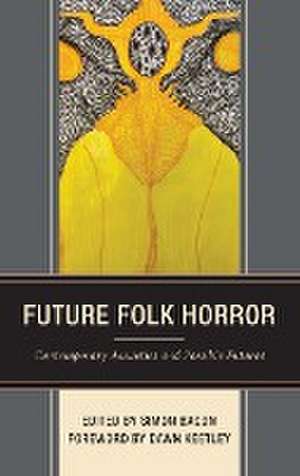
Future Folk Horror: Contemporary Anxieties and Possible Futures: Research in Horror Studies
Editat de Simon Bacon Contribuţii de M. Keith Booker, Vicky Brewster, Stephen Butler, Garret L. Castleberry, Lauryn E. Collins, Stephanie Ellis, Tracy Fahey, Gemma Files, Phil Fitzsimmons, Sandra García Gutiérrez, Danielle Garcia-Karr, Dr Reece Goodall, Brandon R. Grafius, Kit Hawkins, Howard David Ingham, Paul A. J. Lewis, Kingsley Marshall, Conner McAleese, David Norris, Jimmy Packham, James Rose Cuvânt înainte de Professor Dawn Keetleyen Limba Engleză Hardback – 24 iul 2023
Din seria Research in Horror Studies
- 34%
 Preț: 598.78 lei
 - 34%
 Preț: 571.39 lei
 - 33%
 Preț: 585.88 lei
 - 35%
 Preț: 596.39 lei
 - 32%
 Preț: 552.03 lei
 - 28%
 Preț: 221.28 lei
 - 28%
 Preț: 221.53 lei
 - 27%
 Preț: 228.05 lei
 - 26%
 Preț: 259.19 lei
 - 32%
 Preț: 553.17 lei
 - 32%
 Preț: 491.67 lei
 - 36%
 Preț: 524.19 lei
 - 23%
 Preț: 220.25 lei
 -
 Preț: 220.37 lei
 - 35%
 Preț: 527.27 lei
 - 32%
 Preț: 648.31 lei
 - 33%
 Preț: 591.45 lei
 - nou
 Preț: 629.46 lei
Preț: 598.57 lei
Preț vechi: 913.01 lei
-34%
Puncte Express: 898
Carte tipărită la comandă
Livrare economică 08-22 decembrie
Livrare prin curier în România Termenul estimat este afișat lângă disponibilitate.
Transport gratuit pentru acest produs Plată online sau ramburs, în funcție de opțiunile comenzii.
Retur gratuit în 14 zile Comandă securizată și suport în română.
Specificații
ISBN-13: 9781666921236
ISBN-10: 1666921238
Pagini: 346
Ilustrații: 6 b/w illustrations;
Dimensiuni: 160 x 228 x 26 mm
Greutate: 0.68 kg
Editura: Bloomsbury Publishing
Colecția Lexington Books
Seria Research in Horror Studies
Locul publicării:New York, United States
ISBN-10: 1666921238
Pagini: 346
Ilustrații: 6 b/w illustrations;
Dimensiuni: 160 x 228 x 26 mm
Greutate: 0.68 kg
Editura: Bloomsbury Publishing
Colecția Lexington Books
Seria Research in Horror Studies
Locul publicării:New York, United States
V-ar putea interesa
-
 Chow Chop Suey – Food and the Chinese American JourneyAnne MendelsonPreț: 287.25 lei
 -
 The Essay Film – Dialogue, Politics, UtopiaElizabeth Papazian-23%Preț: 488.20 lei634.02 lei
 -
 Global Cinematic Cities – New Landscapes of Film and MediaJohan AnderssonPreț: 279.88 lei
 -
 Atwood, B: Reform Cinema in IranBlake AtwoodPreț: 254.66 lei
 -
 Preț: 188.91 lei
 -
 Preț: 401.33 lei
 -
 Impossible Puzzle FilmsMiklós Kiss-24%Preț: 613.05 lei809.02 lei
 -
 The Cinema of HockeyIri CermakPreț: 309.63 lei
 -
 Brian Donlevy, the Good Bad GuyDerek SculthorpePreț: 245.29 lei
 -
 Horror PickersHoward JacksonPreț: 75.11 lei
 -
 World War II Films of the 1950sScott V. PalmerPreț: 444.57 lei
 -
 Tubby the Fat ClownStephen GnozaPreț: 66.98 lei
 -
 Preț: 90.99 lei
 -
 Preț: 81.11 lei
 -
 Spielräume der Identität in Theaterformen des 18. JahrhundertsFriedemann KreuderPreț: 249.55 lei
 -
 The Courage to BecomeBirgit FritzPreț: 288.28 lei
 -
 Applying the Constitution of the Republic of Poland in Horizontal RelationsMonika Florczak–watorPreț: 297.42 lei
Descriere
Future Folk Horror: Contemporary Anxieties and Possible Futures analyzes folk horror by looking at its recent popularity in novels and films such as The Ritual (2011), The Witch (2015), and Candyman (2021). Countering traditional views of the genre as depictions of the monstrous, rural, and pagan past trying to consume the present, the contributors to this collection posit folk horror as being able to uniquely capture the anxieties of the twenty-first century, caused by an ongoing pandemic and the divisive populist politics that have arisen around it. Further, this book shows how, through its increasing intersections with other genres such as science fiction, the weird, and eco-criticism as seen in films and texts like The Zero Theorum (2013), The Witcher (2007-2021), and Annihilation (2018) as well as through its engagement with topics around climate change, racism, and identity politics, folk horror can point to other ways of being in the world and visions of possible futures.
Cuprins
Section One:
Framing the Past to Make the Present
Chapter 1: "Buried": Folk Horror as Retrieval
Tracy Fahey
Part I: The Folklore of British Folk Horror
Chapter 2. Secret Powers of Attraction: Folk Horror in its Cultural Context
Howard David Ingham
Chapter 3. A Battlefield in England: Folk Horror and War
Jimmy Packham
Chapter 4. Live Horror Theatre, Nostalgia and Folklore
David Norris
Chapter 5. Frayed Strands Entwined: Considering 21st Century Folk Horror
James Rose
Part II: America, Settlers, And Belonging
Chapter 6. Palimpsests and Other Texts: Christianity and Pre-Modern Religions in Folk Horror
Brandon R. Grafius
Chapter 7. "There's some weird shit going on in the woods": Landscape, Cults, and Folklore in the Films of Chad Crawford Kinkle and Andy Mitton
Paul A. J. Lewis
Chapter 8. Fae Fight Back: Monstrous Mycelium and post-Colonial Gothic in The Hallow
Kit Hawkins
Section Two:
Facing Backward Whilst Looking Forward
Part III: Cultural Positionings
Chapter 9. Early
Framing the Past to Make the Present
Chapter 1: "Buried": Folk Horror as Retrieval
Tracy Fahey
Part I: The Folklore of British Folk Horror
Chapter 2. Secret Powers of Attraction: Folk Horror in its Cultural Context
Howard David Ingham
Chapter 3. A Battlefield in England: Folk Horror and War
Jimmy Packham
Chapter 4. Live Horror Theatre, Nostalgia and Folklore
David Norris
Chapter 5. Frayed Strands Entwined: Considering 21st Century Folk Horror
James Rose
Part II: America, Settlers, And Belonging
Chapter 6. Palimpsests and Other Texts: Christianity and Pre-Modern Religions in Folk Horror
Brandon R. Grafius
Chapter 7. "There's some weird shit going on in the woods": Landscape, Cults, and Folklore in the Films of Chad Crawford Kinkle and Andy Mitton
Paul A. J. Lewis
Chapter 8. Fae Fight Back: Monstrous Mycelium and post-Colonial Gothic in The Hallow
Kit Hawkins
Section Two:
Facing Backward Whilst Looking Forward
Part III: Cultural Positionings
Chapter 9. Early
Recenzii
The popularity of such films as The Witch (2015) and Midsommar (2019) signaled the arrival of an era of folk horror. This subgenre found its initial cinematic manifestation in the UK-produced Blood on Satan's Claw (1971), Witchfinder General (1968), and The Wicker Man (1973). In his introduction to this collection editor Simon Bacon writes that these films feature a "location (landscape), which ... causes isolation ... produces a skewed moral or religious perspective, and ... ultimately leads to summoning or happening" (p. 2). Bacon realizes that such a definition is limiting and does not accurately reflect the current state of contemporary or even future folk horror, and he is not content to simply cobble together considerations of previously surveyed films. Rather he presses at the limits of what constitutes a scholarly volume. Along with the expected essays on canonical films, the reader will find a new short story reflective of the subgenre and haunting images termed "visual interventions" that bring an unexpected quality to the project. With essays on haunted attractions, The Witcher video game series, Spanish fairy tales, and regional horror cinema, this unique, noteworthy contribution to horror scholarship not only expands understanding of the subgenre, but also serves to direct the future of folk horror studies. Highly recommended. Upper-division undergraduates through faculty; professionals.
Future Folk Horror: Contemporary Anxieties and Possible Futures is an engaging, ambitious and wide-ranging volume with an impressive line-up of contributors. It should be of interest to anyone interested in contemporary folk horror or in the possibilities contained within its myriad future manifestations.
With its setup of exploring the genre's origins to clarify its future, this fascinating anthology is an invaluable addition to the folk horror field of scholarship. It will no doubt appeal to folk and eco-horror students as a useful starting point of research, directing the reader towards key authorities such as Adam Scovell and his seminal work Folk Horror: Hours Dreadful and Things Strange (2017), as well as providing niche media recommendations. Furthermore, the diversity of essays constructs a uniquely global image of the genre within a single compilation, solidifying folk horror as a continuous 'reservoir of myth, memory and the eerie' (15).
Future Folk Horror: Contemporary Anxieties and Possible Futures is an engaging, ambitious and wide-ranging volume with an impressive line-up of contributors. It should be of interest to anyone interested in contemporary folk horror or in the possibilities contained within its myriad future manifestations.
With its setup of exploring the genre's origins to clarify its future, this fascinating anthology is an invaluable addition to the folk horror field of scholarship. It will no doubt appeal to folk and eco-horror students as a useful starting point of research, directing the reader towards key authorities such as Adam Scovell and his seminal work Folk Horror: Hours Dreadful and Things Strange (2017), as well as providing niche media recommendations. Furthermore, the diversity of essays constructs a uniquely global image of the genre within a single compilation, solidifying folk horror as a continuous 'reservoir of myth, memory and the eerie' (15).