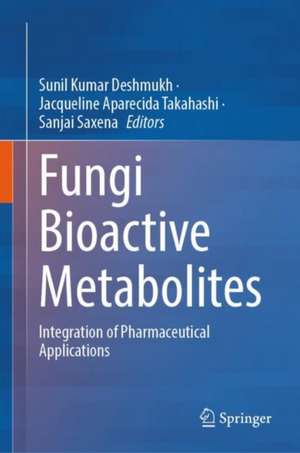
Fungi Bioactive Metabolites
Editat de Sunil Kumar Deshmukh, Jacqueline Aparecida Takahashi, Sanjai Saxenaen Limba Engleză Hardback – 29 feb 2024
În dezvoltarea noilor agenți terapeutici, utilizarea modelelor de screening pentru metaboliții secundari fungici a devenit un pilon central. Considerăm Fungi Bioactive Metabolites o resursă clinică esențială care sintetizează protocoalele de extracție și valorificare a compușilor din surse diverse, de la ciuperci marine la cele din medii extremofile precum Antarctica. Subliniem rigoarea cu care editorii Sunil Kumar Deshmukh, Jacqueline Aparecida Takahashi și Sanjai Saxena au structurat volumul, trecând de la biologia fundamentală a fungilor endofite la aplicații complexe în oncologie și imunologie.
Reținem organizarea tematică pe patru părți majore care ghidează cititorul prin ecosisteme specifice: endofite, fungi endolichenice și resurse marine. Această ediție 2024 nu se rezumă la o simplă enumerare, ci explorează mecanismele de antibiofilm și utilizarea bioinformaticii în optimizarea producției de Echinocandin și acid Kojic. Clinicienii care folosesc Navigating Endophytic Research for Next-Generation Therapeutics ca referință vor găsi aici o extindere necesară către habitatele marine și extremofile, completând spectrul de cercetare cu date despre metaboliți non-peptidici și pigmenți.
Această lucrare consolidează direcțiile de cercetare explorate anterior de Sunil Kumar Deshmukh în volume precum Ecology of Macrofungi sau Progress in Mycology. Dacă lucrările sale precedente se concentrau pe diversitatea ecologică din India și biotehnologia generală, Fungi Bioactive Metabolites rafinează aceste concepte, țintind direct pipeline-ul farmaceutic și managementul bolilor inflamatorii sau trombotice prin biotransformări avansate.
Preț: 1400.73 lei
Preț vechi: 1474.46 lei
-5%
Carte disponibilă
Livrare economică 29 octombrie-12 noiembrie
Specificații
ISBN-10: 9819956951
Pagini: 780
Ilustrații: XVII, 762 p. 1 illus.
Dimensiuni: 160 x 241 x 45 mm
Greutate: 1.46 kg
Ediția:2024
Editura: Springer
Locul publicării:Singapore, Singapore
V-ar putea interesa
-
 -27%Preț: 1488.37 lei2035.63 lei
 -
 Studies in Natural Products ChemistryAtta-Ur-Rahman-31%Preț: 1488.37 lei2167.02 lei
 -
 Fungi for DummiesRene Fester KratzPreț: 96.31 lei
 -
 Fungal Biology 4eDeacon-19%Preț: 443.19 lei547.15 lei
 -
 The Fungal PharmacyRobert Rogers-16%Preț: 222.69 lei265.20 lei
 -
 Natural Products: Structure, Bioactivity & ApplicationsRamiro E Goncalves-27%Preț: 1251.03 lei1703.54 lei
 -
 -9%Preț: 1140.28 lei1253.06 lei
 -
 Dictionary of the FungiPaul Kirk-19%Preț: 488.81 lei603.47 lei
 -
 Fungi DecodedBritt A. BunyardPreț: 89.93 lei
 -
 Pharmaceuticals from MicrobesDivya Arora-15%Preț: 665.02 lei782.38 lei
 -
 Fungi of Antarctica: Diversity, Ecology and Biotechnological ApplicationsLuiz Henrique Rosa-24%Preț: 853.00 lei1122.38 lei
 -
 -18%Preț: 1031.94 lei1258.47 lei
 -
 Fungal MetabolitesJean-Michel Mérillon-18%Preț: 3707.67 lei4521.54 lei
 -
 Industrial ApplicationsMartin Hofrichter-18%Preț: 2035.16 lei2481.90 lei
 -
 -18%Preț: 959.01 lei1169.52 lei
 -
 EndophytesRavindra H. Patil-24%Preț: 880.63 lei1158.72 lei
 -
 Extremophilic FungiSanjay Sahay-24%Preț: 1493.77 lei1965.49 lei
 -
 Fungi and Fungal Products in Human Welfare and BiotechnologyTulasi Satyanarayana-24%Preț: 1375.58 lei1809.98 lei
 -
 Medicinal Lichens: Indigenous Wisdom and Modern PharmacologyRobert Dale Rogers-28%Preț: 149.66 lei207.17 lei
 -
 The Fern Pharmacy: Indigenous Wisdom and Modern PharmacologyRobert Dale Rogers-22%Preț: 145.78 lei187.69 leiRecomandat
De ce să citești această carte
Recomandăm acest volum specialiștilor în microbiologie și biotehnologie farmaceutică dornici să exploreze frontiera dintre micologie și medicină. Cititorul câștigă acces la strategii de screening de ultimă oră pentru compuși bioactivi proveniți din habitate inaccesibile, oferind un avantaj teoretic în dezvoltarea terapiilor de generație viitoare împotriva rezistenței bacteriene și a afecțiunilor autoimune.
Despre autor
Sunil Kumar Deshmukh este un cercetător proeminent în domeniul micologiei, cu o carieră dedicată explorării potențialului fungilor în beneficiul sănătății umane. Alături de Jacqueline Aparecida Takahashi și Sanjai Saxena, acesta a coordonat numeroase proiecte de bioprospectare, punând accent pe metaboliții secundari. Experiența sa este reflectată în lucrări de referință precum Fungi and Fungal Products in Human Welfare and Biotechnology și Bioprospects of Macrofungi, unde a investigat aplicabilitatea ciupercilor în sectoarele farmaceutic și industrial. În prezenta lucrare, expertiza sa se concentrează pe integrarea noilor tehnologii bioinformatice în descoperirea de medicamente de origine fungică.
Descriere scurtă
This book is going to be a comprehensive treatise and a valuable source for mycologists, biotechnologists, microbiologists, biotechnologists, and undertaking research in pharmaceutical sector as well as academia in setting up their research aspirations for using fungi in the process of drug discovery and development.
Cuprins
Notă biografică
Dr. Jacqueline Aparecida Takahashi is a full professor at the Universidade Federal de Minas Gerais (Brazil). For more than two decades, she has been studying routes to modulate fungal secondary metabolism, and she has been dedicated in recent years to issues related to access to Brazilian biodiversity, in reference to international treaties. She is a member of the Disciplinary Nucleus of Bioactive Natural Products of the Montevideo Group Universities Association (AUGM). She has to her credit 8 patents, 183 publications, and 12 book chapters on natural products from plants and fungi. She is a member of the Brazilian Society of Chemistry (SBQ) and of the Brazilian Society for the Progress of Science (SBPS). She serves as a referee for more than 20 national and international journals.
Dr. Sanjai Saxena currently an academic and researcher with over two decades of experience in bio-tech research and development He is currently a full professor in the Department of Biotechnology, Thapar Institute of Engineering and Technology (Patiala), India. He has embarked upon his journey as an innovator turned entrepreneur and founded a startup, Agpharm Bioinnovations LLP with a pursuit to address the ever-arising unanswered pharmaceutical and agricultural sector needs. He continually focuses on exploring and exploiting novel biomolecules drawn from biological systems and their interactions in nature, particularly plant-microbe interactions. Prof. Saxena, focuses his research primarily on microbial secondary metabolites, microbial diversity and bioprospecting, biochemistry, and drug discovery. His research work has resulted in significant extramural funding, 4 patents, over 78 peer-reviewed publications in referred research journals, 12 book chapters, and 1 book on applied microbiology to his credit. Dr. Saxena is a fellow of Association of Advancement of Biodiversity Science, Karnataka. Prof. Saxena serves as a referee for approximately 25 peer-reviewed journals apart from being on editorial board of a couple of them.
Caracteristici
Descriere
This book presents the exploration and exploitation of various bioactive metabolites obtained from fungi isolated from diverse habitats for pharmaceutical applications.