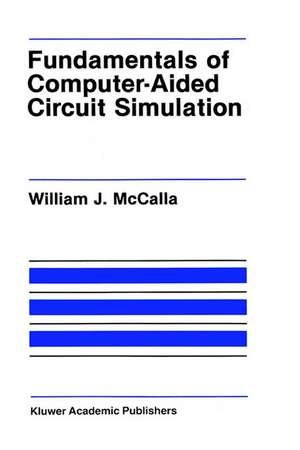
Fundamentals of Computer-Aided Circuit Simulation
Autor William J McCallaen Limba Engleză Hardback – 30 noi 1987
Preț: 912.98 lei
Preț vechi: 1113.39 lei
-18%
Puncte Express: 1369
Carte tipărită la comandă
Livrare economică 09-23 iunie
Specificații
ISBN-13: 9780898382488
ISBN-10: 0898382483
Pagini: 176
Ilustrații: XVI, 176 p.
Dimensiuni: 160 x 241 x 16 mm
Greutate: 0.47 kg
Ediția:1988 edition
Editura: Springer Us
Locul publicării:New York, NY, United States
ISBN-10: 0898382483
Pagini: 176
Ilustrații: XVI, 176 p.
Dimensiuni: 160 x 241 x 16 mm
Greutate: 0.47 kg
Ediția:1988 edition
Editura: Springer Us
Locul publicării:New York, NY, United States
V-ar putea interesa
-
 -11%Preț: 113.56 lei126.96 lei
 -
 Microelectronic CircuitsAdel S. Sedra-24%Preț: 842.67 lei1107.29 lei
 -
 SimulationSheldon M. Ross-33%Preț: 477.63 lei713.85 lei
 -
 Sabiston Textbook of Surgery: The Biological Basis of Modern Surgical PracticeDouglas Scott Tyler-30%Preț: 1092.91 lei1567.58 leiRecomandat
 -
 Computer Architecture: A Quantitative ApproachJohn L. Hennessy-20%Preț: 708.10 lei885.13 lei
 -
 -32%Preț: 435.48 lei644.89 lei
 -
 The Art of ElectronicsPaul Horowitz-14%Preț: 737.95 lei858.09 lei
 -
 -19%Preț: 404.35 lei499.20 lei
 -
 Circuit Analysis for DummiesJohn SantiagoPreț: 110.77 lei
 -
 CMOSR. Jacob Baker-23%Preț: 854.13 lei1109.27 lei
 -
 Engineering Circuit Analysis, International AdaptationJ. David Irwin-19%Preț: 405.42 lei500.51 lei
 -
 Design of Analog CMOS Integrated CircuitsBehzad Razavi-26%Preț: 376.13 lei505.69 lei
 -
 ISE Fundamentals of Electric CircuitsCharles Alexander-8%Preț: 464.77 lei505.18 lei
 -
 Simulation Modeling and Analysis, Sixth EditionAverill Law-34%Preț: 730.42 lei1105.12 lei
 -
 Storey, N: ElectronicsNeil Storey-13%Preț: 543.48 lei624.69 lei
 -
 Electronic Devices, Global EditionThomas Floyd-13%Preț: 601.74 lei691.65 lei
 -
 Foundations of Analog and Digital Electronic CircuitsAnant Agarwal-29%Preț: 511.04 lei718.84 lei
 -
 Computational Electronic CircuitsSotoudeh Hamedi-HaghPreț: 490.86 lei
 -
 Advanced Topics in Electric CircuitsZdzislaw Trzaska-18%Preț: 922.68 lei1125.22 lei
Public țintă
ResearchCuprins
1. Circuit Equation Formulation.- 1.1 Branch Constitutive Equations.- 1.2 Nodal Analysis.- 1.3 Modified Nodal Analysis.- 1.4 Sparse Tableau Analysis.- 2. Linear Equation Solution.- 2.1 Gaussian Elimination.- 2.2 LU Transformation.- 2.3 LU Transformation Variations.- 2.4 Determinants.- 2.5 Accuracy Enhancement.- 2.6 Iterative Methods.- 3. Sparse Matrix Methods.- 3.1 Sparse Matrix Storage.- 3.2 Optimal Ordering.- 4. Nonlinear Equation Solution.- 4.1 Newton-Raphson Iteration.- 4.2 Convergence and Termination.- 4.3 Variations of Newton-Raphson Iteration.- 4.4 Internal Device Node Suppression.- 5. Numerical Integration.- 5.1 Introduction to Integration Formulas.- 5.2 Application of Integration Formulas.- 5.3 Construction of Integration Formulas.- 5.4 Truncation Error of Integration Formulas.- 5.5 Stability of Integration Methods.- 5.6 Automatic Timestep Control.- 6. Adjoint Networks and Sensitivity.- 6.1 Adjoint Networks.- 6.2 Element Sensitivity.- 6.3 Small-Signal Sensitivities.- 6.4 Noise and Group Delay Response.- 7. Pole-Zero Evaluation.- 7.1 Two-Port Transfer Functions.- 7.2 Muller’s Method.- 8. Statistical Analysis.- 8.1 Distributions.- 8.2 Tracking and Pivots.- 8.3 Pivot Sorting Algorithm.- 8.4 Correlation.- References.