
Fundamental Mathematical Concepts for Machine Learning in Science
Autor Umberto Micheluccien Limba Engleză Hardback – 17 mai 2024
Găsim în această carte, încă de la primele capitole, o orientare clară către rezolvarea problemelor de integritate a datelor și validare a modelelor, elemente adesea ignorate în manualele tehnice de programare. Reținem că Fundamental Mathematical Concepts for Machine Learning in Science nu este doar un inventar de algoritmi, ci un ghid de bune practici pentru cercetătorii din fizică, medicină sau biologie care doresc să evite erorile fundamentale în antrenarea rețelelor neuronale. Suntem de părere că accentul pus pe teoria eșantionării și pe reglarea hiperparametrilor (hyperparameter tuning) oferă cititorului rigoarea necesară pentru a construi modele predictibile și reproductibile. Structura volumului urmează o progresie logică, pornind de la Analiza Matematică și Optimizare, trecând prin Algebră Liniară și ajungând la Statistică și Probabilități. Această ierarhie reflectă viziunea autorului Umberto Michelucci, care a explorat anterior aplicabilitatea practică în Applied Deep Learning with TensorFlow 2 și rigoarea statistică în Statistics for Scientists. Dacă în lucrările precedente accentul cădea pe implementarea software, volumul de față consolidează baza teoretică, explicând de ce anumite metode funcționează și cum pot fi ele adaptate pentru date experimentale complexe. Comparativ cu Mathematical Foundations of Data Science de Tomas Hrycej, care caută un echilibru între complexitate și simplificare pentru informaticieni, lucrarea de față adoptă o abordare mai orientată către omul de știință practician. Deși acoperă aceeași arie tematică, Fundamental Mathematical Concepts for Machine Learning in Science se distinge prin tratarea detaliată a seturilor de date dezechilibrate și a importanței caracteristicilor (feature importance), oferind instrumente matematice direct aplicabile în laboratorul de cercetare.
Preț: 521.72 lei
Preț vechi: 613.80 lei
-15%
Carte disponibilă
Livrare economică 17 noiembrie-01 decembrie
Specificații
ISBN-10: 3031564308
Pagini: 268
Ilustrații: XVII, 249 p.
Dimensiuni: 160 x 241 x 21 mm
Greutate: 0.52 kg
Ediția:2024
Editura: Springer
Locul publicării:Cham, Switzerland
V-ar putea interesa
-
 Just Enough Data Science and Machine LearningMark LevenePreț: 352.28 lei
-
 Foundations of Science MathematicsDevinder Sivia-11%Preț: 281.48 lei318.02 lei
-
 -18%Preț: 527.45 lei646.10 lei
-
 Understanding Deep LearningSimon J. D. Prince-20%Preț: 636.22 lei795.27 lei
-
 The Elements of Statistical LearningTrevor Hastie-20%Preț: 546.54 lei683.17 lei
-
 -38%Preț: 398.93 lei646.62 lei
-
 -31%Preț: 607.05 lei885.58 lei
-
 Machine Learning: An Algorithmic Perspective, Second EditionStephen Marsland-20%Preț: 625.22 lei781.53 lei
-
 Math and Architectures of Deep LearningKrishnendu Chaudhury-20%Preț: 410.21 lei512.76 lei
-
 -20%Preț: 250.26 lei312.82 lei
-
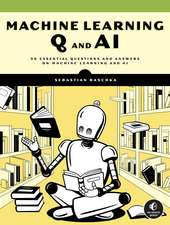 -20%Preț: 249.08 lei311.36 lei
-
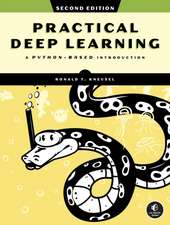 Practical Deep Learning, 2nd Edition: A Python-Based IntroductionRonald T. Kneusel-35%Preț: 333.73 lei515.68 lei
-
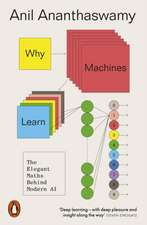 Why Machines LearnAnil AnanthaswamyPreț: 160.44 lei
-
 Materials Data ScienceStefan Sandfeld-19%Preț: 624.52 lei771.02 lei
-
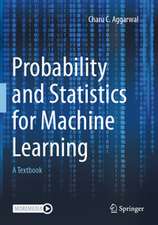 Probability and Statistics for Machine LearningCharu C. Aggarwal-20%Preț: 445.19 lei556.49 lei
-
 Statistics for ScientistsUmberto Michelucci-20%Preț: 279.62 lei349.53 lei
-
 The Data Science Design ManualSteven S. Skiena-20%Preț: 417.78 lei522.22 lei
-
 Mathematical Introduction to Data ScienceSven A. Wegner-20%Preț: 574.81 lei718.51 lei
-
 -24%Preț: 677.56 lei886.96 lei
De ce să citești această carte
Această carte se adresează cercetătorilor care vor să treacă de la simpla utilizare a unor biblioteci software la înțelegerea mecanismelor matematice din spatele învățării automate. Cititorul câștigă capacitatea de a valida riguros modelele și de a gestiona corect seturile de date experimentale. Este o resursă esențială pentru a evita erorile de logică matematică ce pot compromite rezultatele unei întregi cercetări științifice.
Despre autor
Umberto Michelucci este un expert recunoscut în aplicarea algoritmilor de învățare automată în context științific, având o experiență vastă în publicarea de manuale tehnice la editura Springer. Cu un portofoliu ce include titluri precum Advanced Applied Deep Learning și Statistics for Scientists, Michelucci s-a specializat în traducerea conceptelor matematice abstracte în soluții practice pentru cercetători. Expertiza sa acoperă atât fundamentul teoretic al rețelelor neuronale, cât și utilizarea framework-urilor moderne precum TensorFlow, fiind un punct de referință pentru integrarea inteligenței artificiale în disciplinele STEM.
Cuprins
Notă biografică
Textul de pe ultima copertă
Numerous texts delve into the technical execution of machine learning algorithms, often overlooking the foundational concepts vital for fully grasping these methods. This leads to a gap in using these algorithms effectively across diverse disciplines. For instance, a firm grasp of calculus is imperative to comprehend the training processes of algorithms and neural networks, while linear algebra is essential for the application and efficient training of various algorithms, including neural networks. Absent a solid mathematical base, machine learning applications may be, at best, cursory, or at worst, fundamentally flawed. This book lays the foundation for a comprehensive understanding of machine learning algorithms and approaches.