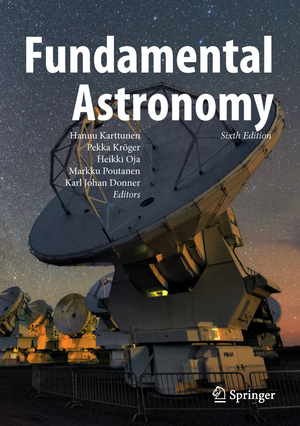
Fundamental Astronomy
Editat de Hannu Karttunen, Pekka Kröger, Heikki Oja, Markku Poutanen, Karl Johan Donneren Limba Engleză Hardback – 20 noi 2016
În peisajul academic actual, Fundamental Astronomy reprezintă un pilon fundamental pentru cursurile introductive de astronomie la nivel universitar. Ajuns la a șasea ediție, acest volum editat de Hannu Karttunen și echipa sa de la Universitatea din Turku, se adaptează ritmului accelerat în care evoluează explorarea spațială, oferind o bază teoretică riguroasă, ancorată în principii fizice solide. Remarcăm o restructurare atentă a conținutului: capitolul extins despre sistemul solar a fost divizat pentru o mai bună claritate, separând trăsăturile generale de analiza corpurilor cerești individuale, în timp ce noile descoperiri despre exoplanete beneficiază acum de o secțiune dedicată. Suntem de părere că progresia materialului este exemplară pentru un manual de referință. Cartea debutează cu aspectele clasice ale astronomiei sferice și instrumentației, avansează spre mecanica cerească și fotometrie, pentru ca în a doua jumătate să abordeze teme complexe precum evoluția stelară, mediul interstelar și structura galaxiilor. Această ediție a fost modernizată substanțial, în special în zonele dinamice ale cosmologiei și astrofizicii extragalactice. Comparativ cu Introduction to Astronomy and Cosmology de Ian Morison, care oferă de asemenea o bază solidă pentru studenții din primul an, Fundamental Astronomy adoptă o abordare mai tehnică și mai cuprinzătoare, fiind ideală pentru cei care doresc să treacă de la textele populare la o înțelegere matematică și fizică a fenomenelor. În timp ce Astronomy de Andrew Fraknoi pune accent pe explicații non-tehnice și analogii, volumul de față menține un echilibru precis între conceptele astronomice și legile fizicii care le guvernează, pregătind cititorul pentru studii avansate în domeniu.
Preț: 542.39 lei
Preț vechi: 638.11 lei
-15%
Carte disponibilă
Livrare economică 18 mai-01 iunie
Specificații
ISBN-10: 3662530449
Pagini: 506
Ilustrații: Bibliographie
Dimensiuni: 183 x 260 x 34 mm
Greutate: 1.37 kg
Ediția:6th edition
Editura: Springer
Locul publicării:Berlin, Heidelberg, Germany
V-ar putea interesa
-
 -21%Preț: 66.74 lei84.65 lei
 -
 Measurement: A Very Short IntroductionDavid J. Hand-21%Preț: 53.00 lei67.50 lei
 -
 What is Life?: How Chemistry Becomes BiologyAddy Pross-21%Preț: 66.74 lei84.65 lei
 -
 Gaia: A New Look at Life on EarthJames Lovelock-21%Preț: 58.49 lei74.36 lei
 -
 -7%Preț: 200.24 lei215.33 lei
 -
 Preț: 341.47 lei
 -
 Men, Machines, and Modern Times: Ediție aniversară 50 aniElting E. MorisonPreț: 150.46 lei
 -
 New HorizonsC T Russell-18%Preț: 924.76 lei1127.76 lei
 -
 Network GeeksBrian E. CarpenterPreț: 139.95 lei
 -
 Lessons from the MastersRobert GendlerPreț: 339.87 lei
 -
 Murder on the Einstein Express and Other StoriesHarun ŠiljakPreț: 97.05 lei
 -
 The Realization of Star Trek TechnologiesMark E. LasburyPreț: 298.33 lei
 -
 Handbook of Practical AstronomyGünter D. Roth-8%Preț: 567.02 lei616.33 lei
 -
 Algorithms UnpluggedBerthold Vöcking-24%Preț: 659.67 lei867.99 lei
 -
 Chemicals for Life and LivingEiichiro OchiaiPreț: 187.87 lei
 -
 Sea - Wind - PowerMichael DurstewitzPreț: 258.17 lei
 -
 OriginaliiAdam GrantPreț: 65.00 lei
De ce să citești această carte
Recomandăm această ediție a șasea studenților la fizică și astronomie, dar și amatorilor dedicați care caută o rigoare superioară manualelor comerciale. Cititorul câștigă o perspectivă actualizată asupra sistemului solar și a exoplanetelor, beneficiind de o structură didactică ce facilitează înțelegerea mecanismelor radiației și a structurii stelare prin date concrete și revizuiri recente din domeniu.
Despre autor
Hannu Karttunen este un respectat astronom și Systems Manager la Observatorul Tuorla din cadrul Universității din Turku, Finlanda. Expertiza sa în gestionarea datelor observaționale și în educația academică se reflectă în calitatea editorială a acestui manual, devenit referință internațională. Alături de co-editorii Pekka Kröger, Heikki Oja, Markku Poutanen și Karl Johan Donner, Karttunen a reușit să mențină relevanța acestui text încă de la prima ediție din 1987, adaptându-l constant la noile tehnologii și descoperiri din astrofizica modernă.
Cuprins
Recenzii
Notă biografică
Heikki Oja is a Finnish astronomer and associate professor at the University of Helsinki, as well as the former director of the Almanac Office. Dr. Oja has written dozens of non-technical non-fiction books and appeared frequently on the radio to talk about astronomy and space research. He has received several awards for his outreach activities.
Textul de pe ultima copertă
The chapters on galactic and extragalactic astronomy as well as cosmology were extensively modernized in the previous edition. In this new edition they have been further revised to include more recent results. The long chapter on the solar system has been split into two parts: the first one deals with the general properties, and the other one describes individual objects. A new chapter on exoplanets has been added to the end of the book next to the chapter on astrobiology.
In response to the fact that astronomy has evolved enormously over the last few years, only a few chapters of this book have been left unmodified.
Long considered a standard text for physical science majors, Fundamental Astronomy is also an excellent reference and entrée for dedicated amateur astronomers. For their benefit the introductory chapter has been extended to give a brief summary of the different types of celestial objects.
From reviews of earlier editions:
"… The wide range of expertise gives the book an authority that would be almost impossible for a single-author text ... There are other aids to the reader: worked examples ... starred sections in small print take the inquisitive reader beyond the general level of the book." (Nature)
“This textbook, suitable for a university first course in astronomy, is the outgrowth of a long and outstanding astronomical tradition in Finland, and the result of an extensive collaborative effort, which included also teaching and interaction with many people. … I highly recommend this book for class use … it will be useful for professionals as well.” (Bruno Bertotti, Prometeo, Vol. 24 (3-4), 2008)