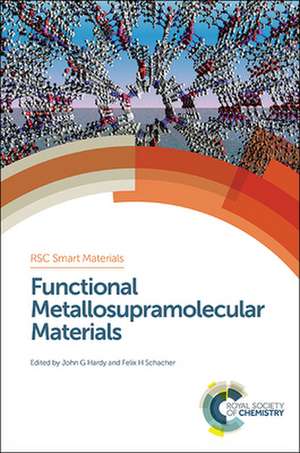
Functional Metallosupramolecular Materials
Editat de John George Hardy, Felix H Schacheren Limba Engleză Hardback – 17 iul 2015
Preț: 1185.85 lei
Preț vechi: 1378.89 lei
-14% Nou
Puncte Express: 1779
Preț estimativ în valută:
209.84€ • 246.06$ • 184.28£
209.84€ • 246.06$ • 184.28£
Carte disponibilă
Livrare economică 26 ianuarie-09 februarie
Preluare comenzi: 021 569.72.76
Specificații
ISBN-13: 9781782620228
ISBN-10: 1782620222
Pagini: 416
Ilustrații: 6 black & white tables
Dimensiuni: 163 x 239 x 30 mm
Greutate: 0.73 kg
Editura: RSC Publishing
ISBN-10: 1782620222
Pagini: 416
Ilustrații: 6 black & white tables
Dimensiuni: 163 x 239 x 30 mm
Greutate: 0.73 kg
Editura: RSC Publishing
V-ar putea interesa
-
 Exercises in Synthetic Organic ChemistryChiara Ghiron-31%Preț: 491.45 lei716.88 lei
 -
 Organic Chemistry: A Very Short IntroductionGraham PatrickPreț: 48.12 lei
 -
 Advanced Organic ChemistryFrancis A. CareyPreț: 547.74 lei
 -
 -23%Preț: 525.07 lei681.92 lei
 -
 Organosilanes in Radical ChemistryChryssostomos Chatgilialoglu-9%Preț: 1447.97 lei1591.17 lei
 -
 -14%Preț: 1369.83 lei1592.83 lei
 -
 Intermediate Organic Chemistry 3eAM Fabirkiewicz-23%Preț: 651.68 lei846.34 lei
 -
 BIOS Instant Notes in Organic ChemistryGraham PatrickPreț: 249.14 lei
 -
 Modern Physical Organic ChemistryEric V. Anslyn-18%Preț: 928.05 lei1131.77 lei
Textul de pe ultima copertă
There is great interest in metallosupramolecular materials because of their use in magnetic, photonic and electronic materials. Functional Metallosupramolecular Materials focuses on the applications of these materials covering the chemistry underlying the synthesis of a variety of ligands to coordinate various metal ions and the generation of 2D and 3D materials based on these constructs.
The book starts by looking at different metallosupramolecular systems including naturally occurring functional metallosupramolecular materials; DNA-based metallosupramolecular materials; metallopolymers; metallogels as well as functional materials based on MOFs. Subsequent chapters then systematically cover the different applications such as molecular computation, spin-crossover, light harvesting and as photocatalysts for the production of solar fuels.
The book provides an overview of functional metallosupramolecular materials that will be of interest to graduate students, academics and industrial chemists interested in supramolecular chemistry, materials science and the materials applications.
The book starts by looking at different metallosupramolecular systems including naturally occurring functional metallosupramolecular materials; DNA-based metallosupramolecular materials; metallopolymers; metallogels as well as functional materials based on MOFs. Subsequent chapters then systematically cover the different applications such as molecular computation, spin-crossover, light harvesting and as photocatalysts for the production of solar fuels.
The book provides an overview of functional metallosupramolecular materials that will be of interest to graduate students, academics and industrial chemists interested in supramolecular chemistry, materials science and the materials applications.