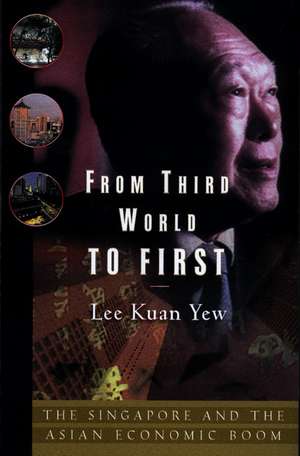
From Third World to First
Autor Lee Kuan Yewen Limba Engleză Paperback – feb 2011
Imaginați-vă un oraș-stat fără resurse naturale, o fostă colonie britanică înconjurată de vecini ostili, unde în 1965 supraviețuirea părea un pariu pierdut. Impactul lui Lee Kuan Yew asupra secolului XX transcende granițele minusculei insule Singapore, oferind lumii un model de dezvoltare care a sfidat toate previziunile economice tradiționale. În From Third World to First, asistăm la transformarea radicală a unei mlaștini insalubre într-un nod tehnologic și financiar global, un proces orchestrat cu o mână de fier și o viziune care a prioritizat eficiența în detrimentul ideologiilor rigide. Remarcăm în paginile acestui volum o sinceritate tăioasă, rară în rândul memoriilor politice. Lee Kuan Yew nu își cere scuze pentru „statul dădacă” pe care l-a construit; dimpotrivă, el detaliază cum controlul strict asupra ordinii publice, educației și chiar a alegerilor personale ale cetățenilor a fost fundamentul prosperității actuale. Suntem de părere că forța narativă rezidă în accesul la documente guvernamentale anterior secrete, care dezvăluie mecanismele interne ale construcției unei națiuni: de la eradicarea corupției coloniale, până la crearea unei linii aeriene de talie mondială. Narativul amintește de Lion City prin intensitatea cu care reconstituie o epocă de incertitudine totală, însă, spre deosebire de analiza lui Jeevan Vasagar, aici avem perspectiva directă a arhitectului sistemului. Dacă Singapore de John Curtis Perry oferă o privire istorică echilibrată, memoriile lui Lee sunt o lecție de realism politic, punctată de portrete memorabile ale unor lideri precum Margaret Thatcher sau Deng Xiaoping, pe care autorul i-a consiliat și observat îndeaproape. Este o cronică despre voința de a fi corect, mai degrabă decât „corect politic”.
Preț: 114.30 lei
Carte disponibilă
Livrare economică 16-30 noiembrie
Livrare express 31 octombrie-06 noiembrie pentru 47.20 lei
Specificații
ISBN-10: 0060957514
Pagini: 768
Dimensiuni: 154 x 228 x 45 mm
Greutate: 0.8 kg
Editura: Harper Collins Publ. USA
Colecția HarperBusiness
V-ar putea interesa
-
 NoiseDaniel KahnemanPreț: 58.65 lei
 -
 World OrderKissingerPreț: 94.27 lei
 -
 LeadershipKissinger-28%Preț: 78.33 lei108.72 lei
 -
 LeadershipKissinger-33%Preț: 144.53 lei215.76 lei
 -
 Lee Kuan YewGraham Allison-27%Preț: 113.10 lei155.86 lei
 -
 Lion City: Singapore and the Invention of Modern AsiaJeevan Vasagar-27%Preț: 68.60 lei93.44 lei
 -
 Long Walk To Freedom: 'Essential reading' Barack ObamaNelson Mandela-22%Preț: 87.42 lei112.22 lei
 -
 Hawks, Doves, & OwlsGraham T. AllisonPreț: 137.88 lei
 -
 DiplomacyKissinger-23%Preț: 117.46 lei153.12 lei
 -
 14,000 Things to Be Happy About.: Newly Revised and UpdatedBarbara Ann Kipfer-22%Preț: 56.91 lei73.42 lei
 -
 Singapore: World CityKim Inglis-19%Preț: 162.42 lei200.99 lei
 -
 Ghost NationChris Horton-32%Preț: 107.98 lei159.56 lei
 -
 The Birth of Korean CoolEuny HongPreț: 98.21 lei
 -
 -26%Preț: 99.39 lei135.09 lei
 -
 Living the Asian Century: An Undiplomatic MemoirKishore Mahbubani-27%Preț: 96.93 lei132.74 lei
 -
 Singapore, SingapuraNicholas Walton-25%Preț: 93.66 lei125.25 lei
 -
 Rethinking OurselvesAnwar IbrahimPreț: 164.85 lei
 -
 Geh, wohin dein Herz dich trägtSusanna TamaroPreț: 101.02 lei
 -
 Robert Kuok a MemoirAndrew Tanzer-15%Preț: 168.69 lei197.42 lei
 -
 Stories of IntegrationVandana AggarwalPreț: 69.99 lei
De ce să citești această carte
Recomandăm această carte oricui dorește să înțeleagă cum se poate construi o superputere economică de la zero. Cititorul câștigă o perspectivă rară asupra strategiei geopolitice și a managementului de stat, fiind martorul modului în care pragmatismul extrem poate schimba destinul unei națiuni. Este o lectură esențială pentru pasionații de istorie politică și economie care caută să descopere mintea din spatele „miracolului singaporez”.
Despre autor
Lee Kuan Yew (1923–2015) a fost părintele fondator al Singaporelui modern și primul său prim-ministru, ocupând această funcție timp de peste trei decenii, din 1959 până în 1990. Descendent al unor imigranți chinezi și educat în drept la Universitatea Cambridge, Lee a co-fondat People's Action Party, transformând o insulă devastată de cel de-al Doilea Război Mondial într-un centru financiar global. Recunoscut pentru viziunea sa strategică și pentru promovarea „valorilor asiatice”, el a rămas o figură influentă în politica internațională până la sfârșitul vieții, servind ca Senior Minister și mentor pentru generațiile următoare de lideri.
Descriere
Few gave tiny Singapore much chance of survival when it was granted independence in 1965. How is it, then, that today the former British colonial trading post is a thriving Asian metropolis with not only the world's number one airline, best airport, and busiest port of trade, but also the world's fourth–highest per capita real income?
The story of that transformation is told here by Singapore's charismatic, controversial founding father, Lee Kuan Yew. Rising from a legacy of divisive colonialism, the devastation of the Second World War, and general poverty and disorder following the withdrawal of foreign forces, Singapore now is hailed as a city of the future. This miraculous history is dramatically recounted by the man who not only lived through it all but who fearlessly forged ahead and brought about most of these changes.
Delving deep into his own meticulous notes, as well as previously unpublished government papers and official records, Lee details the extraordinary efforts it took for an island city–state in Southeast Asia to survive at that time.
Lee explains how he and his cabinet colleagues finished off the communist threat to the fledgling state's security and began the arduous process of nation building: forging basic infrastructural roads through a land that still consisted primarily of swamps, creating an army from a hitherto racially and ideologically divided population, stamping out the last vestiges of colonial–era corruption, providing mass public housing, and establishing a national airline and airport.
In this illuminating account, Lee writes frankly about his trenchant approach to political opponents and his often unorthodox views on human rights, democracy, and inherited intelligence, aiming always "to be correct, not politically correct." Nothing in Singapore escaped his watchful eye: whether choosing shrubs for the greening of the country, restoring the romance of the historic Raffles Hotel, or openly, unabashedly persuading young men to marry women as well educated as themselves. Today's safe, tidy Singapore bears Lee's unmistakable stamp, for which he is unapologetic: "If this is a nanny state, I am proud to have fostered one."
Though Lee's domestic canvas in Singapore was small, his vigor and talent assured him a larger place in world affairs. With inimitable style, he brings history to life with cogent analyses of some of the greatest strategic issues of recent times and reveals how, over the years, he navigated the shifting tides of relations among America, China, and Taiwan, acting as confidant, sounding board, and messenger for them. He also includes candid, sometimes acerbic pen portraits of his political peers, including the indomitable Margaret Thatcher and Ronald Reagan, the poetry–spouting Jiang Zemin, and ideologues George Bush and Deng Xiaoping.
Lee also lifts the veil on his family life and writes tenderly of his wife and stalwart partner, Kwa Geok Choo, and of their pride in their three children –– particularly the eldest son, Hsien Loong, who is now Singapore's deputy prime minister.
For more than three decades, Lee Kuan Yew has been praised and vilified in equal measure, and he has established himself as a force impossible to ignore in Asian and international politics. From Third World to First offers readers a compelling glimpse into this visionary's heart, soul, and mind.