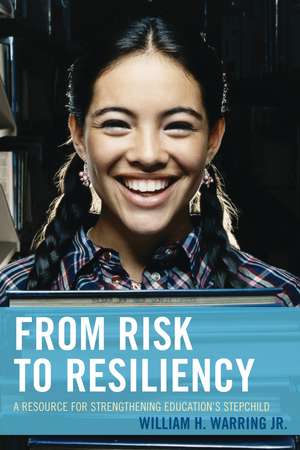
From Risk to Resiliency: A Resource for Strengthening Education's Stepchild
Autor William H. Warring Jr.en Limba Engleză Paperback – 15 dec 2015
Research-based study offering school-wide direction and practice is strongly evidenced throughout educational theory and practices, extending opportunities for significant continuation growth. A successful continuation setting, supported by study and introduced through From Risk to Resiliency, offers opportunities for program developers to bring together personal, closely held stakeholder values with program and classroom practices, opportunities only now being realized.
Preț: 209.36 lei
Preț vechi: 282.83 lei
-26%
Puncte Express: 314
Carte tipărită la comandă
Livrare economică 06-20 iunie
Specificații
ISBN-13: 9781475820973
ISBN-10: 1475820976
Pagini: 164
Dimensiuni: 148 x 226 x 14 mm
Greutate: 0.24 kg
Editura: Bloomsbury Publishing
Colecția Rowman & Littlefield
Locul publicării:New York, United States
ISBN-10: 1475820976
Pagini: 164
Dimensiuni: 148 x 226 x 14 mm
Greutate: 0.24 kg
Editura: Bloomsbury Publishing
Colecția Rowman & Littlefield
Locul publicării:New York, United States
Cuprins
Preface
Acknowledgements
Chapter 1: Dropouts
Who's Dropping Out?
What Do Dropouts Say?
What Have We Learned?
Chapter 2: A Condition of Benign Neglect
Decoupling
School Design Descriptions
Curriculum & Instruction
Continuation School History
Student Performance Expectations
Institutional Train Wreck
Lack of Research
Chapter 3: Pathways to Change
Effective Educational Change Constructs
Cultural Mindsets: Central to School Change
Addressing Teacher Adversity
A Teacher's Explanatory Style
Teacher Concerns
Creating Key Relationships
Changing Staff Relationships
Creating Community Relationship
Adapting Change Components and Innovations
Synthesizing Practitioners with Innovations
External Change Interventions: Mushrooms
School Aims: Happiness in Schools and Classrooms
Evaluating Change
Chapter 4: Diffusing Teacher Change Resistance
Change Agents
Teacher Resistance Themes
Teacher Resistance: External Barriers
Distributive Leadership
Diffusing Resistance Through Communication
Beyond Resistance: What if Change Succeeds?
Chapter 5: Building a Resiliency-Based Paradigm
Educational Resiliency Defined
Four Theories
Resiliency Theory
School Connectedness
Beginning a Trust-Building Process: Listening
A Sense of Autonomy
Altruism
Building High Internal Expectations
Believing in Student Resilience
Effective Teacher Preparation Constructs
Protective Factor Descriptors
Limitations of Resiliency Theory
Self-Efficacy Theory
Life Satisfaction Findings
Home Life Satisfaction Factors
School-Wide Corrective Factors
Effects of Supportive Relationships
Gratitude
Social-Cognitive Theory
Bonding: An Essential Change Agent
Hope Theory
Measuring Hope
Q & A: Resiliency-Based Change Concerns
Author's Note
References
Appendices
Acknowledgements
Chapter 1: Dropouts
Who's Dropping Out?
What Do Dropouts Say?
What Have We Learned?
Chapter 2: A Condition of Benign Neglect
Decoupling
School Design Descriptions
Curriculum & Instruction
Continuation School History
Student Performance Expectations
Institutional Train Wreck
Lack of Research
Chapter 3: Pathways to Change
Effective Educational Change Constructs
Cultural Mindsets: Central to School Change
Addressing Teacher Adversity
A Teacher's Explanatory Style
Teacher Concerns
Creating Key Relationships
Changing Staff Relationships
Creating Community Relationship
Adapting Change Components and Innovations
Synthesizing Practitioners with Innovations
External Change Interventions: Mushrooms
School Aims: Happiness in Schools and Classrooms
Evaluating Change
Chapter 4: Diffusing Teacher Change Resistance
Change Agents
Teacher Resistance Themes
Teacher Resistance: External Barriers
Distributive Leadership
Diffusing Resistance Through Communication
Beyond Resistance: What if Change Succeeds?
Chapter 5: Building a Resiliency-Based Paradigm
Educational Resiliency Defined
Four Theories
Resiliency Theory
School Connectedness
Beginning a Trust-Building Process: Listening
A Sense of Autonomy
Altruism
Building High Internal Expectations
Believing in Student Resilience
Effective Teacher Preparation Constructs
Protective Factor Descriptors
Limitations of Resiliency Theory
Self-Efficacy Theory
Life Satisfaction Findings
Home Life Satisfaction Factors
School-Wide Corrective Factors
Effects of Supportive Relationships
Gratitude
Social-Cognitive Theory
Bonding: An Essential Change Agent
Hope Theory
Measuring Hope
Q & A: Resiliency-Based Change Concerns
Author's Note
References
Appendices
Recenzii
Warring's observations on continuation schools-alternative high school pathways for students not thriving in comprehensive high school settings-are based on his experiences as a continuation school teacher and educational consultant in California. The reform of these schools is desperately needed; in some large urban school districts in California, less than 50 percent of the students graduate from high school. Descriptions of the historical development of these schools and the challenges current students face lead to a discussion of their functions as safety nets, safety valves, or dumping grounds. Warring calls on using a resiliency-based paradigm to develop learners' self-cognitive practices, self-efficacy, resiliency, and hope. He also discusses strategies for reducing faculty and community members' resistance to change. School faculty should increase the quality of their interpersonal relationships with students, improve self-perceptions of all community members, promote school-wide adaptive mental practice, and increase opportunities for students to participate in school-sponsored and out-of-school extracurricular activities. . . .Summing Up: Recommended. Upper-division undergraduates and above.
This book warrants a place on the book shelf of anyone seeking to make and embrace changes that ensure all students receive the best possible education regardless of what school they attend.
Finally, a book that tells all about reforming continuation schools and what most traditional high schools are missing. From Risk to Resiliency addresses serious problems facing alternative schools, with hard data, great examples, and simple stories involving everyday occurrences in continuation schools everywhere. Dr. Warring addresses concerns surrounding our continuation students with compassion and respect showing strong concern for the well-being of adolescents living among adverse conditions.
From Risk to Resiliency is a powerful resource providing vital continuation education reform evidence for ALL educational program developers. This book navigates educators through the facts surrounding continuation schools, their roadblocks, perceptions, myths, strategies, and more.This book's topics serve as springboards from which educators can plunge forward, discovering deeper means of benefiting continuation students.
An excellent source for summarizing the purpose and challenges continuation schools encounter on a daily basis.This book moves from struggles encountered by continuation schools to effective means for affecting their changes. This book is written in an easy-to-read format that includes anecdotes to clarify evidence-based supports necessary for effective school change. The conclusion addresses a much needed description for supporting and developing resiliency in students as well as schools.
Dr. Warring's work profoundly demonstrates the delicate balance necessary in supporting the diverse needs of students growing up in adverse environments. Dr. Warring emphasizes the rarity of safety net schools and their value throughout alternative school settings.
This book warrants a place on the book shelf of anyone seeking to make and embrace changes that ensure all students receive the best possible education regardless of what school they attend.
Finally, a book that tells all about reforming continuation schools and what most traditional high schools are missing. From Risk to Resiliency addresses serious problems facing alternative schools, with hard data, great examples, and simple stories involving everyday occurrences in continuation schools everywhere. Dr. Warring addresses concerns surrounding our continuation students with compassion and respect showing strong concern for the well-being of adolescents living among adverse conditions.
From Risk to Resiliency is a powerful resource providing vital continuation education reform evidence for ALL educational program developers. This book navigates educators through the facts surrounding continuation schools, their roadblocks, perceptions, myths, strategies, and more.This book's topics serve as springboards from which educators can plunge forward, discovering deeper means of benefiting continuation students.
An excellent source for summarizing the purpose and challenges continuation schools encounter on a daily basis.This book moves from struggles encountered by continuation schools to effective means for affecting their changes. This book is written in an easy-to-read format that includes anecdotes to clarify evidence-based supports necessary for effective school change. The conclusion addresses a much needed description for supporting and developing resiliency in students as well as schools.
Dr. Warring's work profoundly demonstrates the delicate balance necessary in supporting the diverse needs of students growing up in adverse environments. Dr. Warring emphasizes the rarity of safety net schools and their value throughout alternative school settings.