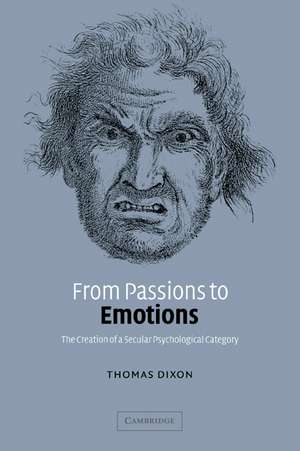
From Passions to Emotions: The Creation of a Secular Psychological Category
Autor Thomas Dixonen Limba Engleză Paperback – 31 mai 2006
Destinat studenților în psihologie, cercetătorilor din istoria ideilor și practicienilor interesați de fundamentele conceptuale ale disciplinei, volumul From Passions to Emotions oferă o perspectivă critică asupra modului în care ne conceptualizăm viața interioară. Ne-a atras atenția teza provocatoare a lui Thomas Dixon: ideea că „emoțiile”, așa cum le înțelegem astăzi, sunt o construcție seculară relativ recentă, apărută în secolul al XIX-lea pentru a înlocui un vocabular teologic și filosofic mult mai nuanțat, format din pasiuni, pofte și sentimente.
Observăm cum autorul reconstruiește riguros acest proces de transformare, plasând lucrările lui Charles Darwin și William James într-un context mult mai larg decât cel oferit de istoriile clasice ale psihologiei. Merită menționat că Dixon nu se limitează la o simplă cronologie, ci argumentează că această „industrie a emoțiilor” contemporană, deși prosperă, suferă de o supra-incluziune care ne împiedică să discutăm cu finețe despre raționalitate și stările mentale. Cartea reprezintă o alternativă necesară la Thinking about the Emotions de Alix Cohen pentru cursurile de istoria psihologiei sau filosofia minții, având avantajul unei analize focalizate pe momentul precis al secularizării limbajului psihologic și pe influența instituțiilor religioase asupra științei moderne.
În contextul operei sale, această lucrare fundamentează temele explorate ulterior în The History of Emotions, oferind detaliile academice și studiile de caz pe care se bazează sintezele sale mai recente. Stilul este academic, dens în informație factuală, dar structurat clar, fiind esențial pentru oricine dorește să înțeleagă de ce gândim despre simțire în termenii biologici actuali.
Preț: 208.79 lei
Carte tipărită la comandă
Livrare economică 11-25 iunie
Specificații
ISBN-10: 0521026695
Pagini: 300
Ilustrații: black & white illustrations
Dimensiuni: 154 x 229 x 19 mm
Greutate: 0.44 kg
Editura: Cambridge University Press
Colecția Cambridge University Press
Locul publicării:Cambridge, United Kingdom
V-ar putea interesa
-
 The Proper Study Of MankindIsaiah Berlin-34%Preț: 147.86 lei225.16 lei
 -
 Two Girls, One on Each KneeAlan ConnorPreț: 88.77 lei
 -
 Rationalism, Pluralism, and FreedomJacob T. Levy-30%Preț: 392.90 lei563.90 lei
 -
 Peter of Spain: Summaries of Logic: Text, Translation, Introduction, and NotesBrian P. Copenhaver-37%Preț: 879.23 lei1396.99 lei
 -
 -27%Preț: 576.55 lei784.51 lei
 -
 Kant and Rational PsychologyCorey W. Dyck-34%Preț: 574.46 lei864.96 lei
 -
 -30%Preț: 394.11 lei559.14 lei
 -
 Articulating Medieval LogicTerence Parsons-22%Preț: 652.21 lei838.02 lei
 -
 Foundations of Modern International ThoughtDavid ArmitagePreț: 193.40 lei
 -
 Preț: 375.29 lei
 -
 Kant on Representation and ObjectivityA. B. DickersonPreț: 290.56 lei
 -
 Essays on Kant's AnthropologyBrian JacobsPreț: 341.75 lei
 -
 Lectures on the Philosophy of World HistoryGeorg Wilhelm Friedrich HegelPreț: 270.86 lei
 -
 Hegelianism: The Path Toward Dialectical Humanism, 1805–1841John Edward ToewsPreț: 287.49 lei
 -
 -14%Preț: 768.72 lei893.86 lei
 -
 'Tis Nature's Fault: Unauthorized Sexuality during the EnlightenmentRobert Purks MaccubbinPreț: 296.35 lei
 -
 Preț: 367.53 lei
 -
 -18%Preț: 1254.98 lei1530.46 lei
 -
 The $1.75 Guardian AngelThomas DixonPreț: 45.44 lei
De ce să citești această carte
Această carte este esențială pentru cititorul care dorește să treacă dincolo de clișeele psihologiei populare. Veți câștiga o înțelegere profundă a modului în care limbajul științific a absorbit și transformat concepte religioase vechi de secole. Este o recomandare certă pentru cei care studiază evoluția conceptelor și vor să descopere cum „pasiunile” de altădată au devenit „emoțiile” de astăzi sub bisturiul istoriei și al neuroștiințelor.
Despre autor
Thomas Dixon este un distins istoric al ideilor și profesor, cunoscut pentru cercetările sale asupra intersecției dintre știință, religie și emoții. În lucrări precum Weeping Britannia, el a explorat istoria culturală a plânsului în Marea Britanie, demontând mituri despre stoicismul național. Expertiza sa în transformările conceptuale ale secolului al XIX-lea este dublată de o capacitate remarcabilă de a sintetiza dezbateri complexe pentru publicul larg, contribuția sa la seria „Very Short Introductions” cu volumul Science and Religion fiind o dovadă a autorității sale în domeniu. Activitatea sa academică este marcată de o rigoare documentară care ancorează fenomenele psihologice în realități istorice și sociale concrete.
Descriere scurtă
Cuprins
Recenzii
'From Passions to Emotions will be consulted for a long time … not least because it is an important contribution to the history of several fields … Dixon has reduced the main issues to their essences, and one cannot imagine the task having been better accomplished by others.' History of Psychiatry
'In a series of closely argued and well-documented chapters, Dixon shows that this category had no equivalent in earlier discourse … Dixon clearly demonstrates that 'emotion' constitutes a specifically modern discursive construction rather than an analogue of some ancient psychological category …Dixon presents a superb analysis of the interrelationship between the historical fate of the will and the passions … Measured against the sharper, more differentiated analysis presented this book, the conventional understanding of 'emotion' begins to look like a very blunt instrument. Dixon's contribution is not 'merely' historical; it has considerable relevance for contemporary attempts to achieve a richer conceptualisation of affective life.' Journal of the History of the Behavioral Sciences
'From Passions to Emotions offers a cogent, and I think, convincing argument on an issue of crucial public interest. It is a piece of good old-fashioned intellectual history …'. Galton Institute Newsletter
'… a most significant and most interesting contribution both to the history of psychology and to the study of relations between the modern scientific world view and religion. … it will substantially alter how writers refer to the history of what we loosely call the 'feelings'. … There has been little systematic history of the 'emotions' before this book, and this book provides a new and firm reference point. … [there] is a much-needed seriousness about the centrality, complexity and subtlety of interrelations between religion and psychology. There is no doubt that ignorance, indifference or antagonism to religion has marked the history of this field. Here we now have a model study that shows what is involved in overcoming this limitation. … very valuable scholarship and persusasive clarity …' British Journal of the History of Science