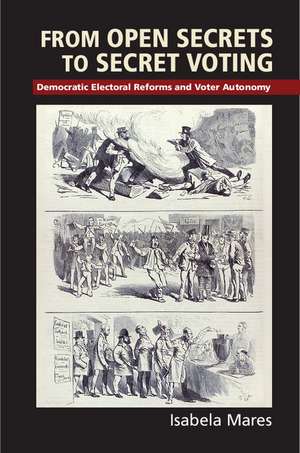
From Open Secrets to Secret Voting
Autor Isabela Maresen Limba Engleză Paperback – 18 iun 2015
Preț: 260.01 lei
Puncte Express: 390
Carte tipărită la comandă
Livrare economică 07-21 decembrie
Livrare prin curier în România Termenul estimat este afișat lângă disponibilitate.
Transport gratuit de la 400.00 lei Plată online sau ramburs, în funcție de opțiunile comenzii.
Retur gratuit în 14 zile Comandă securizată și suport în română.
Specificații
ISBN-13: 9781107495296
ISBN-10: 1107495296
Pagini: 290
Ilustrații: 17 b/w illus. 2 maps 30 tables
Dimensiuni: 152 x 229 x 17 mm
Greutate: 0.47 kg
Editura: Cambridge University Press
Locul publicării:New York, United States
ISBN-10: 1107495296
Pagini: 290
Ilustrații: 17 b/w illus. 2 maps 30 tables
Dimensiuni: 152 x 229 x 17 mm
Greutate: 0.47 kg
Editura: Cambridge University Press
Locul publicării:New York, United States
V-ar putea interesa
-
 -31%Preț: 742.50 lei1072.02 lei
 -
 -31%Preț: 826.04 lei1191.14 lei
 -
 America's Supreme Court: Making Democracy WorkStephen Breyer-11%Preț: 348.83 lei391.44 lei
 -
 Preț: 340.53 lei
 -
 Competing SovereigntiesRichard Joyce-18%Preț: 1257.96 lei1534.10 lei
 -
 Preț: 274.66 lei
 -
 Ruling EuropeMartin HeipertzPreț: 305.45 lei
 -
 PlatoPlatoPreț: 153.27 lei
 -
 The Cambridge Companion to Plato's RepublicG. R. F. FerrariPreț: 367.73 lei
 -
 The Rise and Decline of the StateMartin Van CreveldPreț: 311.81 lei
 -
 Understanding Russian PoliticsStephen WhitePreț: 558.45 lei
 -
 The Power of American GovernorsThad KousserPreț: 248.50 lei
 -
 The President's Legislative Policy Agenda, 1789-2002Jeffrey E. Cohen-23%Preț: 216.14 lei279.73 lei
 -
 Preț: 281.63 lei
 -
 -27%Preț: 1598.60 lei2182.52 lei
 -
 Preț: 26.72 lei
Cuprins
1. Introduction; 2. The protection of voters' autonomy; 3. Electoral intimidation by state employees; 4. Electoral intimidation by private actors; 5. The production of irregularities at times of elections: a quantitative analysis; 6. The adoption of electoral reforms; 7. Labor scarcity, rural inequality, and electoral reforms: the determinants for electoral reform of the Prussian electoral system; 8. Voting for opposition candidates: economic concentration, skills, and political support for social democracy; 9. Dilemmas on the right and the road to proportional representation; 10. From macro- to micro-historical analysis in comparative research.
Recenzii
'An admirable piece of work that combines an impressive knowledge of German nineteenth-century history with skillful archival research and an astonishing command of quantitative methods. I find the idea of voter intimidation and the costs of voter repression as leading terms in a local-level quantitative analysis of electoral practices and reforms in an emerging nation-state a major step forward in the analysis of institutional change. The way the book moves between qualitative narratives of historical local conditions and sophisticated quantitative analyses is exemplary and sets a standard for social science taking history seriously.' Wolfgang Streeck, Max Planck Institute for the Study of Societies
Descriere
This book presents an account of the adoption of electoral reforms democratizing electoral practices in nineteenth century European countries.