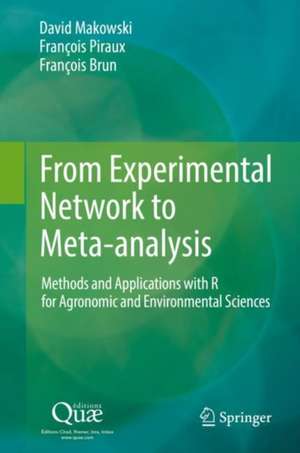
From Experimental Network to Meta-analysis
Autor David Makowski, François Piraux, François Brunen Limba Engleză Hardback – 17 mai 2019
Preț: 948.68 lei
Preț vechi: 1156.93 lei
-18%
Puncte Express: 1423
Carte disponibilă
Livrare economică 23 iulie-06 august
Livrare prin curier în România Termenul estimat este afișat lângă disponibilitate.
Transport gratuit pentru acest produs Plată online sau ramburs, în funcție de opțiunile comenzii.
Retur gratuit în 14 zile Comandă securizată și suport în română.
Specificații
ISBN-13: 9789402416954
ISBN-10: 9402416951
Pagini: 168
Ilustrații: X, 155 p. 69 illus., 43 illus. in color.
Dimensiuni: 160 x 241 x 15 mm
Greutate: 0.46 kg
Ediția:1st ed. 2019
Editura: Springer
Locul publicării:Dordrecht, Netherlands
ISBN-10: 9402416951
Pagini: 168
Ilustrații: X, 155 p. 69 illus., 43 illus. in color.
Dimensiuni: 160 x 241 x 15 mm
Greutate: 0.46 kg
Ediția:1st ed. 2019
Editura: Springer
Locul publicării:Dordrecht, Netherlands
V-ar putea interesa
-
 Research Methods for the BiosciencesDebbie Holmes-21%Preț: 398.31 lei507.09 lei
 -
 -30%Preț: 298.15 lei428.03 lei
 -
 The Statistical Analysis of Small Data SetsMarkus Neuhäuser-13%Preț: 316.14 lei362.97 lei
 -
 Preț: 451.34 lei
 -
 Preț: 407.27 lei
 -
 -9%Preț: 1345.99 lei1479.11 lei
 -
 Starting out in StatisticsPatricia De WinterPreț: 295.82 lei
 -
 Preț: 383.69 lei
 -
 R-TiculateMartin Bader-23%Preț: 645.14 lei837.85 lei
 -
 Statistical Analysis with R For DummiesJoseph Schmuller-20%Preț: 143.09 lei178.87 lei
 -
 Statistical Analysis with Python For DummiesJoseph SchmullerPreț: 194.24 lei
 -
 -26%Preț: 653.90 lei883.65 lei
 -
 A Primer of Ecological StatisticsNicholas J. Gotelli-27%Preț: 818.25 lei1120.89 lei
 -
 Data Analysis in Vegetation EcologyOtto WildiPreț: 410.72 lei
 -
 Preț: 405.98 lei
 -
 Meta-Analysis for PsychologistsRichard Cooke-5%Preț: 269.83 lei284.03 lei
 -
 Statistics for ScientistsUmberto Michelucci-20%Preț: 275.88 lei344.84 lei
Cuprins
Chapter 1. Introduction and examples.- Part I. Analysis of experimental networks.- Chapter 2. Basic Concepts.- Chapter 3. Analysis of network of experiments in blocks of complete randomness as a studied factor.- Chapter 4. Advanced Methods for Network Analysis.- Chapter 5. Planning an Experimental Network.- Part II. The meta-analysis.- Chapter 6. Basics for meta-analysis.- Chapter 7. Specific statistical problems for the meta-analysis.- Annex. R resources to implement the methods of analysis networks and meta-analysis.- Package Codes.
Recenzii
“I would recommend the Meta-analysis in medical research book, or the R meta-analysis tutorials that compare different R packages.” (Ramzi El Feghali, ISCB News, iscb.info, Issue 69, July, 2020)
Textul de pe ultima copertă
Data analysis plays an increasing role in research, scientific expertise and prospective studies. Multiple data sources are often available to estimate a key parameter or to test a hypothesis of scientific or societal interest. These data, obtained under different environmental conditions or based on different experimental protocols, are generally heterogeneous. Sometimes they are not even directly accessible and should be extracted from scientific articles or reports. However, a comprehensive analysis of the available data is essential to increase the accuracy of estimates, assess the validity of research conclusions and understand the origin of the variability of the experimental results. A quantitative synthesis of the data set available allows for a better understanding of the effects of explanatory factors and for evidence-based recommendations.
Designed as a methodological guide, this book shows the interests and limitations of different statistical methods to analyze data from experimental networks and to perform meta-analyses. It is intended for engineers, students and researchers involved in data analysis in agronomy and environmental science. Our objective is to present the main statistical methods to analyze data from experimental networks and scientific publications. Each chapter exposes one or more methods and illustrates them with examples processed with the R software. Data and R codes are provided and commented in order to facilitate their adaptation to other situations. The codes can be reused from the KenSyn R package associated with this book.
Designed as a methodological guide, this book shows the interests and limitations of different statistical methods to analyze data from experimental networks and to perform meta-analyses. It is intended for engineers, students and researchers involved in data analysis in agronomy and environmental science. Our objective is to present the main statistical methods to analyze data from experimental networks and scientific publications. Each chapter exposes one or more methods and illustrates them with examples processed with the R software. Data and R codes are provided and commented in order to facilitate their adaptation to other situations. The codes can be reused from the KenSyn R package associated with this book.