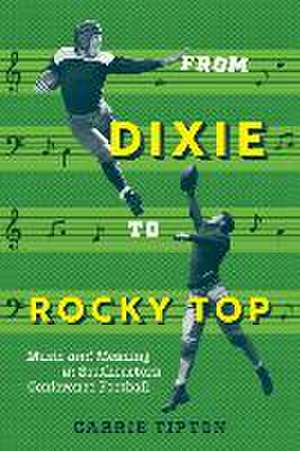
From Dixie to Rocky Top: Music and Meaning in Southeastern Conference Football
Autor Carrie Tiptonen Limba Engleză Paperback – 15 oct 2023
The first book to explore the history of college fight songs as a culturally important phenomenon, From Dixie to Rocky Top zeroes in on the US South, where college football has forged a powerful, quasi-religious sense of meaning and identity throughout the region.
Tracing the story of Southeastern Conference (SEC) fight songs from the late nineteenth to the early twenty-first century, author Carrie Tipton places this popular repertory within the broader commercial music industry and uses fight songs to explore themes of authorship and copyright; the commodification of school spirit; and the construction of race, gender, and regional identity in Southern football culture.
This book unearths the history embedded in SEC football’s music traditions, drawing from the archives of the seventeen universities currently or formerly in the conference. Alongside rich primary sources, Tipton incorporates approaches and literature from sports history, Southern and American history, Southern and American studies, and musicology.
Chronicling iconic Southern fight songs’ origins, dissemination, meanings, and cultural reception over a turbulent century, From Dixie to Rocky Top weaves a compelling narrative around a virtually unstudied body of popular music.
| Toate formatele și edițiile | Preț | Express |
|---|---|---|
| Paperback (1) | 200.65 lei 3-5 săpt. | |
| Vanderbilt University Press – 15 oct 2023 | 200.65 lei 3-5 săpt. | |
| Hardback (1) | 706.40 lei 39-44 zile | |
| Vanderbilt University Press – 15 oct 2023 | 706.40 lei 39-44 zile |
Preț: 200.65 lei
Puncte Express: 301
Preț estimativ în valută:
35.51€ • 41.50$ • 30.83£
35.51€ • 41.50$ • 30.83£
Carte disponibilă
Livrare economică 29 ianuarie-12 februarie
Preluare comenzi: 021 569.72.76
Specificații
ISBN-13: 9780826506399
ISBN-10: 0826506399
Pagini: 320
Dimensiuni: 152 x 229 x 16 mm
Greutate: 0.42 kg
Editura: Vanderbilt University Press
Colecția Vanderbilt University Press
ISBN-10: 0826506399
Pagini: 320
Dimensiuni: 152 x 229 x 16 mm
Greutate: 0.42 kg
Editura: Vanderbilt University Press
Colecția Vanderbilt University Press
Recenzii
"Amid yet another conference realignment saga, Tipton offers a vibrant, timely reminder of how the SEC's boisterous fight songs and rally cries remain steeped in a regional specificity comprised of far more than the pageantry, precision, and patriarchy of Southern football culture."
—Courtney M. Cox, co-director of The Sound of Victory: Music, Sport, and Society
"From Dixie to Rocky Top is the book about Southeastern Conference football that you never knew you needed. Carrie Tipton’s examination of the evolution of the music sung and played at football games, and which became an integral part of college culture, is eye opening history. As she demonstrates, this genre of music was not always benign. “Dixie,” for example, was both an expression of the Lost Cause and a bulwark to racial inclusivity. The book's significance is tied to the fact that Tipton takes popular music seriously. From minstrelsy to ragtime and beyond, music derived from popular culture connected people to one another and to the colleges and football teams she writes about. From Dixie to Rocky Top is also accessible and entertaining, so it surely will find an audience with the larger public, as well as a place in college classrooms."
—Karen L. Cox, author of Dreaming of Dixie: How the South Was Created in American Popular Culture
"Tipton has written a book that challenges accepted stories, complicates received wisdom, and situates an important repertoire within US popular culture of the last century or more."
—Travis D. Stimeling, author of Nashville Cats: Record Production in Music City
—Courtney M. Cox, co-director of The Sound of Victory: Music, Sport, and Society
"From Dixie to Rocky Top is the book about Southeastern Conference football that you never knew you needed. Carrie Tipton’s examination of the evolution of the music sung and played at football games, and which became an integral part of college culture, is eye opening history. As she demonstrates, this genre of music was not always benign. “Dixie,” for example, was both an expression of the Lost Cause and a bulwark to racial inclusivity. The book's significance is tied to the fact that Tipton takes popular music seriously. From minstrelsy to ragtime and beyond, music derived from popular culture connected people to one another and to the colleges and football teams she writes about. From Dixie to Rocky Top is also accessible and entertaining, so it surely will find an audience with the larger public, as well as a place in college classrooms."
—Karen L. Cox, author of Dreaming of Dixie: How the South Was Created in American Popular Culture
"Tipton has written a book that challenges accepted stories, complicates received wisdom, and situates an important repertoire within US popular culture of the last century or more."
—Travis D. Stimeling, author of Nashville Cats: Record Production in Music City
Notă biografică
Carrie Tipton is a musicologist who writes, teaches, and lectures about US vernacular music.
Extras
Fight songs are the most potent and portable of these “shared emblems and experiences,” audible “signs and symbols” of college football culture. Historically disseminated through the dominant channels of the music industry in any given era—sheet music, live performances, recordings, radio, television—fight songs have long moved beyond the boundaries of campus life. In the football-haunted South, these songs have become the hymns of a regional college football culture that scholar Eric Bain-Selbo describes as a religion, the soundtrack of a region that regards sports as “central” to its “modern…identity.”
Despite the significance of college fight songs in southern culture, and U.S. culture more broadly, they figure minimally in academic research. Mentions of fight songs in college football scholarship tend toward the anecdotal and brief: quoting lyrics; stating bare facts of a song’s composition; describing a song’s affective power
In contrast, this book treats SEC fight songs as a cohesive repertory, geographically and historically contingent, bound not by common musical style but by the political, social, and cultural investments of the white South from the late nineteenth to the late twentieth centuries and situated within broader U.S. commercial music history.
Despite the significance of college fight songs in southern culture, and U.S. culture more broadly, they figure minimally in academic research. Mentions of fight songs in college football scholarship tend toward the anecdotal and brief: quoting lyrics; stating bare facts of a song’s composition; describing a song’s affective power
In contrast, this book treats SEC fight songs as a cohesive repertory, geographically and historically contingent, bound not by common musical style but by the political, social, and cultural investments of the white South from the late nineteenth to the late twentieth centuries and situated within broader U.S. commercial music history.
Cuprins
Acknowledgements
Introduction
Chapter One: “Hideous with Unearthly Noises”: Early Football Sounds and Spaces
Chapter Two: Songs of the South: Football Music and the Lost Cause
Chapter Three: Who Wrote This? Authorship and Copyright in Two Early Fight Songs
Chapter Four: The Song That Changed Everything and the Man Who Published It: Thornton W. Allen and the “Washington and Lee Swing” (1910)
Chapter Five: Where Are All the Ladies At?
Chapter Six: Southern Fight Songs in the Jazz Age
Chapter Seven: The Business of College Songs in the 1930s
Chapter Eight: Make It Hot: Pushing for Pep in the 1930s
Chapter Nine: Huey Long’s Band Plays His Songs
Chapter Ten: Three Postwar Fight Songs
Chapter Eleven: What Fades and What Remains
Epilogue: Overtime
Appendix: College Songs Published, Written, or Copyrighted by Thornton W. Allen
Notes
Bibliography
Index
Introduction
Chapter One: “Hideous with Unearthly Noises”: Early Football Sounds and Spaces
Chapter Two: Songs of the South: Football Music and the Lost Cause
Chapter Three: Who Wrote This? Authorship and Copyright in Two Early Fight Songs
Chapter Four: The Song That Changed Everything and the Man Who Published It: Thornton W. Allen and the “Washington and Lee Swing” (1910)
Chapter Five: Where Are All the Ladies At?
Chapter Six: Southern Fight Songs in the Jazz Age
Chapter Seven: The Business of College Songs in the 1930s
Chapter Eight: Make It Hot: Pushing for Pep in the 1930s
Chapter Nine: Huey Long’s Band Plays His Songs
Chapter Ten: Three Postwar Fight Songs
Chapter Eleven: What Fades and What Remains
Epilogue: Overtime
Appendix: College Songs Published, Written, or Copyrighted by Thornton W. Allen
Notes
Bibliography
Index
Descriere
The seismic social, economic, and cultural shifts that unfolded in the South in the twentieth century, as reflected through the history of SEC football fight songs