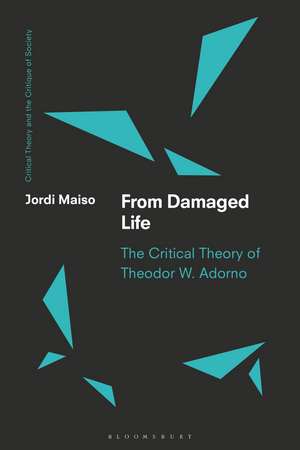
From Damaged Life: The Critical Theory of Theodor W. Adorno: Critical Theory and the Critique of Society
Autor Dr. Jordi Maisoen Limba Engleză Paperback – 17 sep 2026
This certainty - that the conditions governing existence in contemporary societies generate irretrievably damaged lives - lies at the heart of Theodor W. Adorno's critical theory. Emerging from the historical experience of fascism, Auschwitz, and the consolidation of advanced capitalism, Adorno's thought articulates critique from within a damaged reality.
Under the coercion of overwhelming social powers, individual character is constituted as a "system of scars". This notion of "damaged life" stands at the center of this book, which frames critique as emerging from a reality scarred by systemic coercion. It reconstructs Adorno's critical theory as an analysis of the new state of unfreedom linked to total socialization, the anthropological reshaping of subjectivity under advanced capitalism, and the very possibility of critique.
Jordi Maiso's analysis spans key themes: the constellation of fascism and advanced capitalism, the culture industry's role in shaping consciousness, and the persistence of authoritarian potential in everyday life. Revisiting Adorno's conception of critique as a "science of mourning" and his insistence on determinate negation, the book shows how critical thought confronts a historical moment in which emancipatory horizons appear blocked yet remain necessary.
Both historical and urgent, From Damaged Life: The Critical Theory of Theodor W. Adorno interrogates the persistence of fear, heteronomy, and avoidable suffering. It asks whether, under conditions marked by authoritarian regression and damaged subjectivity, critical theory can still resist resignation and keep the possibility of transformation alive.





Preț: 172.01 lei
Nou
Puncte Express: 258
Carte disponibilă
Livrare economică 13-27 noiembrie
Livrare express 29 octombrie-04 noiembrie pentru 36.55 lei
Livrare prin curier în România Termenul estimat este afișat lângă disponibilitate.
Transport gratuit de la 400.00 lei Plată online sau ramburs, în funcție de opțiunile comenzii.
Retur gratuit în 14 zile Comandă securizată și suport în română.
Specificații
ISBN-13: 9781350562783
ISBN-10: 1350562785
Pagini: 352
Dimensiuni: 154 x 232 x 22 mm
Greutate: 0.45 kg
Editura: Bloomsbury Publishing
Colecția Bloomsbury Academic
Seria Critical Theory and the Critique of Society
Locul publicării:London, United Kingdom
ISBN-10: 1350562785
Pagini: 352
Dimensiuni: 154 x 232 x 22 mm
Greutate: 0.45 kg
Editura: Bloomsbury Publishing
Colecția Bloomsbury Academic
Seria Critical Theory and the Critique of Society
Locul publicării:London, United Kingdom
Cuprins
Introduction
Part One: The Core of Experience and the Coordinates of Critique
Critical Theory as a "Science of Mourning"
I. RESIGNATION? HISTORY, EMANCIPATION AND BARBARISM
"After Auschwitz"
"Where is the proletariat?"
"From the standpoint of redemption"
II. DOES IT NOT HURT TO BE DEVOURED? THE POSITION OF THE CRITICAL INTELLECTUAL
The fragile nonconformity of the spirit
Art as a battlefield
Critical theory and praxis
III. A FAREWELL TO MARX? UNRAVELING CONTEMPORARY PREHISTORY
The "unity of an epoch": Capitalism and fascism
Protohistory of contemporary prehistory
Absolutized self-preservation
Part Two: ADORNO AND THE CRITICAL THEORY OF CAPITALISM
In the Labyrinth of the Social Constitution
IV. A NEW STATE OF UNFREEDOM: THE LOGIC OF CAPITALIST SOCIALIZATION
Capitalist society as a "system": a twist on totality
Capitalism as "natural history"
A social whole with no outside: "Total socialization"
V. CULTURE INDUSTRY: INTEGRATION AS MASS DECEPTION
The social location of culture
The culture industry as an instance of socialization
The "deception" of the culture industry and its limits
VI. TOWARDS A NEW TYPE OF HUMAN BEING: ANTHROPOLOGICAL TRANSFORMATION OF ADVANCED CAPITALISM
The historical decline of the individual and the sacrifice of the living
Traits of the "new type of human being"
Contradiction in the subject and the role of psychoanalysis
VII. STATES OF CONSCIOUSNESS AND UNCONSCIOUSNESS: THE NEW FIGURE OF IDEOLOGY
Sociality and appearance: The transformation of ideology
Critique of ideology and analysis of the self
"Normal monsters": The persistent potential of authoritarianism
Coda: "THE LIMIT OF REIFICATION": ADORNO AND LATE CAPITALISM TODAY
Part One: The Core of Experience and the Coordinates of Critique
Critical Theory as a "Science of Mourning"
I. RESIGNATION? HISTORY, EMANCIPATION AND BARBARISM
"After Auschwitz"
"Where is the proletariat?"
"From the standpoint of redemption"
II. DOES IT NOT HURT TO BE DEVOURED? THE POSITION OF THE CRITICAL INTELLECTUAL
The fragile nonconformity of the spirit
Art as a battlefield
Critical theory and praxis
III. A FAREWELL TO MARX? UNRAVELING CONTEMPORARY PREHISTORY
The "unity of an epoch": Capitalism and fascism
Protohistory of contemporary prehistory
Absolutized self-preservation
Part Two: ADORNO AND THE CRITICAL THEORY OF CAPITALISM
In the Labyrinth of the Social Constitution
IV. A NEW STATE OF UNFREEDOM: THE LOGIC OF CAPITALIST SOCIALIZATION
Capitalist society as a "system": a twist on totality
Capitalism as "natural history"
A social whole with no outside: "Total socialization"
V. CULTURE INDUSTRY: INTEGRATION AS MASS DECEPTION
The social location of culture
The culture industry as an instance of socialization
The "deception" of the culture industry and its limits
VI. TOWARDS A NEW TYPE OF HUMAN BEING: ANTHROPOLOGICAL TRANSFORMATION OF ADVANCED CAPITALISM
The historical decline of the individual and the sacrifice of the living
Traits of the "new type of human being"
Contradiction in the subject and the role of psychoanalysis
VII. STATES OF CONSCIOUSNESS AND UNCONSCIOUSNESS: THE NEW FIGURE OF IDEOLOGY
Sociality and appearance: The transformation of ideology
Critique of ideology and analysis of the self
"Normal monsters": The persistent potential of authoritarianism
Coda: "THE LIMIT OF REIFICATION": ADORNO AND LATE CAPITALISM TODAY
Recenzii
The publication in English of Jordi Maiso's book on the thought of Theodor W. Adorno is an event to be welcomed by scholars of Marx, Marxism and Critical theory.
In this book, Jordi Maiso brings the temporal core of truth in Adorno's Critical Theory to light, opening up a privileged path of knowledge through his work
From the Spanish-speaking world arrives the finest book on Adorno in a generation. Jordi Maiso restores Adorno to the center of Critical Theory, one focused on the global social reproduction of life and capital. Sophisticated, precise, and urgently timely
Between antebellum and postbellum we are now located dead center, post prefix: at bellum. The United States has shouldered the mantel of the most dangerous nation on earth, bristling with legalized hostility to itself, to its own population who are disappeared and murdered, and flaunting invasion the world over. The destruction of the environment has been raised to presidential Diktat. In horror, we know we have been here before, and must ask whether there has ever been anything but. This is the thesis of Jordi Maiso's brilliant, closely studied new work, From Damaged Life. That Adorno's reflections may seem lapsed, Maiso writes, is a kind of optical illusion. For the inheritance of our day is nothing but every defeat that befell Adorno's own. From this perspective Maiso presents a carefully reasoned, unified account of Adorno's work, unprecedented in English, that means to speak closely to a world face-to-face with the spectre of despair. From Damaged Life is an impressive, admirable work, the result of years of research and commitment, from which there is much to learn.
Jordi Maiso is doubtless one of the foremost Critical Theorists in the Spanish-speaking world. It is therefore so crucial to have his brilliant book available in English translation. It's a profoundly refreshing alternative to the dominant Anglophone approaches increasingly obsessed with the question of normativity in Adorno's thought. Maiso rescues Teddie from his "devotees" by contending that Adorno's philosophy, which once seemed obsolete as a result of its recent domestication, lives on because the nihilistic conditions of late capitalism that produced it have, in recent, years only deepened and intensified at the global level.
In this book, Jordi Maiso brings the temporal core of truth in Adorno's Critical Theory to light, opening up a privileged path of knowledge through his work
From the Spanish-speaking world arrives the finest book on Adorno in a generation. Jordi Maiso restores Adorno to the center of Critical Theory, one focused on the global social reproduction of life and capital. Sophisticated, precise, and urgently timely
Between antebellum and postbellum we are now located dead center, post prefix: at bellum. The United States has shouldered the mantel of the most dangerous nation on earth, bristling with legalized hostility to itself, to its own population who are disappeared and murdered, and flaunting invasion the world over. The destruction of the environment has been raised to presidential Diktat. In horror, we know we have been here before, and must ask whether there has ever been anything but. This is the thesis of Jordi Maiso's brilliant, closely studied new work, From Damaged Life. That Adorno's reflections may seem lapsed, Maiso writes, is a kind of optical illusion. For the inheritance of our day is nothing but every defeat that befell Adorno's own. From this perspective Maiso presents a carefully reasoned, unified account of Adorno's work, unprecedented in English, that means to speak closely to a world face-to-face with the spectre of despair. From Damaged Life is an impressive, admirable work, the result of years of research and commitment, from which there is much to learn.
Jordi Maiso is doubtless one of the foremost Critical Theorists in the Spanish-speaking world. It is therefore so crucial to have his brilliant book available in English translation. It's a profoundly refreshing alternative to the dominant Anglophone approaches increasingly obsessed with the question of normativity in Adorno's thought. Maiso rescues Teddie from his "devotees" by contending that Adorno's philosophy, which once seemed obsolete as a result of its recent domestication, lives on because the nihilistic conditions of late capitalism that produced it have, in recent, years only deepened and intensified at the global level.