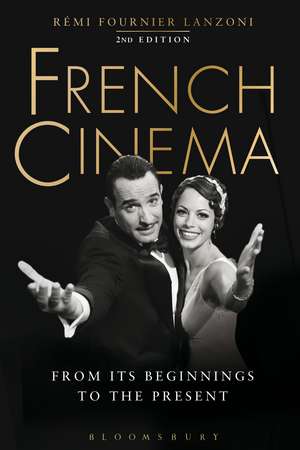
French Cinema: From Its Beginnings to the Present
Autor Rémi Fournier Lanzonien Limba Engleză Paperback – 22 oct 2015
Preț: 285.26 lei
Preț vechi: 367.54 lei
-22%
Puncte Express: 428
Carte disponibilă
Livrare economică 06-20 noiembrie
Livrare prin curier în România Termenul estimat este afișat lângă disponibilitate.
Transport gratuit de la 400.00 lei Plată online sau ramburs, în funcție de opțiunile comenzii.
Retur gratuit în 14 zile Comandă securizată și suport în română.
Specificații
ISBN-13: 9781501303074
ISBN-10: 1501303074
Pagini: 632
Ilustrații: 100 bw illus
Dimensiuni: 152 x 230 x 30 mm
Greutate: 0.94 kg
Ediția:2 Rev ed.
Editura: Bloomsbury Publishing
Colecția Bloomsbury Academic
Locul publicării:New York, United States
ISBN-10: 1501303074
Pagini: 632
Ilustrații: 100 bw illus
Dimensiuni: 152 x 230 x 30 mm
Greutate: 0.94 kg
Ediția:2 Rev ed.
Editura: Bloomsbury Publishing
Colecția Bloomsbury Academic
Locul publicării:New York, United States
V-ar putea interesa
-
 -10%Preț: 386.28 lei428.93 lei
 -
 French Cinema: A Student's GuidePhil Powrie-16%Preț: 243.11 lei287.83 lei
 -
 Reel Power: Hollywood Cinema and American SupremacyMatthew AlfordPreț: 281.20 lei
 -
 Seeing is BelievingPeter Biskind-27%Preț: 89.02 lei121.61 lei
 -
 Discover Your Scottish AncestryGraham Holton-8%Preț: 147.80 lei160.65 lei
 -
 Deleuze and FilmDavid Martin-Jones-16%Preț: 212.88 lei252.00 lei
 -
 Cinema IGilles Deleuze-48%Preț: 317.74 lei611.69 lei
 -
 Quentin Tarantino's Inglourious Basterds: A Manipulation of MetacinemaProfessor or Dr. Robert von Dassanowsky-16%Preț: 181.35 lei216.37 lei
 -
 Why We Make ArtRichard HickmanPreț: 207.50 lei
 -
 Preț: 258.96 lei
 -
 -32%Preț: 162.83 lei239.36 lei
 -
 -19%Preț: 301.92 lei373.23 lei
Cuprins
List of Illustrations
Introduction
Chapter 1: The Invention of Motion Pictures and the Silent Era of Film
Chapter 2: The Golden Age of French Cinema
Chapter 3: French Cinema of the Occupation
Chapter 4: The Postwar Era
Chapter 5: The Years of the French New Wave
Chapter 6: French Cinema of the 1970s
Chapter 7: French Cinema of the 1980s
Chapter 8: French Cinema in the Fin De Siècle
Chapter 9: The New Millennium
Abbreviations
Appendix
Notes
Select Bibliography
Index
Introduction
Chapter 1: The Invention of Motion Pictures and the Silent Era of Film
Chapter 2: The Golden Age of French Cinema
Chapter 3: French Cinema of the Occupation
Chapter 4: The Postwar Era
Chapter 5: The Years of the French New Wave
Chapter 6: French Cinema of the 1970s
Chapter 7: French Cinema of the 1980s
Chapter 8: French Cinema in the Fin De Siècle
Chapter 9: The New Millennium
Abbreviations
Appendix
Notes
Select Bibliography
Index
Recenzii
Rémi Fournier Lanzoni's French Cinema. From Its Beginnings to the Present had already established itself as the authoritative reader for anyone serious about teaching and studying French cinema. This second edition not only brings us up to date the significant French films produced since the beginning of the twenty first century but it also provides welcome and much needed sub chapters dealing with French women filmmakers, Beur cinema, and the recent international accomplishments of French cinema. Written in an engaging, jargon free, and reader friendly style, Lanzoni's book succeeds in connecting the history of French cinema to the history of France, its peoples, and its institutions.
The new edition of French Cinema brings us into the new millennium, as it sheds light on the new generation of directors, their diversity, freedom of expression, their use of new mediums to bring international success to French films. It is captivating. The historical, social and political background presented at the head of each chapter gives a deep understanding of the films and the directors. This book is the perfect companion for film students, professors, as well as anyone who loves cinema.
Fournier Lanzoni (Wake Forest) updates the first edition of this model history of French cinema (CH, Sep'03, 41-0198) with an 84-page chapter titled 'The New Millennium.' As in the earlier edition, he summarizes the changing social, political, industrial, and technical contexts of the films. After a review of pioneering French women directors, he focuses on the controversial work of Catherine Breillat and Virginie Despentes, and on Noémie Lvovaky's less steamy and more complex narratives. Especially timely is his introduction to beur cinema (i.e., work by second-generation filmmakers of Maghrebi descent), politically aware examinations of France's colonial past and its present citizens' tension between integration and ethnic diversity. He surveys Abdellatif Kechiche's dramas of the banlieue and Rachid Bouchareb's reworking of French history. Fournier Lanzoni concludes with the nation's reemergence on the international scene, as exemplified by Michel Hazanavicius's Oscar-winning silent The Artist. Updated appendixes include France's Cannes award winners, the César Awards, box office toppers, and the country's successes at the Oscars. This second edition replaces the first. Summing Up: Recommended. All readers.
The new edition of French Cinema brings us into the new millennium, as it sheds light on the new generation of directors, their diversity, freedom of expression, their use of new mediums to bring international success to French films. It is captivating. The historical, social and political background presented at the head of each chapter gives a deep understanding of the films and the directors. This book is the perfect companion for film students, professors, as well as anyone who loves cinema.
Fournier Lanzoni (Wake Forest) updates the first edition of this model history of French cinema (CH, Sep'03, 41-0198) with an 84-page chapter titled 'The New Millennium.' As in the earlier edition, he summarizes the changing social, political, industrial, and technical contexts of the films. After a review of pioneering French women directors, he focuses on the controversial work of Catherine Breillat and Virginie Despentes, and on Noémie Lvovaky's less steamy and more complex narratives. Especially timely is his introduction to beur cinema (i.e., work by second-generation filmmakers of Maghrebi descent), politically aware examinations of France's colonial past and its present citizens' tension between integration and ethnic diversity. He surveys Abdellatif Kechiche's dramas of the banlieue and Rachid Bouchareb's reworking of French history. Fournier Lanzoni concludes with the nation's reemergence on the international scene, as exemplified by Michel Hazanavicius's Oscar-winning silent The Artist. Updated appendixes include France's Cannes award winners, the César Awards, box office toppers, and the country's successes at the Oscars. This second edition replaces the first. Summing Up: Recommended. All readers.