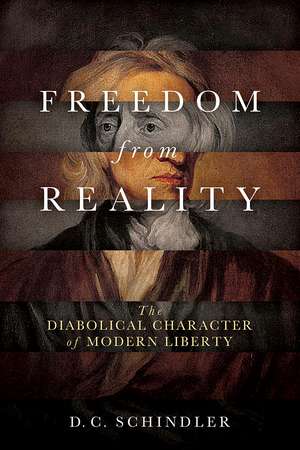
Freedom from Reality: Catholic Ideas for a Secular World
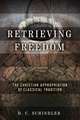
Autor D. C. Schindleren Limba Engleză Hardback – 15 dec 2017
It is commonly observed that behind many of the political and cultural issues that we face today lies an impoverished conception of freedom, which, according to D. C. Schindler, we have inherited from the classical liberal tradition without a sufficient awareness of its implications. Freedom from Reality presents a critique of the deceptive and ultimately self-subverting character of the modern notion of freedom, retrieving an alternative view through a new interpretation of the ancient tradition. While many have critiqued the inadequacy of identifying freedom with arbitrary choice, this book seeks to penetrate to the metaphysical roots of the modern conception by going back, through an etymological study, to the original sense of freedom.
Schindler begins by uncovering a contradiction in John Locke’s seminal account of human freedom. Rather than dismissing it as a mere “academic” problem, Schindler takes this contradiction as a key to understanding the strange paradoxes that abound in the contemporary values and institutions founded on the modern notion of liberty: the very mechanisms that intend to protect modern freedom render it empty and ineffectual. In this respect, modern liberty is “diabolical”—a word that means, at its roots, that which “drives apart” and so subverts. This is contrasted with the “symbolical” (a “joining-together”), which, he suggests, most basically characterizes the premodern sense of reality. This book will appeal to students and scholars of political philosophy (especially political theorists), philosophers in the continental or historical traditions, and cultural critics with a philosophical bent.
Schindler begins by uncovering a contradiction in John Locke’s seminal account of human freedom. Rather than dismissing it as a mere “academic” problem, Schindler takes this contradiction as a key to understanding the strange paradoxes that abound in the contemporary values and institutions founded on the modern notion of liberty: the very mechanisms that intend to protect modern freedom render it empty and ineffectual. In this respect, modern liberty is “diabolical”—a word that means, at its roots, that which “drives apart” and so subverts. This is contrasted with the “symbolical” (a “joining-together”), which, he suggests, most basically characterizes the premodern sense of reality. This book will appeal to students and scholars of political philosophy (especially political theorists), philosophers in the continental or historical traditions, and cultural critics with a philosophical bent.










Preț: 871.15 lei
Preț vechi: 1193.36 lei
-27%
Puncte Express: 1307
Carte tipărită la comandă
Livrare economică 07-21 decembrie
Livrare prin curier în România Termenul estimat este afișat lângă disponibilitate.
Transport gratuit pentru acest produs Plată online sau ramburs, în funcție de opțiunile comenzii.
Retur gratuit în 14 zile Comandă securizată și suport în română.
Specificații
ISBN-13: 9780268102616
ISBN-10: 0268102619
Pagini: 498
Dimensiuni: 157 x 235 x 34 mm
Greutate: 0.91 kg
Ediția:1
Editura: University of Notre Dame Press
Colecția Catholic Ideas for a Secular World
Seria Catholic Ideas for a Secular World
ISBN-10: 0268102619
Pagini: 498
Dimensiuni: 157 x 235 x 34 mm
Greutate: 0.91 kg
Ediția:1
Editura: University of Notre Dame Press
Colecția Catholic Ideas for a Secular World
Seria Catholic Ideas for a Secular World
Recenzii
"This is a brilliant, incredibly erudite, and rigorously argued book. D. C. Schindler's fundamental contribution is the working out of autonomy described as the flight from reality. Nobody has defended this account of the trajectory of modern liberalism more ably than he has. It is a huge and complete accomplishment by one of the most magnificent thinkers of our time." —Peter Lawler, Dana Professor in Government, Berry College
Notă biografică
D. C. Schindler is Associate Professor of Philosophy in the Department of Humanities at Villanova University. He is the author of Hans Urs von Balthasar and the Dramatic Structure of Truth (2004) and Plato's Critique of Impure Reason (2008).
Cuprins
Preface: What is Good?
Part 1. John Locke and the Dialectic of Power
1. Locke's (Re-)conception of Freedom
2. The Political Conquest of the Good in the Second Treatise
Part 2. Modern Liberty as a Flight from the Real
3. The Basic Shape of Modern Liberty
4. Symbolical Order and Diabolical Subversion
5. "A Society of Devils"
Part 3. Retrieving the Origin as the Essence of Freedom
6. Starting Over and Starting After: A First Foundation in Plato and Aristotle
7. Plato: The Golden Thread of Freedom
8. Aristotle: Freedom as Liberality
Conclusion