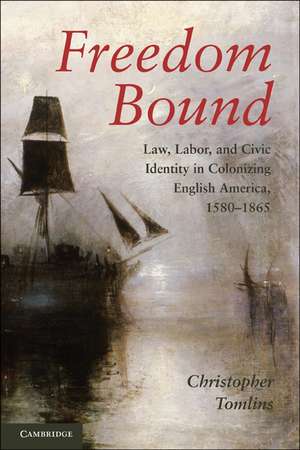
Freedom Bound: Law, Labor, and Civic Identity in Colonizing English America, 1580–1865
Autor Christopher Tomlinsen Limba Engleză Paperback – 30 aug 2010
În capitolul introductiv dedicat conceptului de „Manning” (angajarea forței de muncă), Christopher Tomlins stabilește premisa centrală a lucrării: colonizarea Americii de Nord nu a fost doar o expansiune teritorială, ci un proces juridic riguros care a definit cine este liber și cine este supus servituții. Freedom Bound investighează modul în care legea engleză a servit drept cadru pentru plantarea coloniilor și gestionarea fluxurilor de migranți, transformând identitatea civică într-un instrument de control economic. Reținem perspectiva inedită asupra „gospodăriei” ca unitate de producție și control, unde distincția dintre muncitorul liber și cel sclavizat a fost modelată de nevoile pragmatice ale coloniștilor.
Cartea este organizată în trei secțiuni ample ce urmăresc progresia istorică de la primele așezări până la Războiul Civil American. Partea a doua, „Poly-Olbion”, oferă o analiză densă a modului în care înțelepciunea juridică primită din Anglia a fost „despachetată” și adaptată realităților locale. Freedom Bound acoperă aceeași arie tematică precum The Cambridge History of Law in America, dar cu o abordare mai centrată pe intersecția dintre istoria muncii și teoria juridică, în loc să se limiteze la o cronică instituțională. Spre deosebire de Bonds of Citizenship de Hoang Gia Phan, care se concentrează pe cultură și literatură, Tomlins utilizează 23 de tabele cu date statistice pentru a ancora discuția în realitatea materială a migrației și a structurilor de proprietate.
Credem că rigoarea cu care autorul tratează „modernizarea” patriarhatului și a economiei oferă o înțelegere profundă a tensiunilor ce au culminat în 1861. Tonul este unul academic precis, evitând generalizările, iar prezența tabelelor și a referințelor juridice detaliate face din acest volum o resursă esențială pentru studiul istoriei americane timpurii.
Preț: 325.43 lei
Carte tipărită la comandă
Livrare economică 07-21 decembrie
Specificații
ISBN-10: 0521137772
Pagini: 636
Ilustrații: 1 b/w illus. 23 tables
Dimensiuni: 150 x 226 x 41 mm
Greutate: 0.84 kg
Ediția:New.
Editura: Cambridge University Press
Colecția Cambridge University Press
Locul publicării:New York, United States
V-ar putea interesa
-
 BrazilLeslie BethellPreț: 356.52 lei
 -
 The Cambridge History of American Foreign RelationsWalter LafeberPreț: 321.00 lei
 -
 Ancient MayaArthur DemarestPreț: 244.08 lei
 -
 Dissenting Voices in America's Rise to PowerDavid MayersPreț: 291.85 lei
 -
 The Sioux in South Dakota HistoryRichmond L ClowPreț: 136.87 lei
 -
 Thomas Jefferson and American NationhoodBrian SteelePreț: 288.19 lei
 -
 Freedom's MirrorAda FerrerPreț: 209.92 lei
 -
 Exploring the 'Legal' in Socio-Legal StudiesDavid Cowan-18%Preț: 758.52 lei925.02 lei
De ce să citești această carte
Recomandăm această lucrare cercetătorilor și studenților interesați de fundamentele juridice ale democrației americane. Cititorul câștigă o perspectivă clară asupra modului în care instituția sclaviei și conceptul de libertate au fost codificate legal, nu doar social. Este un volum esențial pentru a înțelege de ce Războiul Civil a reprezentat punctul de cotitură necesar pentru redefinirea identității civice în Statele Unite.
Despre autor
Christopher Tomlins este profesor de drept la University of California, Irvine și un cercetător proeminent în cadrul American Bar Foundation. Cariera sa vastă cuprinde instituții de prestigiu precum Northwestern University și Tel Aviv University. Lucrările sale, printre care se numără The Oxford Handbook of Legal History și In the Matter of Nat Turner, demonstrează un interes constant pentru istoria juridică a muncii și impactul legii asupra structurilor sociale. Tomlins este recunoscut pentru capacitatea de a sintetiza perioade istorice lungi — de la Anglia secolului al XVI-lea la America secolului XX — într-o narațiune coerentă despre putere și identitate.
Descriere scurtă
Cuprins
Recenzii
“Beautifully written, deeply researched, and elegantly argued, Freedom Bound is legal history that changes the way we understand U.S. history. Tomlins masterfully retells the story of America’s founding by following the developing relationships among labor, law, and civic identity. While focused on early America, Freedom Bound speaks broadly to questions about freedom and equality that continue to define the nation’s history into the twenty-first century.” – Laura F. Edwards, Duke University
“An ambitious effort to remake the landscape of the history of the origins of American culture, Tomlins' learned and masterful volume may well turn out to be the most important work published in American history over the past quarter century. Transcending the conventional disciplinary categories – England and America, colonial and national – that contribute to the myopia of so many scholars, he leads his reader through a complex, sober, penetrating, and highly persuasive analysis of the fundamental and interactive role of labor, law, and civic imperatives in shaping American society from the late sixteenth century to the American Civil War. Challenging many existing orthodoxies, including the depiction of the American Revolution as a sharp break with the colonial past, it deserves the careful attention of any serious student of, not only the American past, but of the establishment of settler, colonial, and national regimes all over the globe.” – Jack P. Greene, Johns Hopkins University
“Take time to savor this magisterial book, the fruit of decades of research and reflection. Christopher Tomlins brilliantly revises our understanding of the ideas and practices that shaped the lives of working people, households, and politics, in an account that stretches from England’s Atlantic empire to the eve of the U.S. Civil War. Be warned: many familiar generalizations lie shattered.” – Linda K. Kerber, University of Iowa
“Christopher Tomlins has written a passionate, provocative, brilliant book about how law enabled English colonizers to justify taking what was not theirs and then to keep and work what they had taken. With wide-ranging erudition, he uncovers the legalities that shaped what the English expected to find; what they saw; how they interpreted what they found; how they justified what they did; and what social, political, and legal structures they erected in America. Freedom Bound is, by any standard, a magisterial work of stunning originality.” – Bruce H. Mann, Harvard Law School
“This sweeping and superb magnum opus is a fascinating account of intricate patchworks of disparate legal systems and codes that ranges all across British North America. Law was anything but a national singularity; rather, it encompassed plural discourses and institutions. The constantly evolving relationship between various freedoms and unfreedoms gives the work a powerful and poignant story line.” – Philip Morgan, Johns Hopkins University
“From the beginnings of colonization of the American mainland to the American Civil War, few historians have the knowledge or stamina to rewrite the narrative of American history on such a broad scale. Christopher Tomlins does and has: Freedom Bound is the story of how, from its first imaginings, freedom was bound, limited to white males, secured by the land Native Americans had claimed and populated and by the productive and reproductive labor of wives and slaves. Colonial America is not a time apart; rather it is, in Tomlins’ retelling, the formative era of modern America. This is a demanding book – demanding in length, in the range of methodologies it so expertly employs, but most of all in its conclusions. Majestic. Unrelenting. Haunting. Unanswerable.” – Barbara Young Welke, University of Minnesota
“Tomlins shows how the vast expanse of land available to British colonizers in North America created the conditions for unfreedom. Scarce labor – free and bound – had to be policed. As a technology of power, law was core to the project of creating the blueprints for the plural forms of colonial governance that provided flexibility in disciplining labor. Freedom Bound takes us from British workshops to the marchlands of North America, from America's initial European settlement to its struggle, after independence, as an expansive republic with the legacy of slavery. More importantly, with deftness, intellectual ambition, and remarkable erudition, it forces us to reconsider how new worlds harbor both potential utopias and dystopias. One word best describes this book: magisterial.” – Steven Wilf, University of Connecticut
“What we have long needed is an original and challenging interpretation of early America as a whole. Is there another recent, and not so recent, book that has offered or even attempted the scope and provocation given in Freedom Bound? I can’t think of one.” Sam Middleton, Journal of American Studies
"Comparative history can suggest how to read the past anew—particularly comparative perspectives inspired by so broad-ranging and thoughtful a work as Freedom Bound." -Tamar Herzog and Richard J. Ross, William and Mary Quarterly
“Freedom Bound illuminates and rewrites what the book marks off as a long foundational moment—a moving equilibrium a quarter of a millennium long—in early English American history. Through the lens of land and labor, Christopher Tomlins’s text makes a case for the essential unity of this period with analytic reach, moral force, and literary sensitivity, extending across an expanse of enormous spatial and cultural diversity.” Julia Adams, William & Mary Quarterly
"Tomlins is not the first person to write about the history of law that way. But I think he is more articulate than others have been in explaining exactly what he is doing and why he is doing it. It is this clarity of his method that I find especially valuable." -Stuart Banner, William and Mary Quarterly
"Freedom Bound should – and I very much hope will – revolutionize the way we think about the history of American law and American history generally.” Peter Onuf, Journal of Legal Education
"... a magisterial synthesis and a work of original research, this brilliant, Bancroft Prize-winning volume has much to say about the complexities of law and colonialism, but it also broadens our understanding of law and legal culture in general." James D. Schmidt, American Historical Review
“ Freedom Bound … is long and complex. But it is worth the effort. The work is suffused with an extraordinary and subtle sensibility; and there are even flashes of downright poetry. This is an important book. Awesome, in fact. And also enriching: a real contribution.” Lawrence M. Friedman, Law and Politics Book Review