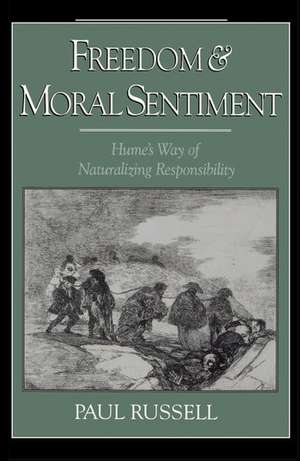
Freedom and Moral Sentiment: Hume's Way of Naturalizing Responsibility
Autor Paul Russellen Limba Engleză Paperback – 25 apr 2002
Preț: 199.98 lei
Preț vechi: 239.70 lei
-17%
Puncte Express: 300
Carte tipărită la comandă
Livrare economică 20 noiembrie-01 decembrie
Livrare prin curier în România Termenul estimat este afișat lângă disponibilitate.
Transport gratuit de la 400.00 lei Plată online sau ramburs, în funcție de opțiunile comenzii.
Retur gratuit în 14 zile Comandă securizată și suport în română.
Specificații
ISBN-13: 9780195152906
ISBN-10: 0195152905
Pagini: 216
Dimensiuni: 152 x 231 x 20 mm
Greutate: 0.35 kg
Ediția:Revised
Editura: Oxford University Press
Colecția OUP USA
Locul publicării:New York, United States
ISBN-10: 0195152905
Pagini: 216
Dimensiuni: 152 x 231 x 20 mm
Greutate: 0.35 kg
Ediția:Revised
Editura: Oxford University Press
Colecția OUP USA
Locul publicării:New York, United States
V-ar putea interesa
-
 Kant's Metaphysics of Morals: Interpretative EssaysMark Timmons-28%Preț: 501.61 lei698.43 lei
 -
 Leibniz: A Very Short IntroductionMaria Rosa Antognazza-20%Preț: 57.12 lei71.12 lei
 -
 Hume's ReasonDavid Owen-18%Preț: 324.23 lei394.53 lei
 -
 Oxford Studies in Early Modern Philosophy Volume 1Daniel Garber-28%Preț: 344.71 lei481.58 lei
 -
 -28%Preț: 427.24 lei595.14 lei
 -
 Hume VariationsJerry A. Fodor-13%Preț: 365.08 lei421.06 lei
 -
 Schiller as Philosopher: A Re-ExaminationFrederick Beiser-21%Preț: 354.21 lei448.82 lei
 -
 -10%Preț: 329.04 lei366.95 lei
 -
 -21%Preț: 444.32 lei561.28 lei
 -
 -25%Preț: 376.78 lei501.07 lei
 -
 Treatise on TolerationVoltaire-27%Preț: 56.25 lei77.05 lei
 -
 Why I Am so CleverFriedrich Nietzsche-39%Preț: 17.06 lei28.11 lei
 -
 Utilitarianism and On LibertyJohn Stuart MillPreț: 97.64 lei
 -
 Spinoza's EthicsBeth LordPreț: 125.13 lei
 -
 Preț: 80.65 lei
 -
 The Philosophy of MarxEtienne BalibarPreț: 112.71 lei
Recenzii
Russell's book makes an important contribution to the literature on Hume's moral philosophy, especially in showing a breadth to his view that is sometimes obscured by too heavy a focus on his subjectivism. And Russell's discussion of Hume's relevance for contemporary debates over naturalism in ethics will be of interest to a wider philosophical audience.