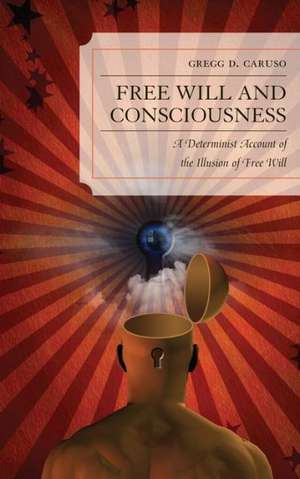
Free Will and Consciousness: A Determinist Account of the Illusion of Free Will
Autor Gregg D. Carusoen Limba Engleză Paperback – mai 2013
| Toate formatele și edițiile | Preț | Express |
|---|---|---|
| Paperback (1) | 339.16 lei 6-8 săpt. | |
| Bloomsbury Publishing – mai 2013 | 339.16 lei 6-8 săpt. | |
| Hardback (1) | 675.48 lei 6-8 săpt. | |
| Bloomsbury Publishing – 23 feb 2012 | 675.48 lei 6-8 săpt. |
Preț: 339.16 lei
Preț vechi: 515.57 lei
-34%
Puncte Express: 509
Preț estimativ în valută:
59.96€ • 68.79$ • 51.81£
59.96€ • 68.79$ • 51.81£
Carte tipărită la comandă
Livrare economică 02-16 mai
Specificații
ISBN-13: 9780739184400
ISBN-10: 0739184407
Pagini: 301
Dimensiuni: 148 x 226 x 20 mm
Greutate: 0.46 kg
Editura: Bloomsbury Publishing
Colecția Lexington Books
Locul publicării:New York, United States
ISBN-10: 0739184407
Pagini: 301
Dimensiuni: 148 x 226 x 20 mm
Greutate: 0.46 kg
Editura: Bloomsbury Publishing
Colecția Lexington Books
Locul publicării:New York, United States
Cuprins
Chapter 1: The Problem of Free Will: A Brief Introduction and Outline of Position
Chapter 2: Against Libertarianism
Chapter 3: Against Compatibilism
Chapter 4: Consciousness and Free Will (I): Automaticity and the Adaptive Unconscious
Chapter 5: Consciousness and Free Will (II): Transparency, Infallibility, and the Higher-Order Thought Theory
Chapter 6: Consciousness and Free Will (III): Intentional States, Spontaneity, and Action Initiation
Chapter 7: Consciousness and Free Will (IV): Self-Consciousness and Our Sense of Agency
Chapter 2: Against Libertarianism
Chapter 3: Against Compatibilism
Chapter 4: Consciousness and Free Will (I): Automaticity and the Adaptive Unconscious
Chapter 5: Consciousness and Free Will (II): Transparency, Infallibility, and the Higher-Order Thought Theory
Chapter 6: Consciousness and Free Will (III): Intentional States, Spontaneity, and Action Initiation
Chapter 7: Consciousness and Free Will (IV): Self-Consciousness and Our Sense of Agency
Recenzii
Free Will and Consciousness is an effort to deal with a series of complex topics such as social and cognitive psychology, neuroscience, philosophy and their relationship with consciousness and free will in a small number of pages. . . . This book is therefore a good example of interdisciplinary research. ... Overall, this book is highly recommend for upper undergraduate courses, graduate students, and researchers. It is tightly organized. The vast amount of literature reviewed by the author makes it a good introduction to the metaphysics of free will and the debate about cognitive illusion of free will. The arguments featured were both robust and convincing with the author achieving a successful concatenation of them in order to uphold his deterministic account.
In this rather ambitious book, Gregg D. Caruso attempts to make the case for free will skepticism, arguing that our feeling of freedom is an illusion. In making his case, Caruso explores some territory often left unexplored by many philosophers working on free will. . . . a substantial portion of the book is devoted to examining the implications of recent work in neuroscience, cognitive psychology, and social psychology for free will. . . . there is a lot going on in this book that should be of interest to philosophers, neuroscientists, and psychologists interested in the free will debate. . . . Caruso deserves praise for making a comprehensive case for free will illusionism that engages with both the recent philosophical and empirical literature on human agency.
This admirable book enriches the philosophical debate about free will by bringing to bear a probing discussion of consciousness along with a rigorous survey of relevant work in experimental psychology and cognitive neuroscience. The result is a compelling theoretical and empirical defense of determinism, which does justice as few treatments ever have to the crucial difference between genuine freedom and the mere subjective appearance of freedom. Having argued convincingly that our will is not actually free, Caruso develops a perceptive account of the conscious phenomenology that gives rise to our persistent impression that we do act freely. Anybody interested in free will, consciousness, or human agency will want to read this book.
This is an aggressive, informative defense of hard determinism using the latest news from cognitive science. It is (almost) fair to sophisticated versions of compatibilism, and will force libertarians to face their worst fears about the subconscious antecedents of behavior. Caruso's unusual clarity makes this an excellent book at all levels of undergraduate and graduate study, and conveys the author's conviction that his conclusions are important.
This is an excellent book: extremely well-researched, combining first-rate skills in philosophical analysis and a detailed understanding of the wide-ranging philosophical arguments concerning free will with a thorough examination of the relevant psychological literature. . . The book makes an important contribution to the current lively discussion of free will, and it is a superb example of the effective integration of empirical research into the analysis of philosophical issues. I recommend [it] very strongly. . . This is, overall, a rigorous and remarkably thorough examination and critique of basic ideas essential to the libertarian theory of free will. It is a very important contribution to the literature, and greatly enriches the philosophical discussion through its extensive yet judicious examination of the relevant psychological research.
In this rather ambitious book, Gregg D. Caruso attempts to make the case for free will skepticism, arguing that our feeling of freedom is an illusion. In making his case, Caruso explores some territory often left unexplored by many philosophers working on free will. . . . a substantial portion of the book is devoted to examining the implications of recent work in neuroscience, cognitive psychology, and social psychology for free will. . . . there is a lot going on in this book that should be of interest to philosophers, neuroscientists, and psychologists interested in the free will debate. . . . Caruso deserves praise for making a comprehensive case for free will illusionism that engages with both the recent philosophical and empirical literature on human agency.
This admirable book enriches the philosophical debate about free will by bringing to bear a probing discussion of consciousness along with a rigorous survey of relevant work in experimental psychology and cognitive neuroscience. The result is a compelling theoretical and empirical defense of determinism, which does justice as few treatments ever have to the crucial difference between genuine freedom and the mere subjective appearance of freedom. Having argued convincingly that our will is not actually free, Caruso develops a perceptive account of the conscious phenomenology that gives rise to our persistent impression that we do act freely. Anybody interested in free will, consciousness, or human agency will want to read this book.
This is an aggressive, informative defense of hard determinism using the latest news from cognitive science. It is (almost) fair to sophisticated versions of compatibilism, and will force libertarians to face their worst fears about the subconscious antecedents of behavior. Caruso's unusual clarity makes this an excellent book at all levels of undergraduate and graduate study, and conveys the author's conviction that his conclusions are important.
This is an excellent book: extremely well-researched, combining first-rate skills in philosophical analysis and a detailed understanding of the wide-ranging philosophical arguments concerning free will with a thorough examination of the relevant psychological literature. . . The book makes an important contribution to the current lively discussion of free will, and it is a superb example of the effective integration of empirical research into the analysis of philosophical issues. I recommend [it] very strongly. . . This is, overall, a rigorous and remarkably thorough examination and critique of basic ideas essential to the libertarian theory of free will. It is a very important contribution to the literature, and greatly enriches the philosophical discussion through its extensive yet judicious examination of the relevant psychological research.