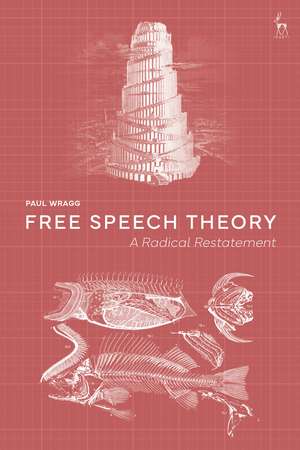
Free Speech Theory: A Radical Restatement
Autor Dr Paul Wraggen Limba Engleză Hardback – 29 mai 2025
Free Speech Theory challenges contemporary thought on this issue. It champions free speech not for its contribution to epistemic advance or informed democratic participation, but as a product of individuality, located in a system of freedom from state control. This has wide-ranging implications for rights-claims directed against private actors concerning online, workplace, and public-interest based forms of speech.
This innovative, rigorously researched, and comprehensive restatement of free speech principle is both topical and important. It has significance for policy makers, practitioners, and commentators around the world.
Preț: 602.81 lei
Preț vechi: 880.46 lei
-32%
Puncte Express: 904
Carte tipărită la comandă
Livrare economică 10-16 decembrie
Livrare prin curier în România Termenul estimat este afișat lângă disponibilitate.
Transport gratuit pentru acest produs Plată online sau ramburs, în funcție de opțiunile comenzii.
Retur gratuit în 14 zile Comandă securizată și suport în română.
Specificații
ISBN-13: 9781509958283
ISBN-10: 1509958282
Pagini: 318
Dimensiuni: 162 x 236 x 24 mm
Greutate: 0.62 kg
Editura: Bloomsbury Publishing
Colecția Hart Publishing
Locul publicării:London, United Kingdom
ISBN-10: 1509958282
Pagini: 318
Dimensiuni: 162 x 236 x 24 mm
Greutate: 0.62 kg
Editura: Bloomsbury Publishing
Colecția Hart Publishing
Locul publicării:London, United Kingdom
V-ar putea interesa
-
 Private CensorshipJ.P. Messina-16%Preț: 183.54 lei218.19 lei
 -
 -14%Preț: 168.58 lei194.95 lei
 -
 Free Speech: A Very Short IntroductionNigel Warburton-20%Preț: 56.69 lei70.53 lei
 -
 That Book Is Dangerous!Adam SzetelaPreț: 198.52 lei
 -
 The Most Human RightEric Heinze-17%Preț: 119.07 lei142.79 lei
 -
 Free Speech And Why It MattersAndrew Doyle-27%Preț: 57.17 lei78.03 lei
 -
 Preț: 95.03 lei
 -
 At the Margins of the Modern StateSeyla BenhabibPreț: 159.20 lei
 -
 Self-CensorshipGlenn C. LouryPreț: 81.26 lei
 -
 Free Speech: A Global History from Socrates to Social MediaJacob Mchangama-25%Preț: 81.82 lei108.70 lei
 -
 Is Free Speech Under Threat?Charlotte Lydia RileyPreț: 78.13 lei
 -
 Fearless Speech: Breaking Free from the First AmendmentMary Anne Franks-30%Preț: 132.94 lei189.63 lei
 -
 Speechless: Controlling Words, Controlling MindsMichael Knowles-18%Preț: 78.20 lei94.79 lei
 -
 Living Language RightsLorena Sekwan FontainePreț: 156.28 lei
 -
 Five Ideas to Fight ForAnthony LesterPreț: 71.12 lei
 -
 The New CensorshipAyala PanievskyPreț: 141.15 lei
 -
 Is Free Speech Under Threat?Charlotte Lydia RileyPreț: 121.87 lei
 -
 -43%Preț: 68.61 lei119.66 lei
 -
 Preț: 110.79 lei
 -
 Free Speech and Neoliberalism: Art, Culture, EducationDr. Asbjørn Skarsvåg Grønstad-32%Preț: 600.44 lei879.04 lei
Cuprins
Part I: Overview
1. Authenticity
Part II: Methodology
2. Orthodoxy
3. Justification as Definition
4. Proof
Part III: Restatement
5. The Problem of Individuality
6. Epistemology
7. Democratic Participation
8. Irrationality
Part IV: Horizontality
9. Digital Speech
10. Public Interest Speech
11. Workplace Speech
Part V: Conclusion
12. A Radical Restatement
1. Authenticity
Part II: Methodology
2. Orthodoxy
3. Justification as Definition
4. Proof
Part III: Restatement
5. The Problem of Individuality
6. Epistemology
7. Democratic Participation
8. Irrationality
Part IV: Horizontality
9. Digital Speech
10. Public Interest Speech
11. Workplace Speech
Part V: Conclusion
12. A Radical Restatement
Recenzii
We should be grateful to Wragg for boiling a considerable ocean of free speech theory down to a series of more cordial measures. He covers a huge amount of ground . [He] has made a significant contribution to the theory of freedom of speech with this book.
In recent years the free speech ecosystem has changed beyond all recognition, necessitating us to question the meaning of free speech, and to re-think the theoretical foundations upon which 'the right to free speech' is laid. Paul Wragg's novel and convincing restatement of free speech theory shakes these foundations and reinvigorates this debate. This book is, therefore, not only timely and ground-breaking, but will be the lodestar that free speech theorists and lawyers follow for years to come.
Professor Paul Wragg's book is probably the most important work on free speech theory since Fred Schauer's Free Speech: A Philosophical Enquiry. Following the intention of John Stuart Mill, the author challenges dead dogmas. Wragg raises Mill from his grave and gives a new, revelatory interpretation of his famous essay. The theoretical issues of freedom of speech have hitherto been dominated in the international arena by American literature, which builds on the First Amendment jurisprudence as its starting point. Now, at last, the essential European work has been written that really digs deep into the question and, moving away from legal positivism, seeks an answer to the question: what is free speech? A fridge magnet in my kitchen proclaims: 'freedom of speech is not a licence to be stupid'. Wragg might have a different opinion. He argues forcefully in defence of 'irrationality', which is the keyword of the book. Not to unleash foolishness and irresponsibility, but to protect the freedom and autonomy of the individual. Wragg follows the greatest liberal English traditions, so his ideal is the individual responsible for herself.
After reading this book, researchers, policy-makers and others interested in the public sphere who are concerned with freedom of speech will find that they look at the subject of their study in a very different way than before. I myself have been dealing with the subject for 25 years, and now I feel I can start all over again...
A timely, ambitious, and intricate philosophical re-examination of free-speech methodology.
This powerful book offers important insights into the relevance of free speech theory for tackling a plethora of current, very thorny issues . It is an exciting book that shows admirable commitment to a theoretical idea, which it follows and develops consistently throughout.
In recent years the free speech ecosystem has changed beyond all recognition, necessitating us to question the meaning of free speech, and to re-think the theoretical foundations upon which 'the right to free speech' is laid. Paul Wragg's novel and convincing restatement of free speech theory shakes these foundations and reinvigorates this debate. This book is, therefore, not only timely and ground-breaking, but will be the lodestar that free speech theorists and lawyers follow for years to come.
Professor Paul Wragg's book is probably the most important work on free speech theory since Fred Schauer's Free Speech: A Philosophical Enquiry. Following the intention of John Stuart Mill, the author challenges dead dogmas. Wragg raises Mill from his grave and gives a new, revelatory interpretation of his famous essay. The theoretical issues of freedom of speech have hitherto been dominated in the international arena by American literature, which builds on the First Amendment jurisprudence as its starting point. Now, at last, the essential European work has been written that really digs deep into the question and, moving away from legal positivism, seeks an answer to the question: what is free speech? A fridge magnet in my kitchen proclaims: 'freedom of speech is not a licence to be stupid'. Wragg might have a different opinion. He argues forcefully in defence of 'irrationality', which is the keyword of the book. Not to unleash foolishness and irresponsibility, but to protect the freedom and autonomy of the individual. Wragg follows the greatest liberal English traditions, so his ideal is the individual responsible for herself.
After reading this book, researchers, policy-makers and others interested in the public sphere who are concerned with freedom of speech will find that they look at the subject of their study in a very different way than before. I myself have been dealing with the subject for 25 years, and now I feel I can start all over again...
A timely, ambitious, and intricate philosophical re-examination of free-speech methodology.
This powerful book offers important insights into the relevance of free speech theory for tackling a plethora of current, very thorny issues . It is an exciting book that shows admirable commitment to a theoretical idea, which it follows and develops consistently throughout.