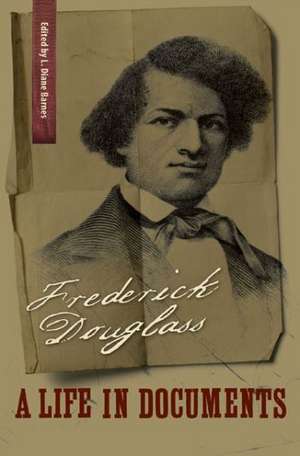
Frederick Douglass: A Life in Documents: Nation Divided: Studies in the Civil War Era
Autor Frederick Douglass Editat de L. Diane Barnesen Limba Engleză Paperback – 5 aug 2013 – vârsta de la 12 până la 17 ani
Din seria Nation Divided: Studies in the Civil War Era
-
 Preț: 394.53 lei
 -
 Preț: 492.15 lei
 -
 Preț: 394.90 lei
 -
 Preț: 345.48 lei
 -
 Preț: 430.91 lei
 -
 Preț: 394.53 lei
 - 23%
 Preț: 430.19 lei
 -
 Preț: 353.06 lei
 -
 Preț: 183.11 lei
Preț: 197.28 lei
Puncte Express: 296
Carte disponibilă
Livrare economică 05-19 noiembrie
Livrare prin curier în România Termenul estimat este afișat lângă disponibilitate.
Transport gratuit de la 400.00 lei Plată online sau ramburs, în funcție de opțiunile comenzii.
Retur gratuit în 14 zile Comandă securizată și suport în română.
Specificații
ISBN-13: 9780813934365
ISBN-10: 0813934362
Pagini: 194
Dimensiuni: 150 x 226 x 18 mm
Greutate: 0.32 kg
Editura: University of Virginia Press
Seria Nation Divided: Studies in the Civil War Era
ISBN-10: 0813934362
Pagini: 194
Dimensiuni: 150 x 226 x 18 mm
Greutate: 0.32 kg
Editura: University of Virginia Press
Seria Nation Divided: Studies in the Civil War Era
V-ar putea interesa
-
 WILLIAM WILBERFORCE PBWilliam HaguePreț: 123.51 lei
 -
 Twelve Years a SlaveSolomon NorthupPreț: 28.01 lei
 -
 The Portable Frederick DouglassFrederick Douglass-17%Preț: 77.90 lei94.06 lei
 -
 Narrative of the Life of Frederick Douglass, an American SlaveFrederick DouglassPreț: 64.70 lei
 -
 -31%Preț: 957.70 lei1384.44 lei
 -
 Human Trafficking in EuropeGillian WyliePreț: 392.52 lei
 -
 Preț: 93.18 lei
 -
 Frederick Douglass: Reformer and StatesmanL. Diane BarnesPreț: 405.92 lei
 -
 Narrative of the Life of Frederick DouglassFrederick Douglass-19%Preț: 23.42 lei28.76 lei
 -
 -27%Preț: 68.42 lei93.17 lei
 -
 A Brief History of Slavery: A New Global HistoryJeremy Black-27%Preț: 66.71 lei91.48 lei
Descriere
Although Frederick Douglass is best known for the first volume of his autobiography, there has never before been a collection of his inspiring speeches and editorials. Noted historian Milton Meltzer has gathered together a unique selection of Douglass's eloquent and impassioned speeches and writings against slavery and other moral injustices.
Recenzii
Universally recognized today as one of the most important and influential Americans of the nineteenth century, Frederick Douglass rose to prominence in the national abolitionist movement before and during the Civil War by virtue of the vividness and power with which, drawing on his personal experiences of enslavement and freedom, he spoke and wrote against American slavery—and he continued to propound his vision of an America that would afford freedom, equality, and opportunity to all long after slavery was formally abolished. This edition offers a selection of Douglass’s most significant writing and oratory from throughout his long career, including the complete texts of Narrative of the Life of Frederick Douglass, an American Slave, which has become a classic example of the slave narrative genre, and The Heroic Slave, Douglass’s only published work of fiction, together with excerpts from Douglass’s other autobiographical writings and key speeches he gave both before and after the Civil War. The edition also provides clear and thorough annotations for the assistance of the student reader and a range of contextual materials, including responses to Douglass’s Narrative and photographs of Douglass. As an introduction to Douglass’s life and work that balances breadth and concision, this edition is well suited for a variety of undergraduate courses in American history and literary studies.
This volume is one of a number of editions that have been drawn from the pages of the acclaimed Broadview Anthology of American Literature. The series is designed to make selections from the anthology available in a format convenient for use in a wide variety of contexts; each edition features an introduction and exaplanatory footnotes, and is designed to meet the needs of today’s students.
“Those who are not teaching a survey of American literature can add to their courses a book or two that focuses on a particular author’s career in some depth. Those who regularly teach Frederick Douglass’s 1845 Narrative but who, like me, also want to teach Douglass’s Fourth of July speech, will have a great and affordable option that includes the annotations that will help students find their way into the layered significance of Douglass’s work.” — John Earnest, University of Delaware, in American Periodicals
COMMENTS ON The Broadview Anthology of American Literature
“The expansion, diversification, and revitalization of the texts and terms of American literary history in recent years is made marvelously accessible in the … new Broadview Anthology of American Literature.” — Hester Blum, Penn State University
“The Broadview Anthology of American Literature is, quite simply, a breakthrough. … Meticulously researched and expertly assembled, this anthology should be the new gold standard for scholars and teachers alike.” — Michael D’Alessandro, Duke University
“So much thought has been put into every aspect of the Broadview Anthology of American Literature, from the selection of texts to their organization to their presentation on the page; it will be a gift to classrooms for years to come.” — Lara Langer Cohen, Swarthmore College
“The multiplicity of early American locations, languages, and genres is here on wondrous display.” — Jordan Alexander Stein, Fordham University
“Above all, this is a volume for the 21st century. … Its capaciousness and ample resource materials make for a text that is always evolving and meeting its readers in new ways.” — Russ Castronovo, University of Wisconsin-Madison
“a rich collection that reflects the diversity of American literatures…. [and] that never forgets its most important audience: students. There is a wealth of material here that will help them imagine and reimagine what American literature could be.” — Michael C. Cohen, UCLA
“The Broadview Anthology of American Literature is an instructor’s dream for introducing students to the diversity and complexity of American literature.” — Venetria K. Patton, University of Illinois, Urbana-Champaign
“I am eager to teach with this anthology! It aligns with cutting-edge research through its selections, its introductions, and explanatory notes, and the texts are supplemented with primary documents that encourage teachers and students to think critically and dynamically.” — Koritha Mitchell, The Ohio State University
This volume is one of a number of editions that have been drawn from the pages of the acclaimed Broadview Anthology of American Literature. The series is designed to make selections from the anthology available in a format convenient for use in a wide variety of contexts; each edition features an introduction and exaplanatory footnotes, and is designed to meet the needs of today’s students.
“Those who are not teaching a survey of American literature can add to their courses a book or two that focuses on a particular author’s career in some depth. Those who regularly teach Frederick Douglass’s 1845 Narrative but who, like me, also want to teach Douglass’s Fourth of July speech, will have a great and affordable option that includes the annotations that will help students find their way into the layered significance of Douglass’s work.” — John Earnest, University of Delaware, in American Periodicals
COMMENTS ON The Broadview Anthology of American Literature
“The expansion, diversification, and revitalization of the texts and terms of American literary history in recent years is made marvelously accessible in the … new Broadview Anthology of American Literature.” — Hester Blum, Penn State University
“The Broadview Anthology of American Literature is, quite simply, a breakthrough. … Meticulously researched and expertly assembled, this anthology should be the new gold standard for scholars and teachers alike.” — Michael D’Alessandro, Duke University
“So much thought has been put into every aspect of the Broadview Anthology of American Literature, from the selection of texts to their organization to their presentation on the page; it will be a gift to classrooms for years to come.” — Lara Langer Cohen, Swarthmore College
“The multiplicity of early American locations, languages, and genres is here on wondrous display.” — Jordan Alexander Stein, Fordham University
“Above all, this is a volume for the 21st century. … Its capaciousness and ample resource materials make for a text that is always evolving and meeting its readers in new ways.” — Russ Castronovo, University of Wisconsin-Madison
“a rich collection that reflects the diversity of American literatures…. [and] that never forgets its most important audience: students. There is a wealth of material here that will help them imagine and reimagine what American literature could be.” — Michael C. Cohen, UCLA
“The Broadview Anthology of American Literature is an instructor’s dream for introducing students to the diversity and complexity of American literature.” — Venetria K. Patton, University of Illinois, Urbana-Champaign
“I am eager to teach with this anthology! It aligns with cutting-edge research through its selections, its introductions, and explanatory notes, and the texts are supplemented with primary documents that encourage teachers and students to think critically and dynamically.” — Koritha Mitchell, The Ohio State University
Cuprins
Introduction
Narrative of the Life of Frederick Douglass, an American Slave. Written by Himself
In Context: Responses to Frederick Douglass’s Narrative
“What to the Slave Is the Fourth of July?”
The Heroic Slave
In Context: Photographs of Frederick Douglass
from My Bondage and My Freedom
from “The Dred Scott Decision”
from “Self-Made Men”
“Men of Color, to Arms!”
from “Composite Nation”
from “Oration in Memory of Abraham Lincoln, Delivered at the Unveiling of the Freedmen’s Monument”
In Context: The Emancipation Memorial (“Freedmen’s Monument”)
In Context: The Black Man at the White House
Narrative of the Life of Frederick Douglass, an American Slave. Written by Himself
In Context: Responses to Frederick Douglass’s Narrative
- Margaret Fuller, Review of Narrative of the Life of Frederick Douglass, an American Slave, from The New York Tribune (10 June 1845)
- A.C.C. Thompson, “To the Public. Falsehood Refuted,” The Liberator (12 December 1845)
- Frederick Douglass, “Reply to Mr. A.C.C. Thompson,” The Liberator (27 February 1846)
“What to the Slave Is the Fourth of July?”
The Heroic Slave
In Context: Photographs of Frederick Douglass
from My Bondage and My Freedom
from “The Dred Scott Decision”
from “Self-Made Men”
“Men of Color, to Arms!”
from “Composite Nation”
from “Oration in Memory of Abraham Lincoln, Delivered at the Unveiling of the Freedmen’s Monument”
In Context: The Emancipation Memorial (“Freedmen’s Monument”)
- Frederick Douglass, Letter to the Editor of the National Republican (19 April 1876)
In Context: The Black Man at the White House
- from “The Black Man at the White House: Frederick Douglass at Bryan Hall; Lecture in Aid of the ‘Ladies’ Freedmen’s Aid Society,’” Chicago Tribune (28 February 1864)