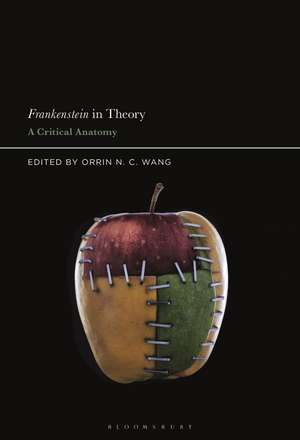
Frankenstein in Theory: A Critical Anatomy
Editat de Prof Orrin N. C. Wangen Limba Engleză Paperback – 28 iul 2022
Preț: 215.07 lei
Preț vechi: 288.83 lei
-26%
Puncte Express: 323
Carte tipărită la comandă
Livrare economică 19 noiembrie-03 decembrie
Livrare prin curier în România Termenul estimat este afișat lângă disponibilitate.
Transport gratuit de la 400.00 lei Plată online sau ramburs, în funcție de opțiunile comenzii.
Retur gratuit în 14 zile Comandă securizată și suport în română.
Specificații
ISBN-13: 9781501372209
ISBN-10: 1501372203
Pagini: 272
Ilustrații: 2 bw illus
Dimensiuni: 152 x 228 x 16 mm
Greutate: 0.41 kg
Editura: Bloomsbury Publishing
Colecția Bloomsbury Academic
Locul publicării:New York, United States
ISBN-10: 1501372203
Pagini: 272
Ilustrații: 2 bw illus
Dimensiuni: 152 x 228 x 16 mm
Greutate: 0.41 kg
Editura: Bloomsbury Publishing
Colecția Bloomsbury Academic
Locul publicării:New York, United States
Cuprins
List of Figures
Acknowledgments
Introduction: Frankenstein in Theory
Orrin N. C. Wang (University of Maryland, College Park, USA)
1. Last Words: Voice, Gesture, and the Remains of Frankenstein
David L. Clark (McMaster University, Canada)
2. When Jane Met Mary; or, Frankenstein's Romantic Comedy
Sonia Hofkosh (Tufts University, USA)
3. Frankenstein's Embodied Imagination: Or, the Limits of Embodied Cognition
Richard C. Sha (American University, USA)
4. Non-Binary Frankenstein?
Chris Washington (Francis Marion University, USA)
5. What's Love Got to Do with It? Frankenstein and Monstrous Psychoanalysis
Joel Faflak (University of Western Ontario, Canada)
6. The "very creature he creates": Frankenstein in the Making of Moby-Dick
Samuel Otter (University of California, Berkeley, USA)
7. Finitude, Frames, and the Plot of Frankenstein
Yoon Sun Lee (Wellesley College, USA)
8. Blackness and Anthropogenesis in Frankenstein
Rei Terada (University of California, Irvine, USA)
9. Mediating Monstrosity: Media, Information, and Mary Shelley's Frankenstein
Andrew Burkett (Union College, USA)
10. "A daemon whom I had myself created": Race, Frankenstein, and Monstering
Patricia A. Matthew (Montclair State University, USA)
11. The Smiles That One Is Owed: Justice, Justine, and Sympathy for a Wretch
Erin M. Goss (Clemson University, USA)
12. The Utopias of Frankenstein
Vivasvan Soni (Northwestern University, USA)
13. Is That All There Is? No Regrets (after 1818)
Jacques Khalip (Brown University, USA)
14. Frankenstein in Practice (as Theory)
Sara Guyer (University of Wisconsin, Madison, USA)
Notes on Contributors
Index
Acknowledgments
Introduction: Frankenstein in Theory
Orrin N. C. Wang (University of Maryland, College Park, USA)
1. Last Words: Voice, Gesture, and the Remains of Frankenstein
David L. Clark (McMaster University, Canada)
2. When Jane Met Mary; or, Frankenstein's Romantic Comedy
Sonia Hofkosh (Tufts University, USA)
3. Frankenstein's Embodied Imagination: Or, the Limits of Embodied Cognition
Richard C. Sha (American University, USA)
4. Non-Binary Frankenstein?
Chris Washington (Francis Marion University, USA)
5. What's Love Got to Do with It? Frankenstein and Monstrous Psychoanalysis
Joel Faflak (University of Western Ontario, Canada)
6. The "very creature he creates": Frankenstein in the Making of Moby-Dick
Samuel Otter (University of California, Berkeley, USA)
7. Finitude, Frames, and the Plot of Frankenstein
Yoon Sun Lee (Wellesley College, USA)
8. Blackness and Anthropogenesis in Frankenstein
Rei Terada (University of California, Irvine, USA)
9. Mediating Monstrosity: Media, Information, and Mary Shelley's Frankenstein
Andrew Burkett (Union College, USA)
10. "A daemon whom I had myself created": Race, Frankenstein, and Monstering
Patricia A. Matthew (Montclair State University, USA)
11. The Smiles That One Is Owed: Justice, Justine, and Sympathy for a Wretch
Erin M. Goss (Clemson University, USA)
12. The Utopias of Frankenstein
Vivasvan Soni (Northwestern University, USA)
13. Is That All There Is? No Regrets (after 1818)
Jacques Khalip (Brown University, USA)
14. Frankenstein in Practice (as Theory)
Sara Guyer (University of Wisconsin, Madison, USA)
Notes on Contributors
Index
Recenzii
A sense of urgency runs through all these essays, persuading us that Frankenstein and his monster matter now. It's not just that present crises help us think anew about Shelley's novel, or that it continually challenges the theories we employ. This provocative collection makes the case that Frankenstein compels us to think rigorously about our historical present.
A superb collection of essays, which reanimates not only this masterpiece of Romantic writing but also the theoretical debates that have shaped Romantic criticism for decades. In keeping with its subject, this is a daring, creative, and provocative contribution to Shelley scholarship.
This groundbreaking volume gathers together the best and most timely scholarship on Mary Shelley's timeless masterpiece. The theoretical perspectives are wonderfully diverse-including monster theory, ecocriticism, corporeality studies, trans studies, with many permutations and cross-pollinations in between. This will be an essential text for teaching Frankenstein for educators going forward. Frankly, this volume is alive!
A superb collection of essays, which reanimates not only this masterpiece of Romantic writing but also the theoretical debates that have shaped Romantic criticism for decades. In keeping with its subject, this is a daring, creative, and provocative contribution to Shelley scholarship.
This groundbreaking volume gathers together the best and most timely scholarship on Mary Shelley's timeless masterpiece. The theoretical perspectives are wonderfully diverse-including monster theory, ecocriticism, corporeality studies, trans studies, with many permutations and cross-pollinations in between. This will be an essential text for teaching Frankenstein for educators going forward. Frankly, this volume is alive!