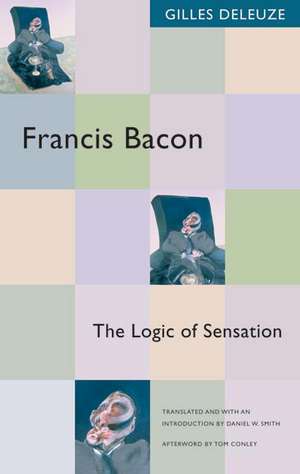
Francis Bacon: The Logic of Sensation
Autor Gilles Deleuzeen Limba Engleză Paperback – 25 mai 2005
Subliniem caracterul profund interdisciplinar al acestui volum, care nu se limitează la a fi o simplă monografie de istoria artei, ci reprezintă o joncțiune esențială între filozofia poststructuralistă, estetică și artele vizuale. În Francis Bacon, Gilles Deleuze folosește pânzele pictorului britanic pentru a articula o „logică a senzației”, explorând modul în care arta poate ocoli reprezentarea narativă pentru a lovi direct sistemul nervos. Merită menționat că această lucrare, apărută inițial în 1981, constituie un punct de cotitură în traiectoria intelectuală a lui Deleuze, anticipând conceptele despre imagine și mișcare pe care le va dezvolta ulterior.
Ne-a atras atenția structura riguroasă a cărții, care ghidează cititorul de la analiza elementelor formale — cum sunt câmpurile de culoare și izolarea figurii în „arie rotundă” — către teme ontologice dificile, precum distincția dintre corp și carne sau procesul de „devenire-animal”. Spre deosebire de Difference and Repetition, unde autorul lucrează la un nivel de abstractizare ridicat, aici ideile de diferență și repetiție sunt ancorate în materialitatea vopselei și în deformările anatomice specifice lui Bacon. Ca alternativă la Deleuze and the Diagram de Dr Jakub Zdebik pentru cursurile de estetică, acest volum are avantajul de a oferi accesul direct la sursa conceptuală originală, fiind completat de o introducere semnată de Daniel W. Smith care clarifică terminologia deleuziană.
Stilul este dens, dar marcat de o precizie terminologică remarcabilă, traducerea reușind să păstreze nuanțele filozofice ale originalului francez. Cartea nu doar interpretează arta lui Bacon, ci o folosește ca pe un laborator pentru a testa limitele percepției și ale limbajului, făcând legături neașteptate cu muzica și literatura.
Preț: 182.35 lei
Carte tipărită la comandă
Livrare economică 30 noiembrie-14 decembrie
Specificații
ISBN-10: 0816643423
Pagini: 224
Ilustrații: none
Dimensiuni: 138 x 216 x 18 mm
Greutate: 0.28 kg
Ediția:First edition
Editura: University of Minnesota Press
Colecția Univ Of Minnesota Press
V-ar putea interesa
-
 Francis BaconMark StevensPreț: 282.96 lei
 -
 Ways of SeeingJohn BergerPreț: 78.02 lei
 -
 The Invention of Art: A Cultural HistoryLarry ShinerPreț: 263.13 lei
 -
 What Is Philosophy?Gilles DeleuzePreț: 149.04 lei
 -
 Ways of CuratingHans Ulrich ObristPreț: 78.13 lei
 -
 The Legacy Of Mark RothkoLee SeldesPreț: 150.39 lei
 -
 Francis Bacon: Books and PaintingChris StephensPreț: 386.38 lei
 -
 Interviews with Francis BaconDavid Sylvester-16%Preț: 117.46 lei140.44 lei
 -
 Symbols in ArtMatthew Wilson-19%Preț: 100.31 lei123.08 lei
 -
 In Camera - Francis BaconMartin Harrison-15%Preț: 202.25 lei239.18 lei
 -
 Francis Bacon Retrieved - Lost Words / New WritingMartin Harrison-24%Preț: 164.31 lei215.24 lei
 -
 -23%Preț: 167.44 lei217.20 lei
 -
 Art in Theory 1900-2000 - An Anthology of Changing Ideas 2eCharles HarrisonPreț: 315.21 lei
 -
 The Dehumanization of Art and Other Essays on Art, Culture, and LiteratureJosé Ortega Y. GassetPreț: 90.47 lei
 -
 Gilles Deleuze''s Logic of SenseJames Williams-20%Preț: 214.91 lei268.82 lei
 -
 Preț: 190.58 lei
 -
 Angels and Demons in ArtRosa GiorgiPreț: 148.45 lei
 -
 Expressionism in PhilosophyGilles DeleuzePreț: 232.43 lei
 -
 Thinking About Art - A Thematic Guide to Art HistoryPenny HuntsmanPreț: 276.39 lei
 -
 The Future of Design: Global Product Innovation for a Complex WorldLorraine Justice-28%Preț: 101.04 lei140.29 lei
 -
 Logic of SenseGilles Deleuze-20%Preț: 169.86 lei211.10 lei
 -
 Concerning the Spiritual in ArtWassily KandinskyPreț: 38.49 lei
 -
 On Painting: Courses, March-June 1981Gilles DeleuzePreț: 208.50 lei
 -
 Francis Bacon: Human PresenceRosie Broadley-16%Preț: 272.68 lei322.85 lei
 -
 Pure ImmanenceGilles DeleuzePreț: 141.13 lei
 -
 The Book of Symbols: Reflections on Archetypal ImagesArchive for Research in Archetypal SymbolismPreț: 251.63 lei
 -
 BaconLuigi FicacciPreț: 132.53 lei
De ce să citești această carte
Această ediție este esențială pentru studenții și cercetătorii din domeniile filozofiei și artelor vizuale care doresc să înțeleagă fundamentul estetic al gândirii lui Deleuze. Cititorul câștigă o perspectivă unică asupra modului în care arta poate genera concepte filozofice noi. Este o recomandare certă pentru cei care caută o analiză riguroasă a picturii contemporane, dincolo de interpretările pur biografice sau psihanalitice.
Despre autor
Gilles Deleuze (1925–1995) a fost profesor de filozofie la Universitatea Paris VIII și este considerat unul dintre cei mai influenți gânditori ai secolului XX. Opera sa vastă, care include 25 de cărți, a redefinit concepte fundamentale în metafizică, ontologie și estetică. Colaborările sale cu Félix Guattari, precum Anti-Oedipus, au marcat profund teoria critică contemporană. În lucrări precum The Logic of Sense sau Cinema I, Deleuze a demonstrat o capacitate unică de a extrage filozofie din literatură și film, abordare care culminează în studiul său dedicat lui Francis Bacon.
Descriere scurtă
Afterword by Tom Conley
Gilles Deleuze had several paintings by Francis Bacon hanging in his Paris apartment, and the painter’s method and style as well as his motifs of seriality, difference, and repetition influenced Deleuze’s work. This first English translation shows us one of the most original and important French philosophers of the twentieth century in intimate confrontation with one of that century’s most original and important painters.
In considering Bacon, Deleuze offers implicit and explicit insights into the origins and development of his own philosophical and aesthetic ideas, ideas that represent a turning point in his intellectual trajectory. First published in French in 1981, Francis Bacon has come to be recognized as one of Deleuze’s most significant texts in aesthetics. Anticipating his work on cinema, the baroque, and literary criticism, the book can be read not only as a study of Bacon’s paintings but also as a crucial text within Deleuze’s broader philosophy of art.
In it, Deleuze creates a series of philosophical concepts, each of which relates to a particular aspect of Bacon’s paintings but at the same time finds a place in the “general logic of sensation.” Illuminating Bacon’s paintings, the nonrational logic of sensation, and the act of painting itself, this work—presented in lucid and nuanced translation—also points beyond painting toward connections with other arts such as music, cinema, and literature. Francis Bacon is an indispensable entry point into the conceptual proliferation of Deleuze’s philosophy as a whole.
Gilles Deleuze (1925–1995) was professor of philosophy at the University of Paris, Vincennes–St. Denis. He coauthored Anti-Oedipus and A Thousand Plateaus with Félix Guattari. These works, as well as Cinema 1, Cinema 2, The Fold, Proust and Signs, and others, are published in English by Minnesota.
Daniel W. Smith teaches in the Department of Philosophy at Purdue University.
Descriere
Gilles Deleuze was one of the most influential and revolutionary philosophers of the twentieth century. Francis Bacon: The Logic of Sensation is his long-awaited work on Bacon,widely regarded as one of the most radical painters of the twentieth century.The book presents a deep engagement with Bacon's work and the nature of art. Deleuze analyzes the distinctive innovations that came to mark Bacon's style: the isolation of the figure, the violation deformations of the flesh, the complex use of color, the method of chance, and the use of the triptych form. Along the way, Deleuze introduces a number of his own famous concepts, such as the 'body without organs' and the 'diagram,' and contrasts his own approach to painting with that of both the phenomenological and the art historical traditions.Deleuze links Bacon's work to CTzanne's notion of a 'logic' of sensation, which reaches its summit in color and the 'coloring sensation.' Investigating this logic, Deleuze explores Bacon's crucial relation to past painters such as Velasquez, CTzanne, and Soutine, as well as Bacon's rejection of expressionism and abstract painting.Long awaited in translation, Francis Bacon is destined to become a classic philosophical reflection on the nature of painting.
Cuprins
Preface to the French Edition, by Alain Badiou and Barbara Cassin
Author's Foreword
Author's Preface to the English Edition
1. The Round Area, the Ring
The round area and its analogues - Distinction between the Figure and the figurative - The fact - The question of "matters of fact" - The three elements of painting: structure, Figure, and contour - Role of the fields
2. Note on Figuration in Past Painting
Painting, religion, and photography - On two misconceptions
3. Athleticism
First movement: from the structure to the Figure - Isolation - Athleticism - Second movement: from the Figure to the structure - The body escapes from itself: abjection - Contraction, dissipation: washbasins, umbrellas, and mirrors
4. Body, Meat, and Spirit, Becoming-Animal
Man and animal - The zone of indiscernibility - Flesh and bone: the meat descends from the bone - Pity - Head, face, and meat
5. Recapitulative Note: Bacon's Periods and Aspects
From the scream to the smile: dissipation - Bacon's three successive periods - The coexistence of all the movements - The functions of the contour
6. Painting and Sensation
Cezanne and sensation - The levels of sensation - Figuration and violence - The movement of translation, the stroll - The phenomenological unity of the senses: sensation and rhythm
7. Hysteria
The body without organs: Artaud - Worringer's Gothic line - What the "difference of level" in sensation means - Vibration - Hysteria and presence - Bacon's doubt - Hysteria, painting, and the eye
8. Painting Forces
Rendering the invisible: the problem of painting - Deformation: neither transformation nor decomposition - The scream - Bacon's love of life - Enumeration of forces
9. Couples and Triptychs
Coupled Figures - The battle and the coupling of sensation - Resonance - Rhythmic Figures - Amplitude and the three rhythms - Two types of "matters of fact"
10. Note: What Is a Triptych?
The attendant - The active and the passive - The fall: the active reality of the difference in level - Light, union and separation
11. The Painting before Painting .. .
Cezanne and the fight against the cliche - Bacon and photographs - Bacon and probabilities - Theory of chance: accidental marks - The visual and the manual - The status of the figurative
12. The Diagram
The diagram in Bacon (traits and color-patches) - Its manual character - Painting and the experience of catastrophe - Abstract painting, code, and optical space - Action Painting, diagram, and manual
space - What Bacon dislikes about both these ways
13. Analogy
Cezanne: the motif as diagram - The analogical and the digital - Painting and analogy - The
paradoxical status of abstract painting - The analogical language of Cezanne and of Bacon: plane, color, and mass - Modulation - Resemblance recovered
14. Every Painter Recapitulates the History of Painting in His or Her Own Way .. .
Egypt and haptic presentation - Essence and accident - Organic representation and the tactileoptical world - Byzantine art: a pure optical world? - Gothic art and the manual - Light and color, the optic and the haptic
15. Bacon's Path
The haptic world and its avatars - Colorism - A new modulation - From Van Gogh and Gauguin to Bacon - The two aspects of color: bright tone and broken tone, field and Figure, shores and flows .. .
16. Note on Color
Color and the three elements of painting - Color-structure: the fields and their divisions - The role of black Color-force: Figures, flows, and broken tones Heads and shadows - Color-contour - Painting and taste: good
and bad taste
17. The Eye and the Hand
Digital, tactile, manual, and haptic - The practice of the diagram - On "completely different" relations - Michelangelo: the pictorial fact
Index of Paintings
Notes
Index
Recenzii
A path-breaking work on the aesthetics of sensation, the philosophy of colour, on form, and on painting in general, Francis Bacon is one of the most important, if not the most crucial, of all of Deleuze's writings.
One of Deleuze's most beautifully crafted studies, and an essential component of his aesthetic philosophy.
Art historians as well as scholars of 20th century intellectual history will find this a rich mine of original thought.
Long-awaited. This book is invaluable for an understanding of the trajectory of Deleuze's own thought. Offers an entry point into Deleuze's more explicitly theoretical work that simultaneously grounds and orients that theory in terms of a specific instance.