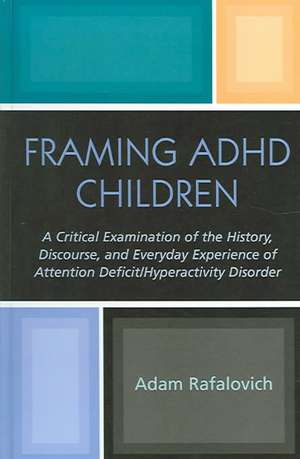
Framing ADHD Children: A Critical Examination of the History, Discourse, and Everyday Experience of Attention Deficit/Hyperactivity Disorder
Autor Adam Rafalovichen Limba Engleză Hardback – 4 aug 2004
Preț: 644.72 lei
Preț vechi: 882.19 lei
-27%
Puncte Express: 967
Carte tipărită la comandă
Livrare economică 28 noiembrie-12 decembrie
Livrare prin curier în România Termenul estimat este afișat lângă disponibilitate.
Transport gratuit pentru acest produs Plată online sau ramburs, în funcție de opțiunile comenzii.
Retur gratuit în 14 zile Comandă securizată și suport în română.
Specificații
ISBN-13: 9780739107478
ISBN-10: 073910747X
Pagini: 208
Dimensiuni: 164 x 234 x 23 mm
Greutate: 0.43 kg
Ediția:New.
Editura: Bloomsbury Publishing
Colecția Lexington Books
Locul publicării:New York, United States
ISBN-10: 073910747X
Pagini: 208
Dimensiuni: 164 x 234 x 23 mm
Greutate: 0.43 kg
Ediția:New.
Editura: Bloomsbury Publishing
Colecția Lexington Books
Locul publicării:New York, United States
V-ar putea interesa
-
 -34%Preț: 846.36 lei1278.12 lei
 -
 The ADHD Parenting HandbookColleen Alexander-RobertsPreț: 96.19 lei
 -
 ADHD & TeensColleen Alexander-RobertsPreț: 90.35 lei
 -
 Zombie in the BasementBrian L. ParkerPreț: 60.48 lei
 -
 You Are Different, You Are SpecialJessica Marie BensonPreț: 77.58 lei
 -
 Memoirs of a MisfitR. E. MillarPreț: 131.30 lei
 -
 Help! My Feelings Are Sticking Out of My Gown!Maurie Shapiro-Comenzo PhdPreț: 135.90 lei
 -
 Cri Du Chat - The First Ten YearsRowan Blair ColverPreț: 60.48 lei
 -
 A Strand of LightRandy DahlPreț: 85.70 lei
 -
 James Learns He Has AutismCarolyn L. HustonPreț: 66.18 lei
 -
 The Summer of My WinterGloria Ann HicksPreț: 70.49 lei
 -
 Life with Kathleen..Jeannine y. BartzPreț: 56.92 lei
 -
 Unexpected Lessons from My DaughterDorothy LaffertyPreț: 120.37 lei
 -
 Persevering ParentDr Karen a. CrumPreț: 98.66 lei
 -
 Moment of DepartureKathy RobersonPreț: 62.24 lei
 -
 I Want To Be Special TooTheresa BuckleyPreț: 143.31 lei
 -
 Near-DrowningJeffrey N. Weiss M. D.Preț: 47.87 lei
 -
 Por Un Lugar En El MundoMonica Aguilar AlvarezPreț: 99.52 lei
 -
 Special Kids, Chosen MomsSandra NietoPreț: 65.25 lei
 -
 Preț: 41.63 lei
 -
 Raising LibbySarah E. ColePreț: 75.25 lei
 -
 Jack Saves the DayL. L. SandovalPreț: 62.78 lei
 -
 James Goes to KindergartenCarolyn L. HustonPreț: 67.37 lei
 -
 The Summer of SasquatchCeleste CornishPreț: 54.42 lei
 -
 Preț: 64.78 lei
 -
 Pieces of MeKira AdamsPreț: 82.37 lei
 -
 Drawing Together to Build CharacterMarge Eaton HeegaardPreț: 54.91 lei
Cuprins
Chapter 1 Introduction
Chapter 2 Before We Called it ADHD: Idiocy, Imbecility and Encephalitis Lethargica
Chapter 3 Psychodynamic versus Neurological Perspectives: Clinicians Discuss DSM IV and the Essences of ADHD
Chapter 4 Clinicians as the Mediators of ADHD Suspicion and Treatment
Chapter 5 The Realm of Semiformal Suspicion: Framing ADHD Children in the Classroom
Chapter 6 Responding to ADHD: School Curricula, Simplified Assignments, and Gender
Chapter 7 Parent Accounts: How Trouble Becomes ADHD
Chapter 8 Developing Informal Expertise: How Parents Negotiate the Meaning of ADHD
Chapter 2 Before We Called it ADHD: Idiocy, Imbecility and Encephalitis Lethargica
Chapter 3 Psychodynamic versus Neurological Perspectives: Clinicians Discuss DSM IV and the Essences of ADHD
Chapter 4 Clinicians as the Mediators of ADHD Suspicion and Treatment
Chapter 5 The Realm of Semiformal Suspicion: Framing ADHD Children in the Classroom
Chapter 6 Responding to ADHD: School Curricula, Simplified Assignments, and Gender
Chapter 7 Parent Accounts: How Trouble Becomes ADHD
Chapter 8 Developing Informal Expertise: How Parents Negotiate the Meaning of ADHD
Recenzii
Highly recommended.
Adam Rafalovich's Framing ADHD Children offers and effective example of how real-life narratives provide richness and multidimensionality to a topic, broadening his original hypothesis about attention-deficit hyperactivity disorder (ADHD) from the specific to the general. This provocative book has a place on the shelf of doctors, psychiatrists, psychologists, social workers, teachers, and parents.
This book artfully illuminates the controversial ADHD diagnosis by linking cultural discourses to lived experiences. It combines careful historical scholarship, insightful institutional analysis, and compelling interview materials. As such, it offers a powerful model for learning just how multiple personal troubles are transformed into emotional disorders. Along with Rafalovich's sociological colleagues, this book deserves to reach those who struggle daily to sort out the ambiguities surrounding proliferating drug treatments for a range of life difficulties.
Adam Rafalovich's Framing ADHD Children offers and effective example of how real-life narratives provide richness and multidimensionality to a topic, broadening his original hypothesis about attention-deficit hyperactivity disorder (ADHD) from the specific to the general. This provocative book has a place on the shelf of doctors, psychiatrists, psychologists, social workers, teachers, and parents.
This book artfully illuminates the controversial ADHD diagnosis by linking cultural discourses to lived experiences. It combines careful historical scholarship, insightful institutional analysis, and compelling interview materials. As such, it offers a powerful model for learning just how multiple personal troubles are transformed into emotional disorders. Along with Rafalovich's sociological colleagues, this book deserves to reach those who struggle daily to sort out the ambiguities surrounding proliferating drug treatments for a range of life difficulties.