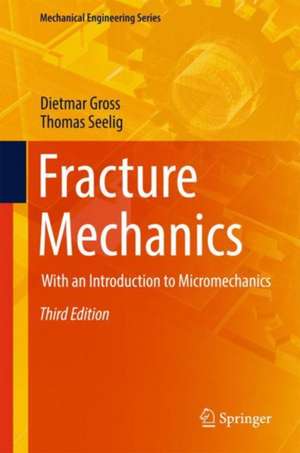
Fracture Mechanics: Mechanical Engineering Series
Autor Dietmar Gross, Thomas Seeligen Limba Engleză Hardback – 7 dec 2017
The third edition is supplemented with various extensions, particularly with regard to the numerical treatment of fracture mechanical problems. Self-contained, well-illustrated and with further reading suggestions, this text serves as a graduate-level text and reference.
Din seria Mechanical Engineering Series
- 18%
 Preț: 1150.77 lei
 - 18%
 Preț: 790.05 lei
 - 15%
 Preț: 633.78 lei
 - 15%
 Preț: 541.47 lei
 - 15%
 Preț: 682.71 lei
 - 15%
 Preț: 643.25 lei
 - 18%
 Preț: 1034.98 lei
 - 15%
 Preț: 556.23 lei
 - 15%
 Preț: 614.77 lei
 - 18%
 Preț: 1171.45 lei
 - 18%
 Preț: 1284.89 lei
 - 15%
 Preț: 667.41 lei
 - 15%
 Preț: 736.05 lei
 - 18%
 Preț: 1046.62 lei
 - 18%
 Preț: 1349.65 lei
 - 15%
 Preț: 659.66 lei
 - 15%
 Preț: 612.66 lei
 - 18%
 Preț: 963.37 lei
 - 18%
 Preț: 1436.90 lei
 - 18%
 Preț: 980.87 lei
 - 18%
 Preț: 977.19 lei
 - 18%
 Preț: 917.76 lei
 - 15%
 Preț: 663.81 lei
 - 18%
 Preț: 1612.20 lei
 - 15%
 Preț: 669.00 lei
 - 18%
 Preț: 847.06 lei
 - 15%
 Preț: 659.45 lei
 -
 Preț: 414.82 lei
 - 15%
 Preț: 617.27 lei
 -
 Preț: 394.77 lei
 -
 Preț: 386.54 lei
 - 18%
 Preț: 770.66 lei
 - 18%
 Preț: 1436.73 lei
 - 18%
 Preț: 1059.37 lei
 - 15%
 Preț: 530.78 lei
 - 18%
 Preț: 1276.06 lei
 - 18%
 Preț: 917.96 lei
 -
 Preț: 431.55 lei
 - 15%
 Preț: 663.90 lei
 -
 Preț: 403.31 lei
 - 18%
 Preț: 988.65 lei
 - 23%
 Preț: 797.31 lei
 -
 Preț: 427.14 lei
 - 18%
 Preț: 752.21 lei
 - 18%
 Preț: 919.51 lei
 - 15%
 Preț: 540.76 lei
 - 15%
 Preț: 635.46 lei
 - 18%
 Preț: 846.51 lei
 - 15%
 Preț: 539.13 lei
Preț: 763.17 lei
Preț vechi: 930.69 lei
-18%
Puncte Express: 1145
Carte tipărită la comandă
Livrare economică 30 noiembrie-14 decembrie
Livrare prin curier în România Termenul estimat este afișat lângă disponibilitate.
Transport gratuit pentru acest produs Plată online sau ramburs, în funcție de opțiunile comenzii.
Retur gratuit în 14 zile Comandă securizată și suport în română.
Specificații
ISBN-13: 9783319710891
ISBN-10: 3319710893
Pagini: 376
Ilustrații: XV, 358 p. 208 illus.
Dimensiuni: 160 x 241 x 26 mm
Greutate: 0.68 kg
Ediția:3rd edition 2018
Editura: Springer
Colecția Mechanical Engineering Series
Seria Mechanical Engineering Series
Locul publicării:Cham, Switzerland
ISBN-10: 3319710893
Pagini: 376
Ilustrații: XV, 358 p. 208 illus.
Dimensiuni: 160 x 241 x 26 mm
Greutate: 0.68 kg
Ediția:3rd edition 2018
Editura: Springer
Colecția Mechanical Engineering Series
Seria Mechanical Engineering Series
Locul publicării:Cham, Switzerland
Cuprins
Elements of solid mechanics.- Classical failure hypotheses.- Micro and macro phenomena of fracture.- Linear fracture mechanics.- Elastic-plastic fracture mechanics.- Creep fracture.- Dynamic fracture mechanics.- Micromechanics and homogenization.- Damage mechanics.- Probabilistic fracture mechanics.
Notă biografică
Prof. Dr.-Ing. Dietmar Gross
studierte Angewandte Mechanik und promovierte an der Universität Rostock. Er habilitierte an der Universität Stuttgart und ist seit 1976 Professor für Mechanik an der TU Darmstadt. Seine Arbeitsgebiete sind unter anderen die Festkörper- und Strukturmechanik sowie die Bruchmechanik. Hierbei ist er auch mit der Modellierung mikromechanischer Prozesse befasst. Er ist Mitherausgeber mehrerer internationaler Fachzeitschriften sowie Autor zahlreicher Lehr- und Fachbücher.
Prof. Dr.Werner Hauger
studierte Angewandte Mathematik und Mechanik an der Universität Karlsruhe und promovierte an der Northwestern University in Evanston/Illinois. Er war mehrere Jahre in der Industrie tätig, hatte eine Professur an der Universität der Bundeswehr in Hamburg und wurde 1978 an die TU Darmstadt berufen. Sein Arbeitsgebiet ist die Festkörpermechanik mit den Schwerpunkten Stabilitätstheorie, Plastodynamik und Biomechanik. Er ist Autor von Lehrbüchern und war Mitherausgeber internationaler Fachzeitschriften.
Prof. Dr.-Ing. Peter Wriggers
studierte Bauingenieur- und Vermessungswesen und promovierte 1980 an der Universität Hannover über Stoß-Kontaktprobleme. 1986 habilitierte er im Fach Mechanik. Weitere Tätigkeiten als Gastprofessor am Department of Civil Engineering an der UC Berkeley (USA) und als Universitätsprofessor für Mechanik an der TH Darmstadt folgten. Ab 1998 war er Professor für Mechanik in der Fakultät für Bauingenieur- und Vermessungswesen der Leibniz Universität Hannover, und er ist seit 2008 Professor für Kontinuumsmechanik in der dortigen Fakultät für Maschinenbau. Seit 2008 steht er der German Association für Computational Mechanics als Präsident vor.
Textul de pe ultima copertă
Concerned with the fundamental concepts and methods of fracture mechanics and micromechanics, this textbook primarily focuses on the mechanical description of fracture process. However, material specific aspects are also discussed. The presentation of continuum mechanical and phenomenological foundations is followed by an introduction into classical failure hypotheses. A major part of the book is devoted to linear elastic and elastic-plastic fracture mechanics. Further subjects are creep fracture, dynamic fracture mechanics, damage mechanics, probabilistic fracture mechanics, failure of thin films and fracture of piezoelectric materials. The book also contains an extensive introduction into micromechanics.
The third edition is supplemented with various extensions, particularly with regard to the numerical treatment of fracture mechanical problems. Self-contained, well-illustrated and with further reading suggestions, this text serves as a graduate-level text and reference.
The third edition is supplemented with various extensions, particularly with regard to the numerical treatment of fracture mechanical problems. Self-contained, well-illustrated and with further reading suggestions, this text serves as a graduate-level text and reference.
Caracteristici
Self-contained and well illustrated Complete and comprehensive derivation of mechanical/mathematical results with emphasis on issues of practical importance Combines classical subjects of fracture mechanics with modern topics such as microheterogeneous materials, piezoelectric materials, thin films, damage Mechanically and mathematically clear and complete derivations of results Includes supplementary material: sn.pub/extras
Recenzii
From the reviews:
"The book ‘Fracture Mechanics with Introduction to Micromechanics’ explains in an easy way fracture processes in homogenous and heterogeneous modern engineering materials with a partial insight into the underlying micromechanism. … This book is essential for several reasons … . In my opinion this excellent book can be recommended both for educational purposes (i.e. advanced courses on composite structures) as well as for scientists, engineers, and Ph. D. students." (Tomasz Sadowski, Zeitschrift für Angewandte Mathematik und Mechanik, Vol. 87 (1), 2007)
"This textbook is an extended English edition of three previous German editions. … this textbook is a well brief presentation of modern concepts and methods of fracture mechanics in both macro- and microscales. The book may be recommended to students, researchers and industry practitioners interested in theoretical backgrounds of fracture mechanics." (I. A. Parinov, Zentralblatt MATH, Vol. 1110 (12), 2007)
"The book ‘Fracture Mechanics with Introduction to Micromechanics’ explains in an easy way fracture processes in homogenous and heterogeneous modern engineering materials with a partial insight into the underlying micromechanism. … This book is essential for several reasons … . In my opinion this excellent book can be recommended both for educational purposes (i.e. advanced courses on composite structures) as well as for scientists, engineers, and Ph. D. students." (Tomasz Sadowski, Zeitschrift für Angewandte Mathematik und Mechanik, Vol. 87 (1), 2007)
"This textbook is an extended English edition of three previous German editions. … this textbook is a well brief presentation of modern concepts and methods of fracture mechanics in both macro- and microscales. The book may be recommended to students, researchers and industry practitioners interested in theoretical backgrounds of fracture mechanics." (I. A. Parinov, Zentralblatt MATH, Vol. 1110 (12), 2007)