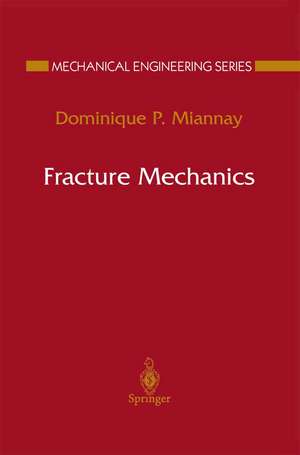
Fracture Mechanics: Mechanical Engineering Series
Autor Dominique P. Miannayen Limba Engleză Paperback – 12 noi 2012
Din seria Mechanical Engineering Series
- 18%
 Preț: 1150.77 lei
 - 18%
 Preț: 790.05 lei
 - 15%
 Preț: 633.78 lei
 - 15%
 Preț: 541.47 lei
 - 15%
 Preț: 682.71 lei
 - 15%
 Preț: 643.25 lei
 - 18%
 Preț: 1034.98 lei
 - 15%
 Preț: 556.23 lei
 - 15%
 Preț: 614.77 lei
 - 18%
 Preț: 1171.45 lei
 - 18%
 Preț: 1284.89 lei
 - 15%
 Preț: 667.41 lei
 - 15%
 Preț: 736.05 lei
 - 18%
 Preț: 1046.62 lei
 - 18%
 Preț: 1349.65 lei
 - 15%
 Preț: 659.66 lei
 - 15%
 Preț: 612.66 lei
 - 18%
 Preț: 963.37 lei
 - 18%
 Preț: 1436.90 lei
 - 18%
 Preț: 980.87 lei
 - 18%
 Preț: 977.19 lei
 - 18%
 Preț: 917.76 lei
 - 15%
 Preț: 663.81 lei
 - 18%
 Preț: 1612.20 lei
 - 15%
 Preț: 669.00 lei
 - 18%
 Preț: 847.06 lei
 - 15%
 Preț: 659.45 lei
 -
 Preț: 414.82 lei
 - 15%
 Preț: 617.27 lei
 -
 Preț: 394.77 lei
 -
 Preț: 386.54 lei
 - 18%
 Preț: 821.38 lei
 - 18%
 Preț: 1436.73 lei
 - 18%
 Preț: 1059.37 lei
 - 15%
 Preț: 530.78 lei
 - 18%
 Preț: 1276.06 lei
 - 18%
 Preț: 917.96 lei
 -
 Preț: 431.55 lei
 - 15%
 Preț: 663.90 lei
 -
 Preț: 403.31 lei
 - 18%
 Preț: 988.65 lei
 - 23%
 Preț: 797.31 lei
 -
 Preț: 427.14 lei
 - 18%
 Preț: 807.38 lei
 - 18%
 Preț: 919.51 lei
 - 15%
 Preț: 540.76 lei
 - 15%
 Preț: 635.46 lei
 - 18%
 Preț: 846.51 lei
 - 15%
 Preț: 539.13 lei
Preț: 622.06 lei
Preț vechi: 731.83 lei
-15%
Puncte Express: 933
Carte tipărită la comandă
Livrare economică 03-17 decembrie
Livrare prin curier în România Termenul estimat este afișat lângă disponibilitate.
Transport gratuit pentru acest produs Plată online sau ramburs, în funcție de opțiunile comenzii.
Retur gratuit în 14 zile Comandă securizată și suport în română.
Specificații
ISBN-13: 9781461272595
ISBN-10: 1461272599
Pagini: 360
Ilustrații: XVIII, 338 p.
Dimensiuni: 155 x 235 x 20 mm
Greutate: 0.55 kg
Ediția:Softcover reprint of the original 1st ed. 1998
Editura: Springer
Colecția Mechanical Engineering Series
Seria Mechanical Engineering Series
Locul publicării:New York, NY, United States
ISBN-10: 1461272599
Pagini: 360
Ilustrații: XVIII, 338 p.
Dimensiuni: 155 x 235 x 20 mm
Greutate: 0.55 kg
Ediția:Softcover reprint of the original 1st ed. 1998
Editura: Springer
Colecția Mechanical Engineering Series
Seria Mechanical Engineering Series
Locul publicării:New York, NY, United States
V-ar putea interesa
-
 The Theory of Materials FailureRichard M. Christensen-28%Preț: 374.03 lei520.50 lei
 -
 Physical Aspects of FractureElisabeth BouchaudPreț: 385.64 lei
 -
 Fracture MechanicsSurjya Kumar Maiti-11%Preț: 479.53 lei538.81 lei
 -
 Fatigue Design of Marine StructuresInge Lotsberg-14%Preț: 882.63 lei1026.31 lei
 -
 Stress Corrosion Cracking of PipelinesY Frank Cheng-9%Preț: 885.69 lei973.29 lei
 -
 Self-Healing CompositesGuoqiang Li-23%Preț: 792.22 lei1028.86 lei
 -
 -18%Preț: 1892.44 lei2307.86 lei
 -
 Preț: 412.54 lei
 -
 -15%Preț: 667.86 lei785.72 lei
 -
 Problems of Fracture Mechanics and FatigueE. E. Gdoutos-18%Preț: 998.37 lei1217.51 lei
 -
 Time-Dependent Fracture MechanicsDominique P. MiannayPreț: 390.21 lei
 -
 Finnie's Notes on Fracture MechanicsC. K. H. Dharan-15%Preț: 609.53 lei717.10 lei
 -
 Experimental Stress Analysis for Materials and StructuresAlessandro Freddi-18%Preț: 1273.53 lei1553.08 lei
 -
 Fracture MechanicsNestor Perez-15%Preț: 618.51 lei727.66 lei
 -
 Elastic-Plastic Mixed-Mode Fracture Criteria and ParametersValery N. Shlyannikov-15%Preț: 664.01 lei781.20 lei
 -
 Multifunctional Barriers for Flexible StructureSophie Duquesne-18%Preț: 985.92 lei1202.34 lei
Public țintă
ResearchCuprins
1 Microscopic aspects of fracture: Cohesive stress.- 2 Linear elastic behaviour of flaws: Purely elastic treatment.- 2.1 The notch: stress and strain concentrations.- 2.2 The crack: stress intensity factors.- 2.3 The three-dimensional crack.- 3 Linear elastic treatment of flaws: Plasticity correction.- 3.1 Model of small scale yielding for a notch.- 3.2 Models of small scale yielding for a crack.- 3.3 Implications of these models in fracture.- 4 Linear elastic treatment of fracture: The risk of brittle fracture.- 4.1 The toughness.- 4.2 The flaw.- 4.3 The mechanical loading.- 4.4 Example of application: Pressure vessels.- 5 Microscopic aspect of fracture: Cleavage and ductile rupture.- 5.1 Background of Dislocation Theory.- 5.2 Experimental modes of investigation.- 5.3 Cleavage fracture.- 5.4 Intergranular fracture.- 5.5 Ductile fracture.- 5.6 Shear fracture.- 5.7 The ductile-brittle transition with smooth and notched specimens.- 6 Plastic treatment of discontinuities: Fully plastic treatment and large deformation correction.- 6.1 Rigid-perfectly plastic material: The limit load.- 6.2 Strain hardening plastic material: The contour integral.- 6.3 The three-dimensional problem.- 6.4 Crack extension.- 6.5 Using the J integral in fatigue analysis.- 7 Plastic treatment of discontinuities: Elastic-plastic treatment.- 7.1 General description of stress and strain fields.- 7.2 The small-scale yielding and theQfamily of fields.- 7.3 Small Scale Yielding and mixed modes.- 7.4 Finite-width crack bodies.- 7.5 The loading parameters.- 7.6 The three-dimensional problem.- 7.7 The quasi-static growth.- 7.8 Implication of these models for fracture.- 8 Elastoplastic treatment of discontinuities: The risk of fracture.- 8.1 Toughness: Relationship between microscopic and macroscopic aspects.- 8.2 Structural applications.- Appendices.- Guide for Further Reading and Bibliography.- Answers to Selected Problems.
Caracteristici
Intended for engineers from a variety of disciplines that deal with structural materials - Describes the current state of knowledge of how fractures in materials form and propagate, leading to failure - Concludes with discussions of generalized plasticity and the link between the microscopic and macroscopic aspects