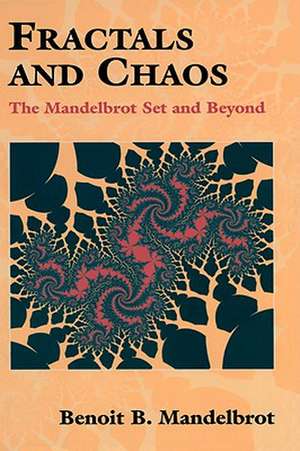
Fractals and Chaos
Autor Benoit Mandelbroten Limba Engleză Hardback – 9 ian 2004
Notăm cu interes apariția volumului Fractals and Chaos, o lucrare de referință care sistematizează contribuțiile fundamentale ale lui Benoit Mandelbrot în domeniul geometriei fractale. Deschidem această analiză prin prisma capitolului dedicat dinamicii quadratice, unde autorul descrie progresia de la simpla observare vizuală la descoperirea matematică riguroasă. Ediția din 2004, publicată de Springer, nu este doar un manual tehnic, ci o arhivă prețioasă ce reunește articole originale, anterior dificil de procurat, și ilustrații din 1979 care, deși pot părea primitive grafic astăzi, au stat la baza unei revoluții în științele exacte. Descoperim aici o structură riguroasă, organizată cronologic și tematic. De la analiza prafului Cantor și Fatou până la demonstrația faptului că frontiera mulțimii Mandelbrot are dimensiunea 2, cartea ghidează cititorul prin procesul intelectual care a dus la definirea „artei rugozității”. Considerăm că forța acestui volum rezidă în capacitatea de a oferi context istoric pentru intuițiile lui Mandelbrot, explicând cum hărțile matematice complexe pot fi generate din reguli simple. Cititorii familiarizați cu Chaos and Fractals de Heinz-Otto Peitgen vor aprecia în acest volum rigoarea surselor primare și perspectiva directă a creatorului domeniului. În timp ce lucrarea lui Peitgen este mai degrabă un text pedagogic accesibil, Fractals and Chaos se concentrează pe fundamentele teoretice și pe evoluția ideilor autorului. Această lucrare completează perfect opera sa, făcând trecerea de la aplicațiile practice din The Misbehavior of Markets la studiul teoretic profund al funcțiilor browniene din Gaussian Self-Affinity and Fractals.
Preț: 1088.14 lei
Preț vechi: 1327.01 lei
-18%
Carte tipărită la comandă
Livrare economică 30 noiembrie-14 decembrie
Livrare express 23-29 octombrie pentru 73.52 lei
Specificații
ISBN-10: 0387201580
Pagini: 324
Ilustrații: XII, 308 p.
Dimensiuni: 160 x 241 x 23 mm
Greutate: 0.6 kg
Ediția:2004
Editura: Springer
Locul publicării:New York, NY, United States
V-ar putea interesa
-
 Euclid's WindowLeonard Mlodinow-31%Preț: 62.99 lei91.64 lei
 -
 -33%Preț: 662.48 lei982.57 lei
 -
 Fractals: A User's Guide for the Natural SciencesHarold M. Hastings-30%Preț: 496.09 lei710.78 lei
 -
 Projective Geometry: An introductionRey Casse-29%Preț: 462.56 lei648.40 lei
 -
 Chaos and Fractals: An Elementary IntroductionDavid P. Feldman-10%Preț: 379.03 lei420.53 lei
 -
 Chaos and FractalsHeinz-Otto Peitgen-23%Preț: 724.70 lei941.16 lei
 -
 Fractals and Scaling in FinanceBenoit B. Mandelbrot-18%Preț: 1049.92 lei1280.39 lei
 -
 Famous Problems in Geometry and How to Solve ThemBenjamin Bold-19%Preț: 63.68 lei78.73 lei
 -
 Excursions in GeometryC. Stanley OgilvyPreț: 73.34 lei
 -
 Introduction to TopologyBert Mendelson-19%Preț: 83.58 lei103.54 lei
 -
 The Mathematics of the Heavens and the EarthGlen van Brummelen-19%Preț: 455.81 lei562.73 lei
 -
 Drawing GeometryJon AllenPreț: 94.11 lei
 -
 Introducing FractalsNigel Lesmoir-GordonPreț: 64.54 lei
Public țintă
ResearchDe ce să citești această carte
Această ediție este esențială pentru cercetătorii și studenții la matematică sau fizică ce doresc să înțeleagă geneza geometriei fractale direct de la sursă. Cititorul câștigă acces la documente istorice și ilustrații rare, beneficiind de o perspectivă unică asupra modului în care vizualizarea computerizată a transformat teoria haosului dintr-o curiozitate matematică într-un instrument științific fundamental.
Despre autor
Benoit Mandelbrot (1924–2010) a fost un matematician polono-francez-american, cunoscut drept părintele geometriei fractale. Cariera sa de 35 de ani la IBM i-a oferit acces la resurse computaționale avansate, permițându-i să devină unul dintre pionierii graficii pe calculator pentru vizualizarea structurilor matematice complexe. Membru de onoare IBM și profesor la Harvard, Mandelbrot a revoluționat înțelegerea formelor naturale, demonstrând că fenomene precum norii sau țărmurile nu pot fi descrise prin geometria euclidiană clasică. A inventat termenul „fractal” în 1975, lăsând o moștenire vastă care influențează astăzi economia, fizica și artele vizuale.
Descriere scurtă
Cuprins
Recenzii
"It is only twenty-three years since Benoit Mandelbrot published his famous picture of what is now called the Mandelbrot Set. The graphics were state of the art, though now they may seem primitive. But how that picture has changed our views of the mathematical and physical universe! Fractals, a term coined by Mandelbrot, are now so ubiquitous in the scientific conscience that it is difficult to remember the psychological shock of their arrival. What we see in this book is a glimpse of how Mandelbrot helped change our way of looking at the world. It is not just a book about a particular class of problems, but contains a view on how to approach the mathematical and physical universe. This view is certain not to fade, but to be part of the working philosophy of the next mathematical revolution, wherever it may take us. So read the book, look at the beautiful pictures that continue to fascinate and amaze, and enjoy! "
--From the foreword by Peter W Jones, Yale University
Praise for Mandelbrot, Benoit B, Fractals and Chaos
American Scientist
"Manderlbrot brings together 25 papers from the past 25 years. Many of them are related in one way or another to the famous inkblot figure to which Mandelbrot’s name is now firmly affixed. Of historical interest are some early images of this fractal object, produced with a crude dot-matrix printer. A few items in the collection have not been previously published, and all are accompanied by feisty commentary."
"This is the fourth volume of Mandelbrot’s Selecta, comprising edited reprints of the author’s papers. … One chapter has been written specifically to help the non-expert appreciate the rest of the book. … accessible to a wide readership. It provides a fascinating insight into the author’s journey of seeing and discovering as the early pictures of the Mandelbrot set started to reveal a whole new world. It gives afeeling for his philosophy and approach of experimental mathematics … ." (Kenneth Falconer, NATURE, Vol. 430, July1, 2004)
"The well-illustrated book combines hard-to-find early papers by the author with additional chapters that describe the historical background and context. Key topics are quadratic dynamics and its Julia and Mandelbrot sets, nonquadratic dynamics, Kleinian limit sets, and the Minkowski measure." (Zentralblatt für Didaktik der Mathematik, Juli, 2004)
"Mandelbrot’s book is a scientific, philosophic and pictorial treatise at the same time and it is one of the rare specimens of serious mathematics books that can be read and re-read at many different levels. … The style is what one would call ‘truly Mandelbrotian’, a mixture of hard science, often with a personal touch … . a book that will be as important for the scientific community … as it will be appealing to a general informed audience." (René L. Schilling, The Mathematical Gazette, March, 2005)
"Benoit Mandelbrot has produced a comprehensive, well-presented review of essential topics … . All chapters are assembled in a way that the overall mix becomes a very well integrated source of know-how … . The author made a serious and effective effort to realize a book that contains more than history, more than mathematics … . it is an excellent book also for supporting courses at University, PhD and Post doc level. Moreover, it is indispensable for scientists … ." (Biomedical Engineering OnLine, May, 2005)
"Chaotic and fractal work has become popular among the mathematicians. … The introductions to reprinted classical texts … . illustrate how a theory emerges, how answers create new questions, and how progress is made. The reader will be grateful not only for these historical explanatory remarks … . Collectively they give a compelling account of how a new branch of mathematics was created by the author. This delightful book makes goodreading." (Helmut Kirchner, Pure and Applied Geophysics, Vol. 162, 2005)
"Benoit Mandelbrot, an award winning, academic nomad … is credited with changing the way scientists in many fields, look at the world. … founded the influential fields of fractal and multifractal geometry. … The book is well populated with black and white graphical computer outputs of fractals and conceptual illustrations. Never before published illustrations … are included. … Recommended for all university science libraries." (James A. Buczynski, E-Streams, Vol. 7 (10), 2004)
"This book is a collection of early papers by Benoit B. Mandelbrot, combined with additional papers … . The reader surely will appreciate the number of pictures and illustrations … . The book will be valued by both mathematicians and physicists who are interested in the field. It is written in a clear and straightforward way whilst pointing out lots of applications. A non-mathematician will appreciate the minimal number of formulas … . the mathematician’s eye will be pleased by the exactness of the presentation." (EMS Newsletter, December, 2005)
"This book contains early papers by Benoit Mandelbrot, as well as additional chapters … . the mathematical papers are extremely interesting, and a collection … is really a treat, but what I found even more fascinating (and more entertaining to read, even for non-specialists) are the papers dealing with background, historical notes, bibliographical notes, commentaries etc. … this is a wonderful book for a large group of readers … . Reading this book was a pleasure." (Mihaela Poplicher, MathDL, January, 2005)
"Benoit Mandelbrot was 80 last year; and it is 25 years since he first saw the ubiquitious set that bears his name. … This book is a selection of articles from the 1980s and early 1990s, together with previously unpublished material from the same period … . The informal mix of mathematics and commentary inMandelbrot’s book provides a fascinating insight into his motivation and method." (Shaun Bullett, Times Higher Education Supplement, August, 2005)
"A scientist becomes rarely the historian of his own work, however here it is the case. … Mandelbrot comments upon each of the selected articles … . The reader will be grateful not only for these historical explanatory remarks, but also for pieces adapted or written by Mandelbrot especially for this book. Collectively they give a compelling account of how a new branch of mathematics was created by the author. This delightful book makes good reading." (Helmut Kirchner, Pure and Applied Geophysics, Vol. 162, 2005)
Textul de pe ultima copertă
"It is only twenty-three years since Benoit Mandelbrot published his famous picture of what is now called the Mandelbrot Set. The graphics were state of the art, though now they may seem primitive. But how that picture has changed our views of the mathematical and physical universe! Fractals, a term coined by Mandelbrot, are now so ubiquitous in the scientific conscience that it is difficult to remember the psychological shock of their arrival. What we see in this book is a glimpse of how Mandelbrot helped change our way of looking at the world. It is not just a book about a particular class of problems, but contains a view on how to approach the mathematical and physical universe. This view is certain not to fade, but to be part of the working philosophy of the next mathematical revolution, wherever it may take us. So read the book, look at the beautiful pictures that continue to fascinate and amaze, and enjoy! "
From the foreword by Peter W Jones, Yale University
This heavily illustrated book combines hard-to-find early papers by the author with additional chapters that describe the historical background and context. Key topics are quadratic dynamics and its Julia and Mandelbrot sets, nonquadratic dynamics, Kleinian limit sets, and the Minkowski measure.
Benoit B Mandelbrot is Sterling Professor of Mathematical Sciences at Yale University and IBM Fellow Emeritus (Physics) at the IBM T J Watson Research Center. He was awarded the Wolf Prize for Physics in 1993 and the Japan Prize for Science and Technology in 2003.