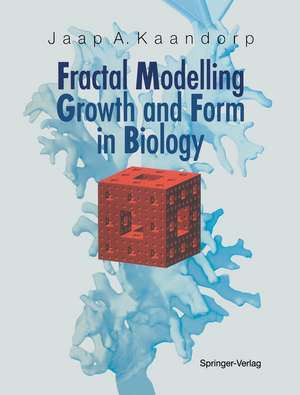
Fractal Modelling
Autor Jaap A. Kaandorpen Limba Engleză Hardback – 12 apr 1994
Preț: 663.30 lei
Preț vechi: 829.13 lei
-20%
Puncte Express: 995
Carte tipărită la comandă
Livrare economică 25 noiembrie-01 decembrie
Livrare prin curier în România Termenul estimat este afișat lângă disponibilitate.
Transport gratuit pentru acest produs Plată online sau ramburs, în funcție de opțiunile comenzii.
Retur gratuit în 14 zile Comandă securizată și suport în română.
Specificații
ISBN-13: 9783540566854
ISBN-10: 3540566856
Pagini: 228
Ilustrații: XIII, 209 p.
Dimensiuni: 215 x 285 x 19 mm
Greutate: 0.81 kg
Ediția:1994
Editura: Springer
Locul publicării:Berlin, Heidelberg, Germany
ISBN-10: 3540566856
Pagini: 228
Ilustrații: XIII, 209 p.
Dimensiuni: 215 x 285 x 19 mm
Greutate: 0.81 kg
Ediția:1994
Editura: Springer
Locul publicării:Berlin, Heidelberg, Germany
V-ar putea interesa
-
 Trigonometry Demystified 2/EStan GibiliscoPreț: 213.91 lei
 -
 -33%Preț: 611.80 lei909.55 lei
 -
 Fractals: A User's Guide for the Natural SciencesHarold M. Hastings-30%Preț: 496.09 lei710.78 lei
 -
 Chaos and Fractals: An Elementary IntroductionDavid P. Feldman-10%Preț: 379.03 lei420.53 lei
 -
 Hyperbolic Dynamics and Brownian Motion: An IntroductionJacques Franchi-31%Preț: 805.16 lei1169.72 lei
 -
 Chaos and FractalsHeinz-Otto Peitgen-23%Preț: 724.70 lei941.16 lei
 -
 Fractals and Scaling in FinanceBenoit B. Mandelbrot-18%Preț: 1049.92 lei1280.39 lei
 -
 Making GeometryJon AllenPreț: 97.17 lei
 -
 Topology and Geometry 2eStahl-9%Preț: 840.15 lei923.24 lei
 -
 -23%Preț: 679.51 lei882.47 lei
 -
 Introducing FractalsNigel Lesmoir-GordonPreț: 64.54 lei
 -
 Diagram GeometryFrancis Buekenhout-18%Preț: 718.47 lei876.18 lei
 -
 PARTICIPATORY APPROACH TO MODERN GEOMETRY, AKappraff JayPreț: 482.16 lei
Public țintă
Professional/practitionerCuprins
1 Introduction.- 1.1 Structure of the Book.- 2 Methods for Modelling Biological Objects.- 2.1 Reaction Diffusion Mechanisms.- 2.2 Iteration Processes and Fractals.- 2.3 Generation of Objects Using Formal Languages.- 2.4 Diffusion Limited Aggregation Models.- 2.5 Generation of Fractal Objects Using Iterated Function Systems.- 2.6 Iterative Geometric Constructions.- 2.7 A Review of the Methods.- 3 2D Models of Growth Forms.- 3.1 Modular Growth.- 3.2 Radiate Accretive Growth.- 3.3 Growth Forms of Modular Organisms and the Physical Environment.- 3.4 Description of the Internal Architecture of the Autotrophic Example: Montastrea annularis.- 3.5 Description of the Internal Architecture of the Heterotrophic Example: Haliclona oculata.- 3.6 An Iterative Geometric Construction Simulating the Radiate Accretive Growth Process of a Branching Organism.- 3.7 A Model of the Physical Environment.- 3.8 Conclusions and Restrictions of the 2D Model.- 3.9 List of Symbols Used in this Chapter.- 4 A Comparison of Forms.- 4.1 A Comparison of a Range of Forms.- 4.2 An Experimental Verification of the Model.- 4.3 Conclusions.- 5 3D Models of Growth Forms.- 5.1 Constructions in Space, a 3D Modelling System for Iterative Constructions.- 5.2 Description of an Organism with Radiate Accretive Growth and a Triangular Tessellation of the Surface.- 5.3 Representation of a Triangular Tessellation.- 5.4 Representation of a Multi-Layer Triangular Tessellation.- 5.5 The Lattice Representation of a Volume Tessellated with Triangles.- 5.6 An Iterative Geometric Construction Simulating the Radiate Accretive Growth Process of a Branching Organism.- 5.7 Conclusions and Restrictions of the Presented 3D Models.- 5.8 List of Symbols Used in Sects. 5.3 to 5.7.- 6 Final Conclusions.- 6.1 The 2D and 3D Simulation Models.- 6.2 Application of the Simulation Models in Ecology.- References.