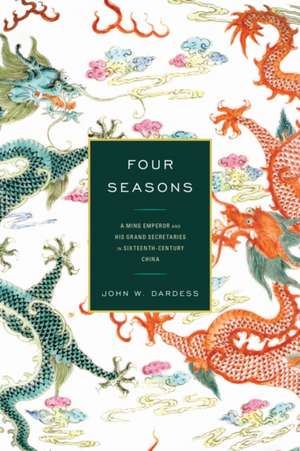
Four Seasons: A Ming Emperor and His Grand Secretaries in Sixteenth-Century China
Autor John W. Dardessen Limba Engleză Paperback – 12 apr 2016
Preț: 295.46 lei
Preț vechi: 379.52 lei
-22%
Puncte Express: 443
Carte tipărită la comandă
Livrare economică 01-15 decembrie
Livrare prin curier în România Termenul estimat este afișat lângă disponibilitate.
Transport gratuit de la 400.00 lei Plată online sau ramburs, în funcție de opțiunile comenzii.
Retur gratuit în 14 zile Comandă securizată și suport în română.
Specificații
ISBN-13: 9781442265592
ISBN-10: 1442265590
Pagini: 294
Dimensiuni: 142 x 226 x 20 mm
Greutate: 0.5 kg
Editura: Bloomsbury Publishing
Colecția Rowman & Littlefield
Locul publicării:New York, United States
ISBN-10: 1442265590
Pagini: 294
Dimensiuni: 142 x 226 x 20 mm
Greutate: 0.5 kg
Editura: Bloomsbury Publishing
Colecția Rowman & Littlefield
Locul publicării:New York, United States
V-ar putea interesa
-
 The Other Side of IsraelSusan NathanPreț: 72.19 lei
 -
 RamessesJoyce TyldesleyPreț: 113.65 lei
 -
 An AutobiographyM. K. Gandhi-29%Preț: 66.52 lei94.29 lei
 -
 Dragon In The Land Of SnowsTsering ShakyaPreț: 235.89 lei
 -
 Zen at WarBrian Daizen Victoria-20%Preț: 317.38 lei397.48 lei
 -
 Genesis of East Asia, 221 B.C.-A.D. 907Charles HolcombePreț: 187.20 lei
 -
 Governing China: 150-1850John W. Dardess-18%Preț: 92.50 lei112.99 lei
 -
 Soldier FiveMike Coburn-24%Preț: 65.89 lei86.37 lei
 -
 Iraq Ablaze: Inside the InsurgencyZaki Chehab-25%Preț: 389.73 lei516.26 lei
Cuprins
Introduction
Chapter 1: A Young Emperor Shows His Teeth
Chapter 2: Spring: Grand Secretary Zhang Fujing
Chapter 3: Summer: Grand Secretary Xia Yan
Chapter 4: Autumn: Grand Secretary Yan Song
Chapter 5: Winter: Grand Secretary Xu Jie
Cast of Principal Characters
Timeline
Bibliography
About the Author
Chapter 1: A Young Emperor Shows His Teeth
Chapter 2: Spring: Grand Secretary Zhang Fujing
Chapter 3: Summer: Grand Secretary Xia Yan
Chapter 4: Autumn: Grand Secretary Yan Song
Chapter 5: Winter: Grand Secretary Xu Jie
Cast of Principal Characters
Timeline
Bibliography
About the Author
Recenzii
Four Seasons is a welcome addition to the field of Ming political history. It will engage students and stimulate scholars. The field would benefit from further studies examining Ming emperors, their Grand Secretaries, and the seasons of government through which they passed.
Professor Dardess's book Four Seasons is a remarkable study of Jiajing's court politics and governance.. In sum, this book is a rich, informative, and thoughtful narrative of Jiajing's court politics and governance refracted through four senior bureaucratic careers. Readers will come away with great appreciation of the role of personality, of the influence of chance, of the relations between the Emperor and his top officials, and of the complexity and ironies at Jiajing's court. The book is a significant contribution to the political history of Ming China.
John W. Dardess offers a detailed and lively narrative of the life of Jiajing and the dramatic period as a whole. . . . Returning to the model of in-depth studies of individuals, Four Seasons represents a long-overdue consideration of the personalities of this pivotal period.
In Four Seasons, John Dardess has once again deployed his unsurpassed mastery of the primary sources for the political history of the Ming court to present a panoramic view of the intricate and fluid dynamics of the Jiajing reign, from 1522 to 1567. Focusing his narrative on the succession of four chief grand secretaries, he traces the course of affairs at the imperial court through the turbulent years of the mid-sixteenth century, from the Great Rites controversy of the 1520s to the aftermath of the fall of Yan Song in the early 1560s. Dardess has mined the correspondence of the emperor and his top counsellors and official records of the court, as well as private writings of the key figures who shaped this era. He has produced an intimate account of the interplay of imperial power in the person of the emperor Zhu Houcong and the individual ambitions and policy agendas of the four most powerful leaders of the civil bureaucracy across the four decades of Jiajing's reign. This book will provide specialists in the Ming with access to a most welcome level of fine detail for a crucial period in China's early modern transformation, and it can also serve as a readable and engaging text for undergraduate courses in Chinese history.
Four Seasons provides a vivid account of the tempestuous confrontations between the Jiajing emperor and his officials-confrontations that altered the political landscape of the Ming Dynasty. Dardess draws on a rich array of private writings and official documents, tracing the arc of the emperor's reign from his hurried and unexpected enthronement as a boy through his political battles over rituals, religion, and war and into cranky old age and Daoist reclusion. Dardess writes with his usual flair, offering a gripping, thoughtful, and informative narrative that's a pleasure to read.
The Jiajing era comes to life in this record of powerful personalities, mammoth rituals, and court intrigue. Four Seasons is a signal contribution to Ming institutional history.
Professor Dardess's book Four Seasons is a remarkable study of Jiajing's court politics and governance.. In sum, this book is a rich, informative, and thoughtful narrative of Jiajing's court politics and governance refracted through four senior bureaucratic careers. Readers will come away with great appreciation of the role of personality, of the influence of chance, of the relations between the Emperor and his top officials, and of the complexity and ironies at Jiajing's court. The book is a significant contribution to the political history of Ming China.
John W. Dardess offers a detailed and lively narrative of the life of Jiajing and the dramatic period as a whole. . . . Returning to the model of in-depth studies of individuals, Four Seasons represents a long-overdue consideration of the personalities of this pivotal period.
In Four Seasons, John Dardess has once again deployed his unsurpassed mastery of the primary sources for the political history of the Ming court to present a panoramic view of the intricate and fluid dynamics of the Jiajing reign, from 1522 to 1567. Focusing his narrative on the succession of four chief grand secretaries, he traces the course of affairs at the imperial court through the turbulent years of the mid-sixteenth century, from the Great Rites controversy of the 1520s to the aftermath of the fall of Yan Song in the early 1560s. Dardess has mined the correspondence of the emperor and his top counsellors and official records of the court, as well as private writings of the key figures who shaped this era. He has produced an intimate account of the interplay of imperial power in the person of the emperor Zhu Houcong and the individual ambitions and policy agendas of the four most powerful leaders of the civil bureaucracy across the four decades of Jiajing's reign. This book will provide specialists in the Ming with access to a most welcome level of fine detail for a crucial period in China's early modern transformation, and it can also serve as a readable and engaging text for undergraduate courses in Chinese history.
Four Seasons provides a vivid account of the tempestuous confrontations between the Jiajing emperor and his officials-confrontations that altered the political landscape of the Ming Dynasty. Dardess draws on a rich array of private writings and official documents, tracing the arc of the emperor's reign from his hurried and unexpected enthronement as a boy through his political battles over rituals, religion, and war and into cranky old age and Daoist reclusion. Dardess writes with his usual flair, offering a gripping, thoughtful, and informative narrative that's a pleasure to read.
The Jiajing era comes to life in this record of powerful personalities, mammoth rituals, and court intrigue. Four Seasons is a signal contribution to Ming institutional history.
Notă biografică
John W. Dardess (1937-2020) was professor emeritus of history at the University of Kansas. His books include Ming China, 1368-1644: A Concise History of a Resilient Empire; Governing China, 150-1850; A Political Life in Ming China: A Grand Secretary and His Times; and Four Seasons: A Ming Emperor and His Grand Secretaries in Sixteenth-Century China.