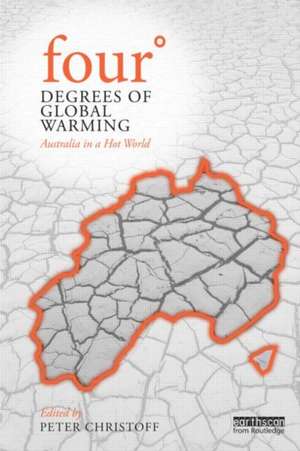
Four Degrees of Global Warming: Australia in a Hot World
Editat de Peter Christoffen Limba Engleză Paperback – 23 sep 2013
Analiza noastră asupra volumului Four Degrees of Global Warming pornește de la datele furnizate de cele mai recente rapoarte climatice internaționale, care indică o prăpastie între promisiunile politice și realitatea emisiilor. Considerăm că această lucrare, coordonată de Peter Christoff, reprezintă un efort academic esențial pentru înțelegerea unui scenariu de criză pe care comunitatea globală a încercat să îl evite la Copenhaga, dar spre care pare să se îndrepte: o lume cu 4 grade Celsius mai caldă.
Textul este structurat riguros în patru părți fundamentale, facilitând o progresie logică de la bazele fizice ale științei climatice către consecințele ecologice, economice și sociale. Primele capitole definesc parametrii climatici ai Australiei într-un astfel de scenariu, fiind urmate de o examinare detaliată a impactului asupra speciilor marine și terestre. Apreciem în mod deosebit includerea unor capitole despre securitatea regională și sănătatea publică, aspecte care transformă criza climatică dintr-o problemă de mediu într-una de stabilitate societală. Din punct de vedere vizual, cele 48 de ilustrații și 33 de desene tehnice oferă o claritate necesară datelor complexe despre creșterea nivelului mării și fenomenele meteorologice extreme.
Acoperă aceeași arie geografică și politică precum The Garnaut Climate Change Review, dar cu o abordare mult mai axată pe consecințele fizice și ecologice specifice pragului de 4 grade, spre deosebire de accentul pus de Garnaut pe cadrele de politici economice. De asemenea, dacă The Copenhagen Diagnosis oferea o actualizare generală a științei climatice, volumul de față aplică aceste date într-un context regional precis, oferind o prognoză dramatică pentru sistemele agricole și urbane ale Australiei. În contextul operei editorului, această carte completează viziunea din The Fires Next Time, unde Peter Christoff analiza impactul incendiilor „Black Summer”, oferind aici cadrul teoretic și climatic mai larg care explică frecvența unor astfel de dezastre.
Preț: 251.13 lei
Carte disponibilă
Livrare economică 15-29 mai
Specificații
ISBN-10: 0415824583
Pagini: 288
Ilustrații: 48 black & white illustrations, 16 black & white tables, 33 black & white line drawings
Dimensiuni: 156 x 234 x 20 mm
Greutate: 0.5 kg
Ediția:New.
Editura: Taylor & Francis
Colecția Routledge
Locul publicării:Oxford, United Kingdom
V-ar putea interesa
-
 Six DegreesMark LynasPreț: 75.66 lei
 -
 Our Final WarningMark LynasPreț: 102.45 lei
 -
 Race for TomorrowSimon MundyPreț: 76.49 lei
 -
 Positive Tipping Points: How to Fix the Climate CrisisTim Lenton OBE-19%Preț: 112.03 lei138.67 lei
 -
 Preț: 214.76 lei
 -
 Sink or Swim: How the world needs to adapt to a changing climateSusannah Fisher-21%Preț: 94.46 lei118.89 lei
 -
 Storms of My GrandchildrenJames Hansen-28%Preț: 64.10 lei88.83 lei
 -
 Capitalism at the LimitUlrich BrandPreț: 152.03 lei
 -
 -27%Preț: 84.62 lei116.63 lei
 -
 -27%Preț: 54.91 lei75.57 lei
 -
 SnoSverker SorlinPreț: 118.80 lei
 -
 2052Jorgen RandersPreț: 139.97 lei
 -
 A Concise Business Guide to Climate ChangeGunnar TrumbullPreț: 188.76 lei
 -
 Living HotClive Hamilton-28%Preț: 48.92 lei68.10 lei
 -
 What We Can KnowIan McEwanPreț: 110.57 leiRecomandat
 -
 OvershootWim CartonPreț: 162.45 lei
 -
 -19%Preț: 73.68 lei90.64 lei
 -
 The 2084 ReportJames Lawrence PowellPreț: 87.38 lei
 -
 -19%Preț: 112.94 lei139.22 leiRecomandat
 -
 Life on a Little-Known PlanetElizabeth KolbertPreț: 180.39 lei
Public țintă
Academic, General, Postgraduate, Professional, Professional Practice & Development, and UndergraduateDe ce să citești această carte
Recomandăm această carte studenților și profesioniștilor din domeniul științelor mediului și politicilor publice care doresc să înțeleagă riscurile concrete ale eșecului negocierilor climatice. Cititorul câștigă o perspectivă fundamentată științific asupra modului în care încălzirea globală reconfigurează economia și securitatea regională. Este un instrument de lucru esențial pentru cei care elaborează strategii de adaptare pe termen lung în fața unor schimbări ireversibile ale ecosistemelor.
Descriere scurtă
Four Degrees of Global Warming: Australia in a Hot World outlines the expected consequences of this world for Australia and its region. Its contributors include many of Australia’s most eminent and internationally recognized climate scientists, climate policy makers and policy analysts. They provide an accessible, detailed, dramatic, and disturbing examination of the likely impacts of a Four Degree World on Australia’s social, economic and ecological systems.
The book offers policy makers, politicians, students, and anyone interested climate change, access to the most recent research on potential Australian impacts of global warming, and possible responses.
Cuprins
Recenzii
–Hans Joachim Schellnhuber, Postdam Institute for Climate Impact Research, Germany
'Four Degrees' reveals what might become of Australians and their country if global average temperatures are allowed to increase by 4 degrees above that of 200 years ago. It paints a 'bleak vision of a continent under assault.' And that will be out future if we do nothing - just keep going along as we are today. Thankfully the book is also full of clear and realistic solutions, which makes it a must-read for all caring Australians.
–Tim Flannery, Chief Commissioner, Climate Commission, Australia
This important book, though ostensibly about climate change, raises profound and personal questions about the type of world we wish to bequeath our children. Setting out stark and scientifically informed choices, the authors provide a cogent framing of the challenging issues facing Australian policy makers, businesses and civil society.
–Kevin Anderson, University of Manchester, UK
Despite a generation of talks, the international community has failed to stem the global increase in greenhouse gas pollution that is causing climate change. Consequently, the earth is set to get hotter, and Australia is in the eye of the storm. In this important new book, Peter Christoff brings together the insights of distinguished scholars, scientists and analysts. They explore the ecological, social and economic impacts for Australia of a much warmer world, in the process providing a valuable guide to the future.
–Paul G. Harris, Hong Kong Institute of Education
This edited volume, with contributions by a large group of Australian physical and social scientists, provides a comprehensive assessment of the impacts of future anthropogenic climate change on the Australian continent. The highly referenced scholarly book is divided into four sections.
– D. Goldblum, Choice Magazine, Northern Illinois University, USA
This text is at once excellent, important and terrifying. The collection of leading scholars on such varied topics puts the text in the best tradition of inter-disciplinary research. The chapters together provide a detailed account of the uncomfortable realities we face in a "four-degree world": a temperature change increasingly feasible given continued emissions growth and the pace of international cooperation.
– Matt McDonald, University of Queensland, Australian Journal of Politics and History
The book’s great strength for use in geographical education is that it brings together papers from elite Australian climate change researchers, each presenting a summary review of issues within their respective fields. The well-structured chapters are generally highly readable and relevant to Australian students.
– Geographical Education, Dr Douglas K Bardsley, The University of Adelaide, South Australia