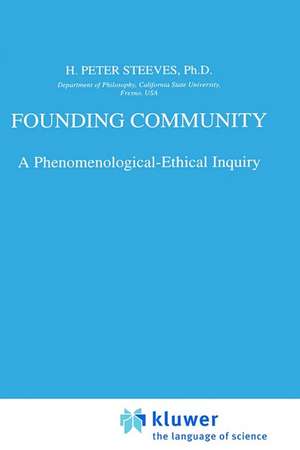
Founding Community: Phaenomenologica, cartea 143
Autor H. P. Steevesen Limba Engleză Hardback – 28 feb 1998
Din seria Phaenomenologica
- 15%
 Preț: 655.58 lei
 -
 Preț: 406.38 lei
 -
 Preț: 405.18 lei
 -
 Preț: 404.74 lei
 -
 Preț: 377.70 lei
 -
 Preț: 412.60 lei
 - 15%
 Preț: 611.34 lei
 - 15%
 Preț: 558.32 lei
 - 15%
 Preț: 542.06 lei
 - 15%
 Preț: 616.27 lei
 - 18%
 Preț: 914.90 lei
 - 18%
 Preț: 978.49 lei
 - 15%
 Preț: 664.25 lei
 -
 Preț: 392.26 lei
 - 18%
 Preț: 1148.59 lei
 - 18%
 Preț: 980.66 lei
 - 18%
 Preț: 1767.29 lei
 - 18%
 Preț: 1598.46 lei
 - 18%
 Preț: 1266.28 lei
 - 18%
 Preț: 972.88 lei
 - 15%
 Preț: 660.08 lei
 - 18%
 Preț: 1146.30 lei
 - 18%
 Preț: 918.59 lei
 - 18%
 Preț: 976.69 lei
 - 18%
 Preț: 1261.30 lei
 - 18%
 Preț: 975.82 lei
 - 15%
 Preț: 448.84 lei
 - 18%
 Preț: 864.41 lei
 - 18%
 Preț: 981.47 lei
 - 15%
 Preț: 663.81 lei
 - 18%
 Preț: 1427.37 lei
 - 15%
 Preț: 662.49 lei
 -
 Preț: 379.04 lei
Preț: 659.66 lei
Preț vechi: 776.08 lei
-15%
Puncte Express: 989
Carte tipărită la comandă
Livrare economică 27 noiembrie-11 decembrie
Livrare prin curier în România Termenul estimat este afișat lângă disponibilitate.
Transport gratuit pentru acest produs Plată online sau ramburs, în funcție de opțiunile comenzii.
Retur gratuit în 14 zile Comandă securizată și suport în română.
Specificații
ISBN-13: 9780792347989
ISBN-10: 0792347986
Pagini: 176
Ilustrații: X, 161 p.
Dimensiuni: 160 x 241 x 15 mm
Greutate: 0.38 kg
Ediția:1998
Editura: Springer
Colecția Phaenomenologica
Seria Phaenomenologica
Locul publicării:Dordrecht, Netherlands
ISBN-10: 0792347986
Pagini: 176
Ilustrații: X, 161 p.
Dimensiuni: 160 x 241 x 15 mm
Greutate: 0.38 kg
Ediția:1998
Editura: Springer
Colecția Phaenomenologica
Seria Phaenomenologica
Locul publicării:Dordrecht, Netherlands
V-ar putea interesa
-
 Moral ClaritySusan NeimanPreț: 125.29 lei
 -
 Free Will and Modern ScienceRichard Swinburne-43%Preț: 144.91 lei254.46 lei
 -
 Utilitarianism and Co-operationDonald H. Regan-33%Preț: 772.14 lei1147.81 lei
 -
 Understanding Human AgencyErasmus Mayr-31%Preț: 745.48 lei1073.55 lei
 -
 -19%Preț: 372.13 lei459.32 lei
 -
 Reflections On How We LiveAnnette Baier-11%Preț: 346.06 lei389.59 lei
 -
 Sidgwickian EthicsDavid Phillips-31%Preț: 691.53 lei1005.82 lei
 -
 Moral Responsibility in Collective ContextsTracy Isaacs-31%Preț: 690.66 lei1005.28 lei
 -
 Gadamer in ConversationHans-Georg GadamerPreț: 239.79 lei
 -
 An Anthropology of EthicsJames D. FaubionPreț: 247.25 lei
 -
 Practical EthicsPeter SingerPreț: 290.54 lei
 -
 Ecological EthicsPatrick CurryPreț: 290.92 lei
 -
 Morality (Canto Classics)Bernard WilliamsPreț: 103.75 lei
 -
 Perspectives on Human Dignity: A ConversationJeff Malpas-15%Preț: 667.08 lei784.79 lei
Public țintă
ResearchCuprins
I: Morality and Phenomenology.- 1. Introduction.- 2. Science, Morality, and Phenomenology.- Notes.- II: The Ego and the Other in a Pairing Relation.- 1. Introduction.- 2. Empathic Perception and the Constitution of the Ego and the Other in Cartesian Meditations.- 3. The Sphere of Ownness.- 4. The Reciprocal Relation of Pairing: Some Problems.- 5. Theunissen and the Question Concerning Pairing.- Notes.- III: Instinct and the Presence of the Other.- 1. The Case for Instinct.- 2. The Other as Unity.- 3. Re-Thinking Infantile Intentionality.- 4. Limitations from a Husserlian Standpoint.- Notes.- IV: Moral Categoriality & Moral Being.- 1. Introduction.- 2. The History of Moral Theory.- 3. Categoriality and Foundations.- 4. Moral Categoriality.- 5. Morality as Choice v. Mode of Being.- 6. Problem: The Unthinking Actor.- 7. Problem: The Non-Judgmental Actor.- 8. Conclusion.- Notes.- V: Phenomenological Communitarianism.- 1. Introduction: The Descriptive and the Normative.- 2. Communitarian Theory in General: Three Problems.- 3. The “Disappearing-Self” Problem.- 4. The “Intersubjective Good” Problem.- 5. The “Constitution of a Community” Problem.- 6. The State of our Union, the Union of our State.- Notes.- VI: Non-Human Life and the Boundaries of Community.- 1. Introduction: A Persian Fable.- 2. Initial Human Pairing with Animals.- 3. “Animal Phenomenology” and the Possibility of Community Generated Without Humans.- 4. The Gracious Act of Attention Late-in-Coming.- 5. Community Through Narrative.- 6. Humans and Animals in a Second-Order Community.- 7. Conclusion: The Common Good as Moral Foundation.- Notes.