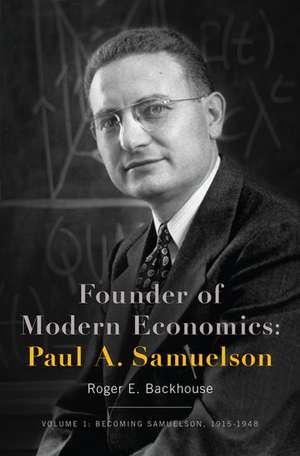
Founder of Modern Economics: Paul A. Samuelson: Volume 1: Becoming Samuelson, 1915-1948: Oxford Studies in History of Economics
Autor Roger E. Backhouseen Limba Engleză Hardback – 27 iul 2017


Preț: 187.39 lei
Preț vechi: 237.02 lei
-21%
Puncte Express: 281
Carte tipărită la comandă
Livrare economică 04-15 decembrie
Livrare prin curier în România Termenul estimat este afișat lângă disponibilitate.
Transport gratuit de la 400.00 lei Plată online sau ramburs, în funcție de opțiunile comenzii.
Retur gratuit în 14 zile Comandă securizată și suport în română.
Specificații
ISBN-13: 9780190664091
ISBN-10: 0190664096
Pagini: 760
Dimensiuni: 163 x 236 x 56 mm
Greutate: 1.09 kg
Editura: Oxford University Press
Colecția OUP USA
Seria Oxford Studies in History of Economics
Locul publicării:New York, United States
ISBN-10: 0190664096
Pagini: 760
Dimensiuni: 163 x 236 x 56 mm
Greutate: 1.09 kg
Editura: Oxford University Press
Colecția OUP USA
Seria Oxford Studies in History of Economics
Locul publicării:New York, United States
Recenzii
Paul Samuelson changed economics and in the process changed the economies and societies we inhabit. This important book tells his story and in the process sheds important new light on the history of our field and our times.
It has been well said that Paul A. Samuelson was the last great general economist-never again will any one person make such foundational contributions to so many distinct areas of economics. His profound theoretical contributions over nearly seven decades of published research have been ecumenical and his ramified influence on the whole of economics has led economists in just about every branch of economics to claim him as one of their own. Here we have an exploration of the role of personality and social networks in understanding the remarkable intellectual development of this singularly remarkable economist. To the reader, Bon Appetit!
America's greatest modern economist transformed economic analysis. The distinguished historian Roger Backhouse has used the newly available Samuelson archives, and much more, to construct this informative and lively intellectual biography to show just how that transformation occurred and Samuelson's role in it. This volume's scholarship will define Samuelson's contributions for a generation.
Like Harrod in his Life of Keynes, Backhouse provides us with an invaluable first full treatment of the life and work of the economist Paul Samuelson, a key transitional figure between prewar and postwar economics. Choosing as his intellectual fathers both Edwin B. Wilson and Alvin Hansen, Samuelson used his third "sacred decade" of intellectual creativity to produce two very different books, Foundations and Economics, so setting the stage for a life of work in the space between them.
Founder of Modern Economics: Paul A. Samuelson Volume 1: Becoming Samuelson, 1915-1948, is an extraordinary achievement. Master historian of thought Roger Backhouse, in producing the definitive study of the development of one of the greatest minds in the history of economics, not only enriches our understanding of the process of the evolution of social science knowledge, but provides new perspectives on the nature of economic theory. This is a wonderful book.
It has been well said that Paul A. Samuelson was the last great general economist-never again will any one person make such foundational contributions to so many distinct areas of economics. His profound theoretical contributions over nearly seven decades of published research have been ecumenical and his ramified influence on the whole of economics has led economists in just about every branch of economics to claim him as one of their own. Here we have an exploration of the role of personality and social networks in understanding the remarkable intellectual development of this singularly remarkable economist. To the reader, Bon Appetit!
America's greatest modern economist transformed economic analysis. The distinguished historian Roger Backhouse has used the newly available Samuelson archives, and much more, to construct this informative and lively intellectual biography to show just how that transformation occurred and Samuelson's role in it. This volume's scholarship will define Samuelson's contributions for a generation.
Like Harrod in his Life of Keynes, Backhouse provides us with an invaluable first full treatment of the life and work of the economist Paul Samuelson, a key transitional figure between prewar and postwar economics. Choosing as his intellectual fathers both Edwin B. Wilson and Alvin Hansen, Samuelson used his third "sacred decade" of intellectual creativity to produce two very different books, Foundations and Economics, so setting the stage for a life of work in the space between them.
Founder of Modern Economics: Paul A. Samuelson Volume 1: Becoming Samuelson, 1915-1948, is an extraordinary achievement. Master historian of thought Roger Backhouse, in producing the definitive study of the development of one of the greatest minds in the history of economics, not only enriches our understanding of the process of the evolution of social science knowledge, but provides new perspectives on the nature of economic theory. This is a wonderful book.
Notă biografică
Roger E. Backhouse is Professor of the History and Philosophy of Economics, University of Birmingham.
Cuprins
- Introduction
- Part I. New Horizons, 1948-60
- 1: MIT and Japan
- 2: Inflation and Stabilization Policy, 1948-60
- 3: RAND and Activity Analysis
- 4: Economic Theory, The 1950s
- 5: Public Economics, The 1950s
- 6: Economics, 1951-59
- 7: Science, Natural, and Social
- Part II. The Kennedy-Johnson Years, 1960-68
- 8: Advising John F. Kennedy, 1960-63
- 9: Johnson and Newsweek, 1963-68
- 10: Economic Theory, The 1960s
- 11: The Two Cambridges
- 12: Marxism and the History of Economic Thought
- 13: Sunday Painting
- Part III. Nobel Prize Winner, 1968-80
- 14: Recognition
- 15: Monetarism and Economic Crises of the 1970s
- 16: Government and the Law
- 17: Economic Theory, 1968-80
- 18: Mathematical Biology
- Part IV. "Retirement," 1980-2009
- 19: Political Economy After 1980
- 20: Mathematical Theory After 1980
- 21: Reflections on Economists
- 22: Creating Modern Economics