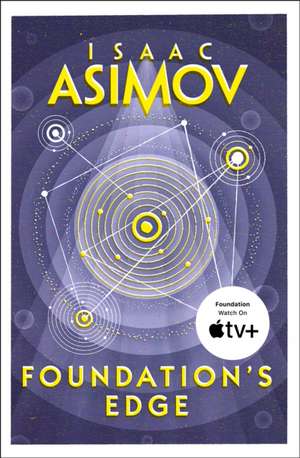
Foundation's Edge: The Foundation Series: Sequels
Autor Isaac Asimoven Limba Engleză Paperback – 17 noi 2016
Notăm cu interes momentul de cotitură pe care Foundation's Edge îl reprezintă în arhitectura vastă a universului asimovian. Premisa ne plasează într-un punct critic: deși Prima Fundație pare să fi câștigat războiul și se pregătește să clădească noul Imperiu pe ruinele celui vechi, zvonurile despre supraviețuirea celei de-a Doua Fundații persistă, amenințând stabilitatea Planului Seldon. Descoperim aici o expansiune fascinantă a lumii, unde certitudinile matematicii psihoistorice sunt provocate de apariția unei entități noi, Gaia — o lume-organism cu o conștiință colectivă care redefinește conceptul de individualitate și control. Reținem modul în care Isaac Asimov rafinează sistemul său magic-tehnologic: dacă în volumele anterioare accentul cădea pe determinismul social, aici explorăm limitele acestuia prin prisma puterilor mentale și a misterului originilor umane. La intersecția dintre Foundation și Second Foundation, această carte combină rigoarea analizei politice cu o aventură spațială de explorare, pe măsură ce protagoniștii caută planeta pierdută, Pământul. Spre deosebire de explorarea dilemelor etice ale inteligenței artificiale din Robot Dreams sau de manipularea temporală din The End of Eternity, Foundation's Edge se concentrează pe destinul biologic și social al umanității, oferind o perspectivă mai matură asupra viitorului. Ritmul este unul cerebral, construit prin dialoguri strategice și dezvăluiri succesive care răstoarnă perspectiva cititorului asupra ierarhiei de putere din galaxie. Este volumul în care Asimov începe să lege firele narative ale tuturor seriilor sale, transformând ficțiunea speculativă într-o veritabilă istorie a viitorului.
Preț: 73.28 lei
Carte disponibilă
Livrare economică 07-21 noiembrie
Livrare express 24-30 octombrie pentru 24.21 lei
Specificații
ISBN-10: 0008117527
Pagini: 432
Dimensiuni: 129 x 195 x 38 mm
Greutate: 0.3 kg
Editura: HarperCollins Publishers
Colecția The Foundation Series: Sequels
Seria The Foundation Series: Sequels
V-ar putea interesa
-
 FoundationIsaac AsimovPreț: 71.60 lei
 -
 Foundation and EmpireIsaac AsimovPreț: 71.60 lei
 -
 Second FoundationIsaac AsimovPreț: 71.60 lei
 -
 Foundation and EarthIsaac AsimovPreț: 72.51 lei
 -
 The Caves of SteelIsaac AsimovPreț: 71.89 lei
 -
 The Naked SunIsaac AsimovPreț: 71.76 lei
 -
 The Robots of DawnIsaac AsimovPreț: 80.29 lei
 -
 Robots and EmpireIsaac AsimovPreț: 73.45 lei
 -
 The Complete RobotIsaac AsimovPreț: 74.79 lei
 -
 Foundation's FearGregory BenfordPreț: 67.73 lei
 -
 Foundation's TriumphDavid BrinPreț: 54.31 lei
 -
 Foundation and ChaosGreg BearPreț: 53.32 lei
 -
 -23%Preț: 62.45 lei81.52 lei
 -
 The Hitchhiker's Guide to the GalaxyDouglas AdamsPreț: 54.48 lei
 -
 The Ego Tunnel: The Science of the Mind and the Myth of the SelfThomas Metzinger-14%Preț: 135.15 lei158.05 lei
 -
 Prelude to FoundationIsaac AsimovPreț: 59.91 lei
 -
 FoundationIsaac Asimov-19%Preț: 52.23 lei64.47 lei
 -
 Second FoundationIsaac Asimov-36%Preț: 41.07 lei64.29 lei
 -
 Foundation and EmpireIsaac Asimov-27%Preț: 46.70 lei64.40 lei
 -
 Forward the FoundationIsaac AsimovPreț: 59.91 lei
 -
 Foundation and EarthIsaac AsimovPreț: 60.94 lei
 -
 The End of EternityIsaac AsimovPreț: 128.78 lei
 -
 Twin Peaks: The Final DossierMark FrostPreț: 193.64 lei
 -
 Einstein's DreamsAlan Lightman-28%Preț: 56.21 lei77.83 lei
 -
 Foundation TrilogyIsaac Asimov-17%Preț: 122.52 lei147.36 lei
 -
 One-Punch Man, Vol. 15Shonengahosha-18%Preț: 53.67 lei65.33 lei
De ce să citești această carte
Recomandăm această lectură celor care doresc să vadă cum evoluează Planul Seldon dincolo de trilogia clasică. Cititorul câștigă o înțelegere mai profundă a echilibrului dintre liberul arbitru și predicția statistică, totul pe fundalul unei căutări epice a originilor umanității. Este o piesă esențială pentru a înțelege cum a fuzionat Isaac Asimov universul roboților cu cel al imperiului galactic.
Despre autor
Isaac Asimov (1920–1992) a fost un scriitor american și profesor de biochimie, recunoscut drept unul dintre cei „Trei Mari” autori de literatură științifico-fantastică, alături de Arthur C. Clarke și Robert A. Heinlein. Autor prolific a peste 500 de volume, Asimov este arhitectul seriei Foundation, recompensată cu premiul Hugo pentru „Cea mai bună serie a tuturor timpurilor”. Prin opera sa, acesta a creat o istorie viitoare unificată, legând seria Roboților de Imperiul Galactic și Fundație, explorând teme precum etica tehnologică, psihoistoria și evoluția socială a umanității în cosmos.
Descriere
It is 498 years since the two Foundations came into existence - half-way through the Interregnum planned by Hari Seldon. The Second Foundation has once more successfully concealed its existence so that the laws of psychohistory can operate to usher in a new Empire ruled by the mental sciences.
Descriere scurtă
The Foundation series is Isaac Asimov's iconic masterpiece. Unfolding against the backdrop of a crumbling Galactic Empire, the story of Hari Seldon's two Foundations is a lasting testament to an extraordinary imagination, one that shaped science fiction as we know it today.
Notă biografică
Isaac Asimov began his Foundation Series at the age of twenty-one, not realizing that it would one day be considered a cornerstone of science fiction. During his legendary career, Asimov penned pver 470 books on subjects ranging from science to Shakespeare to history, though he was most loved for his award-winning science fiction sagas, which include the Robot, Empire, and Foundation series. Named a Grand Master of Science Fiction by the Science Fiction Writers of America, Asimov entertained and educated readers of all ages for close to five decasdes. He died, at age of seventy-two, in April 1992.
Extras
The First Galactic Empire was falling. It had been decaying and breaking down for centuries and only one man fully realized that fact.
He was Han Seldon, the last great scientist of the First Empire, and it was he who perfected psychohistory-the science of human behavior reduced to mathematical equations.
The individual human being is unpredictable, but the reactions of human mobs, Seldon found, could be treated statistically. The larger the mob, the greater the accuracy that could be achieved. And the size of the human masses that Seldon worked with was no less than the population of all the inhabited millions of worlds of the Galaxy.
Seldon's equations told him that, left to itself, the Empire would fall and that thirty thousand years of human misery and agony would elapse before a Second Empire would arise from the ruins. And yet, if one could adjust some of the conditions that existed, that Interregnum could be decreased to a single millennium-just one thousand years.
It was to insure this that Seldon set up two colonies of scientists that he called "Foundations." With deliberate intention, he set them up "at opposite ends of the Galaxy." The First Foundation, which centered on physical science, was set up in the full daylight of publicity. The existence of the other, the Second Foundation, a world of psychohistorical and "mentalic" scientists, was drowned in silence.
In The Foundation Trilogy, the story of the first four centuries of the Interregnum is told. The First Foundation (commonly known as simply "The Foundation," since the existence of another was unknown to almost all) began as a small community lost in the emptiness of the Outer Periphery of the Galaxy. Periodically it faced a crisis in which the variables of human intercourse-and of the social and economic currents of the time-constricted about it. Its freedom to move lay along only one certain line and when it moved in that direction, a new horizon of development opened before it. All had been planned by Han Seldon, long dead now.
The First Foundation, with its superior science, took over the barbarized planets that surrounded it. It faced the anarchic warlords who broke away from the dying Empire and beat them. It faced the remnant of the Empire itself under its last strong Emperor and its last strong general-and beat it.
It seemed as though the "Seldon Plan" was going through smoothly and that nothing would prevent the Second Empire from being established on timeand with a minimum of intermediate devastation..
But psychohistory is a statistical science. Always there is a small chance that something will go wrong, and something did-something which Han Seldon could not have foreseen. One man, called the Mule, appeared from nowhere. He had mental powers in a Galaxy that lacked them. He could mold men's emotions and shape their minds so that his bitterest opponents were made into his devoted servants. Armies could not, would not, fight him. The First Foundation fell and Seldon's Plan seemed to lie in ruins.
There was left the mysterious Second Foundation, which had been caught unprepared by the sudden appearance of the Mule, but which was now slowly working out a counterattack. Its great defense was the fact of its unknown location. The Mule sought it in order to make his conquest of the Galaxy complete. The faithful of what was left of the First Foundation sought it to obtain help.
Neither found it. The Mule was stopped first by the action of a woman, Bayta Darell, and that bought enough time for the Second Foundation to organize the proper action and, with that, to stop the Mule permanently. Slowly they prepared to reinstate the Seldon Plan.
But, in a way, the cover of the Second Foundation was gone. The First Foundation knew of the Second's existence, and the First did not want a future in which they were overseen by the mentalists. The First Foundation was the superior in physical force, while the Second Foundation was hampered not only by that fact, but by being faced by a double task: it had not only to stop the First Foundation but had also to regain its anonymity.
This the Second Foundation, under its greatest "First Speaker," Preem Palver, managed to do. The First Foundation was allowed to seem to win, to seem to defeat the Second Foundation, and it moved on to greater and greater strength in the Galaxy, totally ignorant that the Second Foundation still existed.
It is now four hundred and ninety-eight years after the First Foundation had come into existence. It is at the peak of its strength, but one man does not accept appearances--