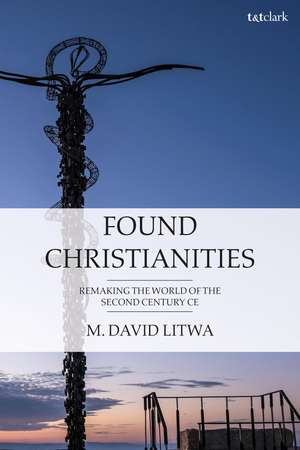
Found Christianities: Remaking the World of the Second Century CE
Autor Dr M. David Litwaen Limba Engleză Hardback – 24 mar 2022
Litwa outlines these different groups and the controversies that surrounded them, presenting readers with an overview of the vast tapestry of beliefs that made up second century Christianity. By moving beyond notions of "gnostic", "heretical" and "orthodox" Litwa allows these "lost Christianities" to speak for themselves. He also questions the notion of some Christian identities "surviving" or "perishing", arguing that all second century "Catholic" groups look very different to any form of modern Roman Catholicism.
Litwa shows that countless discourses, ideas, and practices are continually recycled and adapted throughout time in the building of Christian identities, and indeed that the influence of so-called "lost" Christianities can still be felt today.
Preț: 514.87 lei
Preț vechi: 666.02 lei
-23%
Puncte Express: 772
Carte tipărită la comandă
Livrare economică 15-29 septembrie
Livrare prin curier în România Termenul estimat este afișat lângă disponibilitate.
Transport gratuit pentru acest produs Plată online sau ramburs, în funcție de opțiunile comenzii.
Retur gratuit în 14 zile Comandă securizată și suport în română.
Specificații
ISBN-13: 9780567703873
ISBN-10: 0567703878
Pagini: 336
Dimensiuni: 156 x 234 x 25 mm
Greutate: 0.64 kg
Editura: Bloomsbury Publishing
Colecția T&T Clark
Locul publicării:London, United Kingdom
ISBN-10: 0567703878
Pagini: 336
Dimensiuni: 156 x 234 x 25 mm
Greutate: 0.64 kg
Editura: Bloomsbury Publishing
Colecția T&T Clark
Locul publicării:London, United Kingdom
Cuprins
Acknowledgements
Abbreviations
Chronological Table
Introduction
Chapter 1: Setting the Scene: The World of the Second Century CE
Part I: Early Christian Leaders and their Movements
Chapter 2: Cerinthus and John
Chapter 3: Simon, Helen, and Simonian Christians
Chapter 4: The "Nicolaitans" and Nicolaus
Part II: Early Syrian Teachers
Chapter 5: Menander
Chapter 6: Saturninus
Chapter 7: The Seed of Seth
Part III: Early Egyptian Theologians
Chapter 8: "Ophite" and "Peratic" Christians
Chapter 9: Basilides and Isidore
Chapter 10: Carpocrates, Epiphanes, and Marcellina
Chapter 11: Valentinus
Part IV: Texts and Figures in Rome
Chapter 12: The Gospel of Truth
Chapter 13: The Treatise on the Resurrection
Chapter 14: Marcion
Chapter 15: Ptolemy and Flora
Chapter 16: Heracleon
Part V: Some Christian Leaders in Asia Minor
Chapter 17: Marcus and the Rise of Valentinian Churches
Chapter 18: Noetus and his Followers
Part VI: Theologians in Later Second-century Rome
Chapter 19: Tatian
Chapter 20: Lucanus, Apelles, and Philumene
Chapter 21: Theodotus, Florinus, and "Melchizedekian" Christians
Chapter 22: Justin, author of Baruch
Part VII: Later Theologians in Alexandria
Chapter 23: Julius Cassianus and Tatian
Chapter 24: Prodicus and his Disciples
Chapter 25: The Naassene Preacher
Chapter 26: "Sethian" Christians of the Refutation
Conclusion
Bibliography
Index
Abbreviations
Chronological Table
Introduction
Chapter 1: Setting the Scene: The World of the Second Century CE
Part I: Early Christian Leaders and their Movements
Chapter 2: Cerinthus and John
Chapter 3: Simon, Helen, and Simonian Christians
Chapter 4: The "Nicolaitans" and Nicolaus
Part II: Early Syrian Teachers
Chapter 5: Menander
Chapter 6: Saturninus
Chapter 7: The Seed of Seth
Part III: Early Egyptian Theologians
Chapter 8: "Ophite" and "Peratic" Christians
Chapter 9: Basilides and Isidore
Chapter 10: Carpocrates, Epiphanes, and Marcellina
Chapter 11: Valentinus
Part IV: Texts and Figures in Rome
Chapter 12: The Gospel of Truth
Chapter 13: The Treatise on the Resurrection
Chapter 14: Marcion
Chapter 15: Ptolemy and Flora
Chapter 16: Heracleon
Part V: Some Christian Leaders in Asia Minor
Chapter 17: Marcus and the Rise of Valentinian Churches
Chapter 18: Noetus and his Followers
Part VI: Theologians in Later Second-century Rome
Chapter 19: Tatian
Chapter 20: Lucanus, Apelles, and Philumene
Chapter 21: Theodotus, Florinus, and "Melchizedekian" Christians
Chapter 22: Justin, author of Baruch
Part VII: Later Theologians in Alexandria
Chapter 23: Julius Cassianus and Tatian
Chapter 24: Prodicus and his Disciples
Chapter 25: The Naassene Preacher
Chapter 26: "Sethian" Christians of the Refutation
Conclusion
Bibliography
Index
Recenzii
[Found Christianities] forges the way for the reader to understand early Christian groups as part of the larger Christian context and not as the "other." It is, therefore, an important book for those who wish to know more about the history of Christianity before the triumph of orthodoxy.
There's no time better than the present to study early Christianity. Long-forgotten ancient writings that resurfaced in the nineteenth and twentieth centuries have overturned traditional accounts of Christianity's rise. The task now is to rewrite that history in a way that takes into consideration all of the available voices, even those long ago dismissed as 'heretical.' Found Christianities takes up this challenge by restoring marginalized early Christian writers to their rightful place alongside the so-called Church Fathers as pioneers and influencers in Christianity's earliest centuries.
David Litwa's fascinating book tells the stories of those early Christians whom other Christians rejected by denying they were Christian. Navigating carefully amidst ancient sources, Litwa offers a comprehensive treatment of the varieties of second-century Christianity. I highly recommend this book for anyone wishing to understand the complex world in which Christianity evolved.
There's no time better than the present to study early Christianity. Long-forgotten ancient writings that resurfaced in the nineteenth and twentieth centuries have overturned traditional accounts of Christianity's rise. The task now is to rewrite that history in a way that takes into consideration all of the available voices, even those long ago dismissed as 'heretical.' Found Christianities takes up this challenge by restoring marginalized early Christian writers to their rightful place alongside the so-called Church Fathers as pioneers and influencers in Christianity's earliest centuries.
David Litwa's fascinating book tells the stories of those early Christians whom other Christians rejected by denying they were Christian. Navigating carefully amidst ancient sources, Litwa offers a comprehensive treatment of the varieties of second-century Christianity. I highly recommend this book for anyone wishing to understand the complex world in which Christianity evolved.