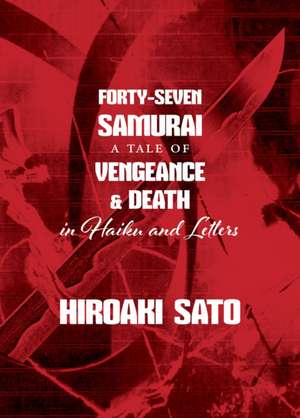
Forty-Seven Samurai
Autor Hiroaki Satoen Limba Engleză Paperback – 26 noi 2019
Aplicabilitatea practică a volumului Forty-Seven Samurai rezidă în capacitatea sa de a demonta mitul popular pentru a restabili adevărul istoric al incidentului Ako din 1701. Notăm cu interes modul în care Hiroaki Sato refuză simplificările narative, alegând în schimb o examinare multidisciplinară care îmbină rigoarea documentară cu analiza literară. Reținem că această lucrare nu se limitează la cronica evenimentelor — rana provocată de lordul Asano Naganori și vendeta ulterioară a celor 46 de samurai — ci investighează modul în care gestul lor a fost codificat cultural prin haiku-urile compuse chiar de către aceștia înainte de seppuku. Descoperim aici o perspectivă critică asupra modului în care loialitatea și onoarea au fost interpretate în perioada Edo, oferind portrete nuanțate ale protagoniștilor care depășesc arhetipurile din teatrul kabuki sau producțiile cinematografice recente. Forty-Seven Samurai acoperă aceeași arie tematică precum volumul 47 Ronin de A. B. Mitford, însă propune o abordare mai analitică și mai ancorată în surse primare, spre deosebire de caracterul legendar și anecdotic al versiunii lui Mitford. De asemenea, față de lucrarea lui Stephen Turnbull, The Revenge of the 47 Ronin, care pune accentul pe detaliile militare și tactice ale asaltului asupra reședinței lui Kira Yoshinaka, Sato oferă o dimensiune umanistă esențială prin includerea traducerii povestirii lui Akutagawa Ryunosuke. Această ediție de la Stone Bridge Press devine astfel o resursă academică și literară ce permite cititorului să înțeleagă de ce acest act de violență ritualică a rămas pilonul central al identității etice japoneze, dincolo de distorsionările comerciale moderne.
Preț: 114.80 lei
Carte disponibilă
Livrare economică 16-30 noiembrie
Specificații
ISBN-10: 1611720540
Pagini: 266
Dimensiuni: 152 x 216 x 14 mm
Greutate: 0.37 kg
Editura: Stone Bridge Press
V-ar putea interesa
-
 Preț: 267.75 lei
-
 My Friend Hitler: And Other PlaysYukio MishimaPreț: 260.44 lei
-
 On HaikuHiroaki SatoPreț: 132.50 lei
-
 Bathhouse and Other TankaIshii TatsuhikoPreț: 93.23 lei
-
 Poems of a PenisistMutsuo TakahashiPreț: 103.51 lei
-
 One Hundred FrogsHiroaki SatoPreț: 133.76 lei
-
 Sleeping, Sinning, FallingMutsuo TakahashiPreț: 84.55 lei
-
 Bibliography of JapanBrooklyn MuseumPreț: 75.36 lei
-
 Monograph on Ivory Carving in BurmaPratt H. S.Preț: 75.15 lei
-
 Dating PilipinasSofronio G. Calder N.Preț: 99.92 lei
-
 Preț: 184.69 lei
-
 The Proper Limits of the Government's Interference with the Affairs of the East-India CompanyStair John Dalrymple Earl ofPreț: 85.65 lei
-
 The Importance of a Clear Understanding of Britain's Work in India: An Inaugural Lecture DeliveredVerney Lovett Harrington Verney LovettPreț: 75.92 lei
-
 Preț: 86.44 lei
-
 Records of Travels Is Turkey, Greece, &C.Adolphus SladePreț: 209.43 lei
-
 Preț: 317.44 lei
-
 A Muslim Conspiracy in British India?Chandra MallampalliPreț: 296.84 lei
-
 To Kill a SultanHoussine Alloul-15%Preț: 591.75 lei696.18 lei
-
 -25%Preț: 250.23 lei332.02 lei
-
 The Chaplains of the East India Company, 1601-1858Revd Dr Daniel O'ConnorPreț: 275.79 lei
-
 -15%Preț: 606.46 lei713.49 lei
De ce să citești această carte
Această carte se adresează celor care doresc să depășească clișeele cinematografice despre samurai. Cititorul câștigă o înțelegere profundă a codului bushido prin documente autentice și poezie, nu doar prin cronica luptelor. Este o recomandare esențială pentru studenții de istorie asiatică și pentru pasionații de cultură japoneză care caută rigoare istorică împletită cu analiză literară de înaltă clasă.
Descriere
Notă biografică
Hiroaki Sato is a prolific, award-winning writer of books on Japanese history and literature, and a translator of classical and modern Japanese poetry into English. American poet Gary Snyder has called Sato "perhaps the finest translator of contemporary Japanese poetry into American English."
He is the author of the classic works Legends of the Samurai. and The Sword and the Mind
His reviews and articles have appeared in The Philadelphia Inquirer, The New York Times Book Review, AsiaWeek, Mainichi Daily News, St. Andrews Review, Journal of the Association of Teachers of Japanese, The Journal of American and Canadian Studies, Comparative Literature Studies, The Japan Times, The Harvard Journal of Asiatic Studies, The Journal of Japanese Studies, Modern Haiku, Japan Focus, and others.
He recently received the 2017-2018 Japan-U.S. Friendship Commission Translation Prize for Silver Spoon (Stone Bridge Press).
Cuprins
Contents
Introduction
Part I: Grudge and Vendetta (12,500 words)
- The Country Is “Full of Light”
- Shogun Tsunayoshi and Genroku Era
- “Pitying the Sentient” Edicts
- A Haiku Scholar’s Take
- Titles and Number of Participants
- Asano Attacks Kira
- Why Did Asano Want to Kill Kira?
- Neither a Daimyo Nor a Samurai
- Dramatic Elements
- Seppuku
- The Treatment of Avengers
- Camouflage
Part II: Leader Ōishi Kuranosuke and His Men (19,400 words)
- Escheatment
- The First Ninja’s Report
- We Are All Hicks
- Another Ninja’s Report
- The Disagreements
- Onodera Jūnai’s Letters
- Failure to Commit Seppuku Mocked
- Restoring the Asano House
- The “Radicals”
- Kuranosuke Responds
- Kuranosuke’s Appearance
- Sword Fights and Killings
- Uncertain Samurai Life
- Kuranosuke Indulges in Gay Quarters
- A House of Sorrow
- Did Kuranosuke Really Drown in “Wine and Flesh”?
- The Way of the Samurai
- Kuranosuke’s Last Letters
Chapter III: Poetic Connections
- Gengo’s Travelogue: Going Down the Tōkaidō Road in a Daimyo Procession
- Gengo’s Haikai Teacher Sentoku’s Opinion: Was the Lord President of Akō Stingy?
- Gengo Pays Respects to Bashō’s Grave
- 1697: Another Ill Effect of “Pitying the Sentient”
- Gengo’s Haikai Anthology and Kayano Sanpei’s Suicide
- A Mysterious Tale about a Mysterious Birth
- How Ōtaka Shiyō Made Use of Haikai Man Teisa
- Gengo’s Encounter with Haikai Master Kikaku the Day before the Vendetta
- Kikaku’s Letter on the Night of the Raid
- A Real Kikaku Letter?
- The Great Fire, Asano Naganao, the Firefighters’ Uniform
- The Announcement, the Raid, and its Aftermath
- Extracts from the First Full Account of the Forty-Seven Samurai
- Ōtaka Gengo’s Farewell-to-the-World Verse
- Sentoku’s Other Students
- Another Story about Teisa and Akō Men
- A Spearman Had to Drop Out
IV: An Akutagawa Story
Bibliography
Index