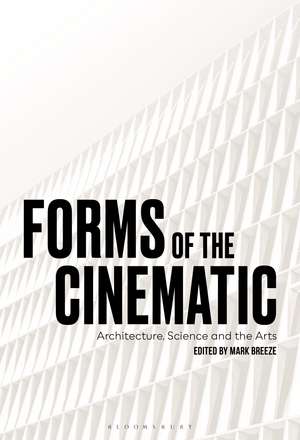
Forms of the Cinematic: Architecture, Science and the Arts
Editat de Mark Breezeen Limba Engleză Paperback – 28 iul 2022
| Toate formatele și edițiile | Preț | Express |
|---|---|---|
| Paperback (1) | 202.96 lei 6-8 săpt. | |
| Bloomsbury Publishing – 28 iul 2022 | 202.96 lei 6-8 săpt. | |
| Hardback (1) | 555.03 lei 6-8 săpt. | |
| Bloomsbury Publishing – 25 feb 2021 | 555.03 lei 6-8 săpt. |
Preț: 202.96 lei
Preț vechi: 278.79 lei
-27%
Puncte Express: 304
Preț estimativ în valută:
35.89€ • 42.28$ • 31.29£
35.89€ • 42.28$ • 31.29£
Carte tipărită la comandă
Livrare economică 10-24 aprilie
Specificații
ISBN-13: 9781501374906
ISBN-10: 1501374907
Pagini: 232
Ilustrații: 26 bw illus
Dimensiuni: 152 x 229 mm
Greutate: 0.31 kg
Editura: Bloomsbury Publishing
Colecția Bloomsbury Academic
Locul publicării:New York, United States
ISBN-10: 1501374907
Pagini: 232
Ilustrații: 26 bw illus
Dimensiuni: 152 x 229 mm
Greutate: 0.31 kg
Editura: Bloomsbury Publishing
Colecția Bloomsbury Academic
Locul publicării:New York, United States
Cuprins
Forms of the cinematic: An introduction
Mark E. Breeze (University of Cambridge, UK)
Part One
Rethinking: from Idea to Structure
1. Idea and image
D. N. Rodowick (University of Chicago, USA)
2. The screen as barrier and support: Monitoring, projection and perfectionism in Brad Bird's Tomorrowland: A World Beyond (2015)
Stephen Mulhall (University of Oxford, UK)
3. Surface thoughts: On the look of cinema
John O´Maoilearca (Kingston University, UK)
4. The film event: From Bazin to Deleuze
Tom Conley (Harvard University, USA)
Part Two
Revisualizing: from the Tangible to the Intangible
5. What film studies is: Mapping the discipline
Annette Kuhn and Guy Westwell (Queen Mary University of London, UK)
6. A cinematic aided design approach and the need for (in)-disciplinarity
Francois Penz (University of Cambridge, UK)
7. Microcinematography and biomedical science
Brian Stramer (King's College London, UK)
8. Cinematic forms and cultural heritage
Maureen Thomas (Norwegian Film School, Norway)
Part Three
Reconstructing: from Writing to Architecture
9. The modulation of emphasis: Screenwriting as a literary art
Clare L. E. Foster (University of Cambridge, UK)
10. Mapping Andrei Tarkovsky's Stalker: An architectural exploration of the 'Zone'
Stavros Alifragkis (Aristotle University of Thesonaliki, Greece)
11. Architecture Beyond Sight: Filming blindness
Anna Ulrikke Andersen (University College London, UK)
12. Towards an architecture of the cinematic
Mark E. Breeze (University of Cambridge, UK)
Index
Mark E. Breeze (University of Cambridge, UK)
Part One
Rethinking: from Idea to Structure
1. Idea and image
D. N. Rodowick (University of Chicago, USA)
2. The screen as barrier and support: Monitoring, projection and perfectionism in Brad Bird's Tomorrowland: A World Beyond (2015)
Stephen Mulhall (University of Oxford, UK)
3. Surface thoughts: On the look of cinema
John O´Maoilearca (Kingston University, UK)
4. The film event: From Bazin to Deleuze
Tom Conley (Harvard University, USA)
Part Two
Revisualizing: from the Tangible to the Intangible
5. What film studies is: Mapping the discipline
Annette Kuhn and Guy Westwell (Queen Mary University of London, UK)
6. A cinematic aided design approach and the need for (in)-disciplinarity
Francois Penz (University of Cambridge, UK)
7. Microcinematography and biomedical science
Brian Stramer (King's College London, UK)
8. Cinematic forms and cultural heritage
Maureen Thomas (Norwegian Film School, Norway)
Part Three
Reconstructing: from Writing to Architecture
9. The modulation of emphasis: Screenwriting as a literary art
Clare L. E. Foster (University of Cambridge, UK)
10. Mapping Andrei Tarkovsky's Stalker: An architectural exploration of the 'Zone'
Stavros Alifragkis (Aristotle University of Thesonaliki, Greece)
11. Architecture Beyond Sight: Filming blindness
Anna Ulrikke Andersen (University College London, UK)
12. Towards an architecture of the cinematic
Mark E. Breeze (University of Cambridge, UK)
Index
Recenzii
This rich interdisciplinary collection establishes the cinematic as a form for rethinking, revisualizing and reconstructing space and time, and as a socio-cultural tool that enables us to redefine our engagement with the world. Featuring texts by theorists and practitioners from philosophy, film studies, filmmaking, biology, documentary practice, screenwriting and architecture, often employing inventive research methodologies, the anthology is essential in its examination of cinema's wide ranging impact on different fields of knowledge.