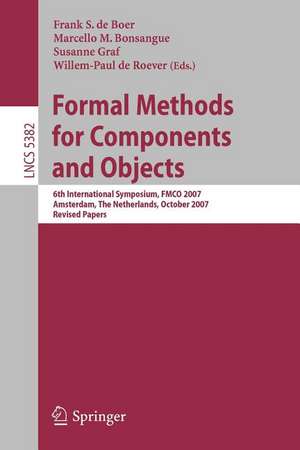
Formal Methods for Components and Objects
Editat de Marcello M. Bonsangue, Susanne Graf, Willem-Paul De Roeveren Limba Engleză Paperback – dec 2008
The 6th International Symposium on Formal Methods for Components and Objects, FMCO 2007, was held in Amsterdam, The Netherlands, in October 2007. This book presents 12 revised papers submitted after the symposium by the speakers of each of the following European IST projects: the IST-FP6 project Mobius, developing the technology for establishing trust and security for the next generation of global computers; the IST-FP6 project SelfMan on self management for large-scale distributed systems based on structured overlay networks and components; the IST-FP6 project GridComp and the FP6 CoreGRID Network of Excellence on grid programming with components; the Real-time component cluster of the Network of Excellence on Embedded System Design ARTIST, focussing on design processes, and architectures for real-time embedded systems; and the IST-FP6 project CREDO on modeling and analysis of evolutionary structures for distributed services.
Preț: 323.39 lei
Preț vechi: 404.23 lei
-20%
Puncte Express: 485
Carte tipărită la comandă
Livrare economică 28 noiembrie-12 decembrie
Livrare prin curier în România Termenul estimat este afișat lângă disponibilitate.
Transport gratuit de la 400.00 lei Plată online sau ramburs, în funcție de opțiunile comenzii.
Retur gratuit în 14 zile Comandă securizată și suport în română.
Specificații
ISBN-13: 9783540921875
ISBN-10: 3540921877
Pagini: 324
Ilustrații: X, 313 p.
Dimensiuni: 155 x 235 x 18 mm
Greutate: 0.49 kg
Ediția:2008
Editura: Springer
Locul publicării:Berlin, Heidelberg, Germany
ISBN-10: 3540921877
Pagini: 324
Ilustrații: X, 313 p.
Dimensiuni: 155 x 235 x 18 mm
Greutate: 0.49 kg
Ediția:2008
Editura: Springer
Locul publicării:Berlin, Heidelberg, Germany
V-ar putea interesa
-
 -27%Preț: 676.09 lei926.15 lei
 -
 Software Modeling and DesignHassan Gomaa-20%Preț: 665.25 lei831.56 lei
 -
 KanbanDavid J. Anderson-20%Preț: 264.20 lei330.25 lei
 -
 The Human Side of AgileGil BrozaPreț: 271.68 lei
 -
 Software EngineeringRuneson-20%Preț: 471.15 lei588.94 lei
 -
 Professional GitBrent Laster-20%Preț: 256.78 lei320.97 lei
 -
 Python AlgorithmsMagnus Lie Hetland-20%Preț: 468.00 lei584.99 lei
 -
 The Definitive Guide to HTML5 WebSocketVanessa Wang-20%Preț: 372.28 lei465.36 lei
 -
 PC VirusesAlan Solomon-20%Preț: 324.72 lei405.90 lei
 -
 Head First AgileAndrew Stellman-20%Preț: 343.20 lei429.00 lei
 -
 Reliability and Optimization of Structural SystemsRudiger Rackwitz-20%Preț: 1244.28 lei1555.34 lei
 -
 Continuous Delivery with Visual Studio ALM 2015Mathias Olausson-20%Preț: 299.70 lei374.63 lei
 -
 Design It! : Pragmatic ProgrammersMicahel Keeling-20%Preț: 257.50 lei321.87 lei
 -
 Mastering ServiceNow - Second EditionMartin Wood-20%Preț: 368.74 lei460.93 lei
 -
 Automated Technology for Verification and AnalysisDang Van Hung-20%Preț: 334.63 lei418.29 lei
 -
 -20%Preț: 321.63 lei402.04 lei
 -
 Linear Time, Branching Time and Partial Order in Logics and Models for ConcurrencyJacobus W. De Bakker-20%Preț: 671.75 lei839.68 lei
 -
 Das CD-ROM-BuchRalf Menssen-20%Preț: 357.09 lei446.35 lei
 -
 Stepwise Refinement of Distributed SystemsJaco W. De Bakker-20%Preț: 676.86 lei846.06 lei
 -
 Formal Techniques in Real-Time and Fault-Tolerant SystemsHans Langmaack-20%Preț: 649.91 lei812.38 lei
 -
 -20%Preț: 651.59 lei814.48 lei
 -
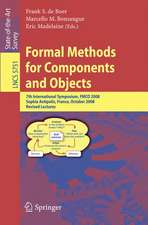 Formal Methods for Components and ObjectsMarcello M. Bonsangue-20%Preț: 322.80 lei403.50 lei
 -
 Software Engineering for Resilient SystemsAnatoliy Gorbenko-20%Preț: 290.24 lei362.80 lei
 -
 Formal Methods and Software EngineeringLindsay Groves-20%Preț: 344.83 lei431.04 lei
 -
 Conceptual Modeling - ER 2013Wilfred Ng-20%Preț: 348.02 lei435.02 lei
 -
 The NIAM Information Analysis MethodJ. J. V. R. Wintraecken-20%Preț: 332.05 lei415.06 lei
Public țintă
ResearchCuprins
The MOBIUS Project.- The MOBIUS Proof Carrying Code Infrastructure.- Certification Using the Mobius Base Logic.- Safety Guarantees from Explicit Resource Management.- Universe Types for Topology and Encapsulation.- COSTA: Design and Implementation of a Cost and Termination Analyzer for Java Bytecode.- The GridCOMP Project.- Active Objects and Distributed Components: Theory and Implementation.- The SELFMAN Project.- Self Management for Large-Scale Distributed Systems: An Overview of the SELFMAN Project.- The ARTIST Project.- Causal Semantics for the Algebra of Connectors.- Multiple Viewpoint Contract-Based Specification and Design.- The CREDO Project.- Coordination: Reo, Nets, and Logic.- An Object-Oriented Component Model for Heterogeneous Nets.- Coordinating Object Oriented Components Using Data-Flow Networks.
Textul de pe ultima copertă
Formal methods have been applied successfully to the verification of medium-sized programs in protocol and hardware design. However, their application to the development of large systems requires more emphasis on specification, modelling and validation techniques supporting the concepts of reusability and modifiability, and their implementation in new extensions of existing programming languages like Java.
The 6th International Symposium on Formal Methods for Components and Objects, FMCO 2007, was held in Amsterdam, The Netherlands, in October 2007. This book presents 12 revised papers submitted after the symposium by the speakers of each of the following European IST projects: the IST-FP6 project Mobius, developing the technology for establishing trust and security for the next generation of global computers; the IST-FP6 project SelfMan on self management for large-scale distributed systems based on structured overlay networks and components; the IST-FP6 project GridComp and the FP6 CoreGRID Network of Excellence on grid programming with components; the Real-time component cluster of the Network of Excellence on Embedded System Design ARTIST, focussing on design processes, and architectures for real-time embedded systems; and the IST-FP6 project CREDO on modeling and analysis of evolutionary structures for distributed services.
The 6th International Symposium on Formal Methods for Components and Objects, FMCO 2007, was held in Amsterdam, The Netherlands, in October 2007. This book presents 12 revised papers submitted after the symposium by the speakers of each of the following European IST projects: the IST-FP6 project Mobius, developing the technology for establishing trust and security for the next generation of global computers; the IST-FP6 project SelfMan on self management for large-scale distributed systems based on structured overlay networks and components; the IST-FP6 project GridComp and the FP6 CoreGRID Network of Excellence on grid programming with components; the Real-time component cluster of the Network of Excellence on Embedded System Design ARTIST, focussing on design processes, and architectures for real-time embedded systems; and the IST-FP6 project CREDO on modeling and analysis of evolutionary structures for distributed services.