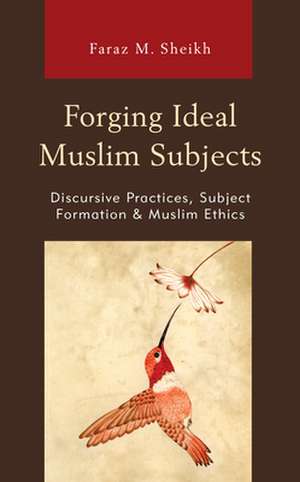
Forging Ideal Muslim Subjects
Autor Faraz Masood Sheikhen Limba Engleză Hardback – 22 iul 2020
Preț: 615.15 lei
Preț vechi: 723.71 lei
-15%
Puncte Express: 923
Carte tipărită la comandă
Livrare economică 25 noiembrie-09 decembrie
Livrare prin curier în România Termenul estimat este afișat lângă disponibilitate.
Transport gratuit pentru acest produs Plată online sau ramburs, în funcție de opțiunile comenzii.
Retur gratuit în 14 zile Comandă securizată și suport în română.
Specificații
ISBN-13: 9781793620125
ISBN-10: 1793620121
Pagini: 198
Dimensiuni: 157 x 235 x 15 mm
Greutate: 0.45 kg
Editura: Bloomsbury Publishing
Locul publicării:New York, United States
ISBN-10: 1793620121
Pagini: 198
Dimensiuni: 157 x 235 x 15 mm
Greutate: 0.45 kg
Editura: Bloomsbury Publishing
Locul publicării:New York, United States
Cuprins
Acknowledgments
Notes on Transliteration
Introduction
Narrating Ideal Muslim Subjectivities in a Foucauldian Register
Chapter One
Muhasibian Religious Subjectivity & the Travails of Sincerity
Chapter Two
Living with Vulnerabilities: Muhasibian Moral Subjectivity and Self-Care
Chapter Three
Belief Perspectives & the Nursian Religious Subject
Chapter Four
Nursian Believer as Moral Subject
Conclusion
Forging Ideal Subjectivities Everyday & Over a Lifetime
Bibliography
Index
About the Author
Notes on Transliteration
Introduction
Narrating Ideal Muslim Subjectivities in a Foucauldian Register
Chapter One
Muhasibian Religious Subjectivity & the Travails of Sincerity
Chapter Two
Living with Vulnerabilities: Muhasibian Moral Subjectivity and Self-Care
Chapter Three
Belief Perspectives & the Nursian Religious Subject
Chapter Four
Nursian Believer as Moral Subject
Conclusion
Forging Ideal Subjectivities Everyday & Over a Lifetime
Bibliography
Index
About the Author
Recenzii
Sheikh's work includes a dissertation on ninth-century Arab Muslim thinker and moral teacher al-Harith, born Asad al-Muhasibi. Sheikh (William and Mary) has also presented at conferences and written journal articles-evidence of his significant scholarship in religious ethics. In the present book, Sheikh applies what is appropriately termed a "third wave" interpretation in comparative religious ethics. He adds to his previous writings by integrating a close reading of 20th-century Kurdish Muslim Qur'anic scholar Said Nursi (1878-1960) with work of French philosopher Pierre Hadot and with late-career, post-Iranian revolution writings of Michel Foucault. The introduction, "Narrating Ideal Muslim Subjectivities in a Foucauldian Register," provides a succinct orientation to the project. Four substantive chapters-two on Muhasibi and two on Nursi-bring received Muslim categories into a more general discussion that includes the formation of moral subjectivity, sincerity, and self-care practice central to the work of Hadot and Foucault. The result is a serious, consequential analysis that can show new ways to appreciate long-established practices and methods for Muslim moral formation. Extensive references, bibliography, and index. Summing Up: Recommended. Upper-division undergraduates through faculty.
Faraz M. Sheikh's engrossing study, framed through a comparative religious ethics lens, gifts its readers with insightful views into the religio-moral ideals of two prominent Muslim sages, the ninth-century pietist Muhasibi and the early twentieth-century thinker Said Nursi. The work is not only an invaluable contribution to the study of Muslim ethics, but also for the field of religious ethics more broadly.
Textually layered, theoretically vivacious, and historically grounded, Forging Ideal Muslim Subjects marks a major intervention in the study of Muslim ethics and moral philosophy. How have Muslim thinkers wrestled with the foundational question of what constitutes a normatively good life and subjectivity? Faraz Sheikh examines this question, combining brilliance with deep reflection, through an unprecedented exploration of the religious thought and career of two major though less explored scholars from the 9th and 20th centuries: al-Harith al-Muhasibi (d.856) and Said Nursi (d.1960). Faraz successfully demonstrates that while distinctive and separated by many centuries, these thinkers present us with particularly effective examples of the enduring yet variegated significance of moral discipline and subjectivity in Muslim thought and practice. This book should and will be widely read and debated.
Living in the modern world demands subservience to the gods of materialism, tribalism, and efficiency. How may one escape this iron cage? Faraz Sheikh investigates the writings of al-Harith al-Muhasibi and Said Nursi to find out and discovers that these two thinkers have plenty to say. Both thinkers drew exquisitely detailed portraits of the ideal subjectivity and wrote incisively about how one may fashion it. This beautifully written book is an exemplary constructive and conceptual contribution to the field of religious ethics that puts Islamic thought in dialogue with ethicists concerned with secularism, pluralism, and the place of religion in the modern world.
Faraz M. Sheikh's engrossing study, framed through a comparative religious ethics lens, gifts its readers with insightful views into the religio-moral ideals of two prominent Muslim sages, the ninth-century pietist Muhasibi and the early twentieth-century thinker Said Nursi. The work is not only an invaluable contribution to the study of Muslim ethics, but also for the field of religious ethics more broadly.
Textually layered, theoretically vivacious, and historically grounded, Forging Ideal Muslim Subjects marks a major intervention in the study of Muslim ethics and moral philosophy. How have Muslim thinkers wrestled with the foundational question of what constitutes a normatively good life and subjectivity? Faraz Sheikh examines this question, combining brilliance with deep reflection, through an unprecedented exploration of the religious thought and career of two major though less explored scholars from the 9th and 20th centuries: al-Harith al-Muhasibi (d.856) and Said Nursi (d.1960). Faraz successfully demonstrates that while distinctive and separated by many centuries, these thinkers present us with particularly effective examples of the enduring yet variegated significance of moral discipline and subjectivity in Muslim thought and practice. This book should and will be widely read and debated.
Living in the modern world demands subservience to the gods of materialism, tribalism, and efficiency. How may one escape this iron cage? Faraz Sheikh investigates the writings of al-Harith al-Muhasibi and Said Nursi to find out and discovers that these two thinkers have plenty to say. Both thinkers drew exquisitely detailed portraits of the ideal subjectivity and wrote incisively about how one may fashion it. This beautifully written book is an exemplary constructive and conceptual contribution to the field of religious ethics that puts Islamic thought in dialogue with ethicists concerned with secularism, pluralism, and the place of religion in the modern world.