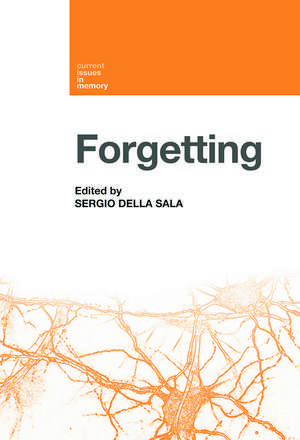
Forgetting: Current Issues in Memory
Editat de Sergio Della Salaen Limba Engleză Paperback – 11 noi 2013
This volume addresses various aspects of forgetting, drawing from several disciplines, including experimental and cognitive psychology, cognitive and clinical neuropsychology, behavioural neuroscience, neuroimaging, clinical neurology, and computational modeling. The first chapters of the book discuss the history of forgetting, its theories and accounts, the difference between short-term and long-term forgetting as well as the relevance of forgetting within each of the numerous components of memory taxonomy. The central part summarizes and discusses what we have learned about forgetting from animal work, from computational modeling, and from neuroimaging. Further chapters discuss pathological forgetting in patients with amnesia and epilepsy, as well as psychogenic forgetting. The book concludes by focusing on the difference between forgetting of autobiographical memories versus collective memory forgetting.
This book is the first to address the issue of forgetting from an interdisciplinary point of view, but with a particular emphasis on psychology. The book is scientific and yet accessible in tone, and as such is suitable for advanced undergraduate and postgraduate students of psychology and related subjects, such as science and neuroscience.
Preț: 465.83 lei
Preț vechi: 548.04 lei
-15%
Puncte Express: 699
Carte tipărită la comandă
Livrare economică 27 noiembrie-11 decembrie
Livrare prin curier în România Termenul estimat este afișat lângă disponibilitate.
Transport gratuit pentru acest produs Plată online sau ramburs, în funcție de opțiunile comenzii.
Retur gratuit în 14 zile Comandă securizată și suport în română.
Specificații
ISBN-13: 9780415647854
ISBN-10: 0415647851
Pagini: 352
Ilustrații: 51 black & white illustrations, 2 black & white tables, 9 black & white halftones, 42 black & white line drawings
Dimensiuni: 156 x 234 x 19 mm
Greutate: 0.54 kg
Ediția:1
Editura: Taylor & Francis
Colecția Psychology Press
Seria Current Issues in Memory
Locul publicării:Oxford, United Kingdom
ISBN-10: 0415647851
Pagini: 352
Ilustrații: 51 black & white illustrations, 2 black & white tables, 9 black & white halftones, 42 black & white line drawings
Dimensiuni: 156 x 234 x 19 mm
Greutate: 0.54 kg
Ediția:1
Editura: Taylor & Francis
Colecția Psychology Press
Seria Current Issues in Memory
Locul publicării:Oxford, United Kingdom
V-ar putea interesa
-
 Boost Your BrainMajid FotuhiPreț: 111.03 lei
 -
 Tall Tales about the Mind and Brain: Separating fact from fictionSergio Della Sala-32%Preț: 989.03 lei1462.70 lei
 -
 Neuroscience in Education: The good, the bad, and the uglySergio Della Sala-25%Preț: 529.66 lei705.54 lei
 -
 Handbook of Frontal Lobe AssessmentSarah E. MacPherson-24%Preț: 554.39 lei728.84 lei
 -
 Preț: 110.28 lei
 -
 Candle ExercisesClaude NeedhamPreț: 121.51 lei
 -
 Delos the Island of MiraclesGeorge VoulgarisPreț: 107.94 lei
 -
 Preț: 330.17 lei
 -
 Memory and Society: Psychological PerspectivesLars-Göran NilssonPreț: 344.40 lei
 -
 Remember It!Nelson Dellis-20%Preț: 93.37 lei116.56 lei
 -
 Communicating Memory & HistoryDavid W. Park-27%Preț: 818.26 lei1120.90 lei
 -
 Preț: 121.43 lei
 -
 Max Your MindSandra Sanquist StantonPreț: 104.14 lei
 -
 Cómo mejorar la memoria y la concentraciónJosué RodríguezPreț: 59.84 lei
 -
 Great Quotes from Great Women JournalSourcebooks-17%Preț: 49.89 lei60.23 lei
 -
 The I Love My Life ChallengeAdam MarkelPreț: 69.91 lei
 -
 How to Develop a Brilliant Memory Week by WeekDominic O'BrienPreț: 78.92 lei
 -
 The Practice of ThinkingMarta LenartowiczPreț: 376.05 lei
Cuprins
H.L. Roediger III, Y. Weinstein, P.K. Agarwal, Forgetting: Preliminary Consideration. H.J. Markowitsch, M. Brand, Forgetting: An Historical Perspective. R. Cubelli, A New Taxonomy of Memory and Forgetting. G.D.A. Brown, S. Lewandowsky, Forgetting in Memory Models: Arguments Against Trace Decay and Consolidation Failure. J.M.J. Murre, Connectionist Models of Forgetting. F. Valtorta, F. Benfenati, Synaptic Plasticity and the Neurobiology of Memory and Forgetting. B.J. Levy, B.A. Kuhl, A.D. Wagner, The Functional Neuroimaging of Forgetting. P. Peigneux, R. Schmitz, C. Urbain, Sleep and Forgetting. M. Dewar, N. Cowan, S. Della Sala, Forgetting due to Retroactive Interference in Amnesia Findings and Implications. C. Butler, N. Muhlert, A. Zeman, Accelerated Long-Term Forgetting. M. Brand, H.J. Markowitsch, Aspects of Forgetting in Psychogenic Amnesia. C.B. Harris, J. Sutton, A.J. Barnier, Autobiographical Forgetting, Social Forgetting and Situated Forgetting: Forgetting in Context. J.T. Wixted, The Role of Retroactive Interference and Consolidation in Everyday Forgetting.
Recenzii
"Forgetting is a well-written, thought-provoking book. The chapters are concise and provide an understandable explanation of various aspects of forgetting and memory. ... the individual chapters are engaging and comprehensible in a way that takes the book beyond ordinary educational literature. ... It is both enjoyable and a much-needed reference for both memory scholars and their students." – Benton H. Pierce and Melissa J. Hawthorne in PsycCRITIQUES
"For many years, the study of forgetting has been a relatively neglected area of memory. As this collection of chapters richly demonstrates, this has now begun to change. New approaches using behavioural, neuropsychological and neurobiological methods are turning what previously appeared as tired old controversies into exciting new growth points. I think this collection of chapters by leading theorists will be important in forging a new and more comprehensive approach to our understanding of forgetting." - Alan Baddeley, Professor of Psychology, University of York, UK
"You could build an entire seminar for advanced undergraduate or graduate students around Forgetting. In compellingly-written chapters, leading researchers describe fascinating recent discoveries and provide invigorating new perspectives on long-standing puzzles. Forgetting is a model for interdisciplinary examination of a complex topic." - Keith B. Lyle, Assistant Professor, Department of Psychological and Brain Sciences, University of Louisville, USA
"This volume represents multiple areas of cutting-edge research on forgetting. Although some kinds of memory loss owe to mental limitations, others free the mind for more important memories. Bringing together the rich insights from leading psychologists and neuroscientists, this is a unique and definitive resource on the science of forgetting." - David A. Gallo, Assistant Professor of Psychology, University of Chicago, USA and author of Associative Illusions of Memory
"For many years, the study of forgetting has been a relatively neglected area of memory. As this collection of chapters richly demonstrates, this has now begun to change. New approaches using behavioural, neuropsychological and neurobiological methods are turning what previously appeared as tired old controversies into exciting new growth points. I think this collection of chapters by leading theorists will be important in forging a new and more comprehensive approach to our understanding of forgetting." - Alan Baddeley, Professor of Psychology, University of York, UK
"You could build an entire seminar for advanced undergraduate or graduate students around Forgetting. In compellingly-written chapters, leading researchers describe fascinating recent discoveries and provide invigorating new perspectives on long-standing puzzles. Forgetting is a model for interdisciplinary examination of a complex topic." - Keith B. Lyle, Assistant Professor, Department of Psychological and Brain Sciences, University of Louisville, USA
"This volume represents multiple areas of cutting-edge research on forgetting. Although some kinds of memory loss owe to mental limitations, others free the mind for more important memories. Bringing together the rich insights from leading psychologists and neuroscientists, this is a unique and definitive resource on the science of forgetting." - David A. Gallo, Assistant Professor of Psychology, University of Chicago, USA and author of Associative Illusions of Memory
"For many years, the study of forgetting has been a relatively neglected area of memory. As this collection of chapters richly demonstrates, this has now begun to change. New approaches using behavioural, neuropsychological and neurobiological methods are turning what previously appeared as tired old controversies into exciting new growth points. I think this collection of chapters by leading theorists will be important in forging a new and more comprehensive approach to our understanding of forgetting." - Alan Baddeley, Professor of Psychology, University of York, UK
"You could build an entire seminar for advanced undergraduate or graduate students around Forgetting. In compellingly-written chapters, leading researchers describe fascinating recent discoveries and provide invigorating new perspectives on long-standing puzzles. Forgetting is a model for interdisciplinary examination of a complex topic." - Keith B. Lyle, Assistant Professor, Department of Psychological and Brain Sciences, University of Louisville, USA
"This volume represents multiple areas of cutting-edge research on forgetting. Although some kinds of memory loss owe to mental limitations, others free the mind for more important memories. Bringing together the rich insights from leading psychologists and neuroscientists, this is a unique and definitive resource on the science of forgetting." - David A. Gallo, Assistant Professor of Psychology, University of Chicago, USA and author of Associative Illusions of Memory
"For many years, the study of forgetting has been a relatively neglected area of memory. As this collection of chapters richly demonstrates, this has now begun to change. New approaches using behavioural, neuropsychological and neurobiological methods are turning what previously appeared as tired old controversies into exciting new growth points. I think this collection of chapters by leading theorists will be important in forging a new and more comprehensive approach to our understanding of forgetting." - Alan Baddeley, Professor of Psychology, University of York, UK
"You could build an entire seminar for advanced undergraduate or graduate students around Forgetting. In compellingly-written chapters, leading researchers describe fascinating recent discoveries and provide invigorating new perspectives on long-standing puzzles. Forgetting is a model for interdisciplinary examination of a complex topic." - Keith B. Lyle, Assistant Professor, Department of Psychological and Brain Sciences, University of Louisville, USA
"This volume represents multiple areas of cutting-edge research on forgetting. Although some kinds of memory loss owe to mental limitations, others free the mind for more important memories. Bringing together the rich insights from leading psychologists and neuroscientists, this is a unique and definitive resource on the science of forgetting." - David A. Gallo, Assistant Professor of Psychology, University of Chicago, USA and author of Associative Illusions of Memory
Descriere
In order to understand memory we need to understand how and why we forget. This book addresses forgetting, drawing from several disciplines, and is suitable for advanced undergraduate and postgraduate students of psychology and related subjects.