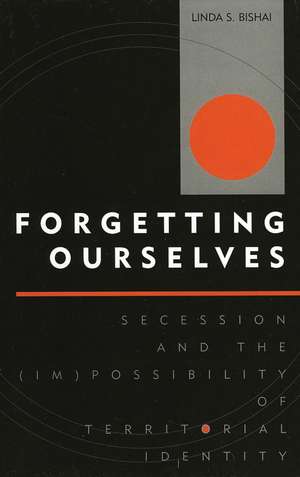
Forgetting Ourselves: Secession and the (Im)possibility of Territorial Identity: Innovations in the Study of World Politics
Autor Linda S. Bishaien Limba Engleză Paperback – 5 dec 2006

Preț: 305.82 lei
Preț vechi: 406.65 lei
-25%
Puncte Express: 459
Carte tipărită la comandă
Livrare economică 03-17 decembrie
Livrare prin curier în România Termenul estimat este afișat lângă disponibilitate.
Transport gratuit de la 400.00 lei Plată online sau ramburs, în funcție de opțiunile comenzii.
Retur gratuit în 14 zile Comandă securizată și suport în română.
Specificații
ISBN-13: 9780739120828
ISBN-10: 0739120824
Pagini: 190
Dimensiuni: 156 x 232 x 15 mm
Greutate: 0.29 kg
Editura: Bloomsbury Publishing
Colecția Lexington Books
Seria Innovations in the Study of World Politics
Locul publicării:New York, United States
ISBN-10: 0739120824
Pagini: 190
Dimensiuni: 156 x 232 x 15 mm
Greutate: 0.29 kg
Editura: Bloomsbury Publishing
Colecția Lexington Books
Seria Innovations in the Study of World Politics
Locul publicării:New York, United States
Cuprins
Chapter 1 If at First You Don't Secede: International Relations Theory and Its Shortcomings
Chapter 2 Why the Patient Cannot be Cured
Chapter 3 States Taking Place: History and the Territorialization of Politics
Chapter 4 Begging to Differ: Patriots, Nationalists, Minorities
Chapter 5 Secessionist Performances, Narrating Otherness
Chapter 6 InConclusion: Forgetting and the Theory & Practice of the Self
Chapter 2 Why the Patient Cannot be Cured
Chapter 3 States Taking Place: History and the Territorialization of Politics
Chapter 4 Begging to Differ: Patriots, Nationalists, Minorities
Chapter 5 Secessionist Performances, Narrating Otherness
Chapter 6 InConclusion: Forgetting and the Theory & Practice of the Self
Recenzii
This is a tightly argued and clearly written work engaging both major currents of thought about state territoriality and sovereignty and empirical materials on a selection of contemporary secessionist movements from around the world. Two features are outstanding: the contribution made to understanding the connection between territory and political identity, and the original analysis, of secessionist movements in terms of the 'performance' of territory/identity claims.
This work will best be appreciated by those conversant in liberal and postmodern political theory from John Rawles to Charles Taylor, Will Kymlicka, William Connolly, and those supportive of a constitutive or constructivist IR theoretical approach. Recommended.
Bishai offers an impressive critique of the fantasy of timelessness and indivisibility that befell the understanding of territorial statehood, especially in the discipline of international relations. Through an acute historical and philosophical analysis of the secession phenomenon, she issues an important and timely challenge: to forget 'oneself' in order to make possible 'other selves', to enable a politics of identity which can accommodate overlapping loyalties, a politics not embedded in unreflective homogenization, nation-building and territoriality schemes.
Drawing on Nietzschean insights, Bishai demonstrates the historical newness and philosophical impossibility of secession, and devastates extant ethical and causal scholarship on the issue. Students of IR are forced to pay long overdue interest to a topic that should have been central to the discipline all along.
This work will best be appreciated by those conversant in liberal and postmodern political theory from John Rawles to Charles Taylor, Will Kymlicka, William Connolly, and those supportive of a constitutive or constructivist IR theoretical approach. Recommended.
Bishai offers an impressive critique of the fantasy of timelessness and indivisibility that befell the understanding of territorial statehood, especially in the discipline of international relations. Through an acute historical and philosophical analysis of the secession phenomenon, she issues an important and timely challenge: to forget 'oneself' in order to make possible 'other selves', to enable a politics of identity which can accommodate overlapping loyalties, a politics not embedded in unreflective homogenization, nation-building and territoriality schemes.
Drawing on Nietzschean insights, Bishai demonstrates the historical newness and philosophical impossibility of secession, and devastates extant ethical and causal scholarship on the issue. Students of IR are forced to pay long overdue interest to a topic that should have been central to the discipline all along.