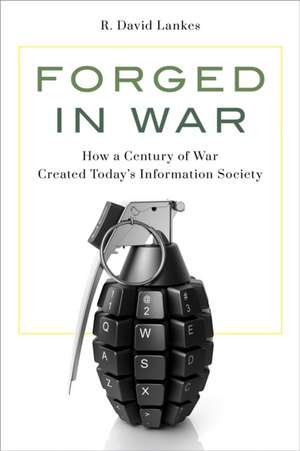
Forged in War: How a Century of War Created Today’s Information Society
Autor R. David Lankesen Limba Engleză Hardback – 15 mai 2021
Many of what we think of as Information Age tools and media - computers, cell phones, the internet, encryption, and more - evolved directly out of modern warfare. These tools started with World War I (which began not with arms, but with England cutting off underwater cables to Germany and isolating it), accelerated through World War II and the Cold War, and now play a center role in both declared and non-declared conflicts like election interference and cyberbattles.
We buy phones and smart speakers because they are new and unlock great potential. Voice assistants like Siri and Alexa help us do our work and answer that one piece of trivia that bugs us. Yet these devices are data gatherers. They collect, repackage, and monetize our questions, purchases, photographs, web surfing to form a data industry now larger than the oil industry.
Well over 100 years ago the data industry put in place a business model that trades our attention for news and entertainment. That model has evolved into a complex art and science of message targeting and content ownership that has splintered communities while simultaneously concentrating media ownership to a few massive corporations.
Forged in War takes a critical look at the systems we use and how we ended up in a society that values data over personal liberty and commerce over the public good. It tells a compelling and previously story of how our ideas of information and knowledge reflect the century of war that has militarized our worldview.
Author David Lankes's work has been funded by organizations such as The MacArthur Foundation, The Institute for Library and Museum Services, NASA, The U.S. Department of Education, The U.S. Department of Defense, The National Science Foundation, and The U.S. State Department. This, his latest book will help all of us learn how war has shaped our world and how to begin to create an agenda to stand down weaponized data and a media that seeks to own our personal, even intimate data like one owns a gold mine.
Preț: 226.91 lei
Preț vechi: 302.48 lei
-25%
Puncte Express: 340
Carte tipărită la comandă
Livrare economică 02-16 decembrie
Livrare prin curier în România Termenul estimat este afișat lângă disponibilitate.
Transport gratuit de la 400.00 lei Plată online sau ramburs, în funcție de opțiunile comenzii.
Retur gratuit în 14 zile Comandă securizată și suport în română.
Specificații
ISBN-13: 9781538148952
ISBN-10: 1538148951
Pagini: 304
Ilustrații: 20 b/w photos
Dimensiuni: 162 x 238 x 28 mm
Greutate: 0.62 kg
Editura: Bloomsbury Publishing
Colecția Rowman & Littlefield
Locul publicării:New York, United States
ISBN-10: 1538148951
Pagini: 304
Ilustrații: 20 b/w photos
Dimensiuni: 162 x 238 x 28 mm
Greutate: 0.62 kg
Editura: Bloomsbury Publishing
Colecția Rowman & Littlefield
Locul publicării:New York, United States
V-ar putea interesa
-
 What Would Google Do?Jeff JarvisPreț: 109.98 lei
 -
 -15%Preț: 204.16 lei240.71 lei
 -
 -17%Preț: 244.81 lei296.43 lei
 -
 The New Librarianship Field GuideR. David LankesPreț: 238.82 lei
 -
 Preț: 125.39 lei
 -
 AI SuperpowersKai-Fu LeePreț: 93.21 lei
 -
 Behind the CloudMarc BenioffPreț: 159.73 lei
 -
 I'm Feeling LuckyDouglas EdwardsPreț: 155.58 lei
 -
 Insanely SimpleKen Segall-31%Preț: 63.61 lei92.60 lei
 -
 The Game to Show the GamesMorgan WickPreț: 73.14 lei
 -
 The Dynamics of Broadband Markets in EuropeWolter Lemstra-23%Preț: 884.64 lei1148.88 lei
 -
 The Philosophy of SoftwareD. BerryPreț: 430.94 lei
 -
 IT in the Public SphereZaigham Mahmood-18%Preț: 1135.60 lei1384.88 lei
 -
 CodeBernard Dionysius GeogheganPreț: 196.44 lei
 -
 The Boring PatientR. David LankesPreț: 80.73 lei
 -
 Thomas Watson, Sr.: IBM and the Computer RevolutionRobert SobelPreț: 254.69 lei
 -
 Preț: 83.67 lei
 -
 New Concepts in Digital ReferenceR. David Lankes-20%Preț: 130.66 lei163.33 lei
 -
 Software Business. Towards Continuous Value DeliveryCasper LasseniusPreț: 392.97 lei
 -
 Preț: 338.97 lei
 -
 Wirtschaftsinformatik in der UnternehmenspraxisPeter PagelPreț: 178.59 lei
 -
 Cybermediaries als neue Geschäftsform im InternetClaudia SchubertPreț: 419.56 lei
 -
 Managing NothingSudhir VaradarajanPreț: 111.17 lei
Cuprins
Table of Contents
Introduction: From Alert to a Promise to the Reader
Data
Chapter 1 Common Carriers: From Telegraphs to Internet Kill Switches
Chapter 2 Encryption: From Zimmerman to the Monetized Self
Chapter 3 Massive Scale Computing: From Depth Bombs to Deep Learning
Chapter 4 The Internet: From Hydrogen Bombs to 5G
Chapter 5 The World Wide Web: From CERN to Facial Recognition
Chapter 6 Dataism: From Reducing Noise to Reducing People
Data Waypoint: The Span of the Knowledge InfrastructureMedia
Chapter 7 Propaganda: From Influencing Minds to Manipulating Brains
Chapter 8 Memory Organizations: From Weaponized Librarianship to a Digital Dark Age
From Collecting Books to Collecting Intelligence
Chapter 9 Media Consolidation: From Steamboat Willie to Disney +
Chapter 10 Trust: From Walter Cronkite to Saul Alinsky
Media Waypoint: The Weaponized Knowledge InfrastructureSociety
Chapter 11 Certainty: From Clockwork to Complexity
Chapter 12 Pandemic: From the Spanish Flu to COVID-19
Chapter 13 People: From Empty Campuses to Open Arms
Chapter 14 Technology: From Zoom Bombs to the Shin Bet
Chapter 15 Sources: From Swans in Venice to Floods in New Orleans
Chapter 16 Policy: From a Commodity to a Public Good
Chapter 17 A Choice: From Chemical Warfare to Healing the World
Society Waypoint: From Chemical Warfare to Healing the WorldExcursus: On the Joys of Writing and How to Check My Facts
About the Author
Introduction: From Alert to a Promise to the Reader
Data
Chapter 1 Common Carriers: From Telegraphs to Internet Kill Switches
Chapter 2 Encryption: From Zimmerman to the Monetized Self
Chapter 3 Massive Scale Computing: From Depth Bombs to Deep Learning
Chapter 4 The Internet: From Hydrogen Bombs to 5G
Chapter 5 The World Wide Web: From CERN to Facial Recognition
Chapter 6 Dataism: From Reducing Noise to Reducing People
Data Waypoint: The Span of the Knowledge InfrastructureMedia
Chapter 7 Propaganda: From Influencing Minds to Manipulating Brains
Chapter 8 Memory Organizations: From Weaponized Librarianship to a Digital Dark Age
From Collecting Books to Collecting Intelligence
Chapter 9 Media Consolidation: From Steamboat Willie to Disney +
Chapter 10 Trust: From Walter Cronkite to Saul Alinsky
Media Waypoint: The Weaponized Knowledge InfrastructureSociety
Chapter 11 Certainty: From Clockwork to Complexity
Chapter 12 Pandemic: From the Spanish Flu to COVID-19
Chapter 13 People: From Empty Campuses to Open Arms
Chapter 14 Technology: From Zoom Bombs to the Shin Bet
Chapter 15 Sources: From Swans in Venice to Floods in New Orleans
Chapter 16 Policy: From a Commodity to a Public Good
Chapter 17 A Choice: From Chemical Warfare to Healing the World
Society Waypoint: From Chemical Warfare to Healing the WorldExcursus: On the Joys of Writing and How to Check My Facts
About the Author
Recenzii
Forged in War reexamines the histories of mobile phones, the internet, data (and its collection), web standards such as HTML, and more. He sheds light on the downsides of the information world we live in now, such as data monetization, attacks on privacy, and erosion of widespread public trust in information sources. . . . Lankes clearly argues that technology, data, and information sharing have human bias and are not objective. . . . [A] multifaceted, intelligent work . . . ideal for readers seeking a more comprehensive look at information dissemination technology, its context, and its impact on the way in which we now live.
Lankes' historical perspective is compelling and his arguments convincing.
With the rise of the 'data revolution, big data, gamification, fuzzy logic, and creative visualizations' this work provides a historical pathway on how information about we as a people is transformed into purposes for commodity, messaging, marketing, and personal truths. The book is a meditation on the informational landscape of the past & present that undoubtedly unfolds into a future based upon those foundations.
This extremely wide-ranging work calls attention to the problems of our newest information age.
Lankes' historical perspective is compelling and his arguments convincing.
With the rise of the 'data revolution, big data, gamification, fuzzy logic, and creative visualizations' this work provides a historical pathway on how information about we as a people is transformed into purposes for commodity, messaging, marketing, and personal truths. The book is a meditation on the informational landscape of the past & present that undoubtedly unfolds into a future based upon those foundations.
This extremely wide-ranging work calls attention to the problems of our newest information age.