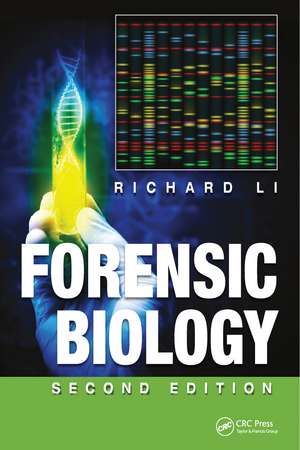
Forensic Biology
Autor Richard Lien Limba Engleză Paperback – 30 iun 2021
Evoluția rapidă a metodelor de analiză și a practicilor de laborator din ultimii ani a transformat biologia criminalistică într-o disciplină de o precizie microscopică, redefinind standardele de investigație la fața locului. În această a treia ediție a lucrării Forensic Biology, publicată de CRC Press, descoperim o actualizare riguroasă a fundamentelor științifice necesare identificării și analizării probelor biologice. Notăm cu interes efortul autorului de a integra noile cercetări prin adăugarea a trei capitole inedite și a peste 200 de figuri color, esențiale pentru vizualizarea proceselor complexe de serologie și genetică.
Structura volumului urmărește o progresie logică, de la gestionarea scenei crimei și analiza urmelor de sânge (Secțiunea I), până la tehnici avansate de extracție a acizilor nucleici și cuantificare ADN (Secțiunea II). Secțiunile finale se concentrează pe identificarea specifică a fluidelor corporale și pe procesul de individualizare a probelor, oferind un cadru metodologic complet. Această abordare sistematică completează perspectiva oferită de Fundamentals of Forensic Biology de Avinash Puri, adăugând o componentă vizuală mult mai densă, susținută de cele 850 de ilustrații care facilitează înțelegerea procedurilor de laborator.
Deși Richard Li a explorat în alte lucrări precum Blended Learning: Re-thinking and Re-defining the Learning Process metodologii educaționale moderne, în Forensic Biology el aplică aceste principii pedagogice pentru a transforma un subiect tehnic într-un parcurs coerent pentru studenți. Față de Essential Forensic Biology de Alan Gunn, care include și studiul nevertebratelor sau al plantelor, lucrarea de față rămâne focalizată strict pe biologia umană și analiza polimorfismului secvențelor, fiind un instrument de lucru precis pentru viitorii experți în medicină legală.
Preț: 566.31 lei
Preț vechi: 615.55 lei
-8%
Carte tipărită la comandă
Livrare economică 04-18 decembrie
Specificații
ISBN-10: 1032098791
Pagini: 568
Ilustrații: 413 Illustrations, black and white
Dimensiuni: 178 x 254 x 40 mm
Greutate: 1.32 kg
Ediția:2 ed
Editura: Taylor & Francis
Colecția CRC Press
Locul publicării:Oxford, United Kingdom
V-ar putea interesa
-
 Silent WitnessesNigel Mccrery-47%Preț: 62.84 lei118.67 lei
 -
 Forensic Testimony: Science, Law and Expert EvidenceC. Michael Bowers-19%Preț: 493.18 lei606.55 lei
 -
 Bayesian Networks ProbabilistiFranco Taroni-8%Preț: 681.91 lei741.20 lei
 -
 Bog Bodies UncoveredMiranda Aldhouse-GreenPreț: 180.50 lei
 -
 Foundations of Forensic Document AnalysisMichael J AllenPreț: 442.52 lei
 -
 Communication in Investigative and Legal ContextsGavin OxburghPreț: 370.81 lei
 -
 Human and Nonhuman Bone Identification: A Concise Field GuideDiane L. France-15%Preț: 705.04 lei829.46 lei
 -
 -18%Preț: 1117.23 lei1362.47 lei
 -
 Bone Histology: An Anthropological PerspectiveSam D. Stout-18%Preț: 1300.05 lei1585.44 lei
 -
 Forensic Pathology of Fractures and Mechanisms of InjuryMichael P Burke-14%Preț: 1941.77 lei2257.87 lei
 -
 Concepts and Case Studies in Threat ManagementFrederick S. Calhoun-18%Preț: 710.62 lei866.61 lei
 -
 Forensics: The Anatomy of CrimeVal McDermid-18%Preț: 71.01 lei86.78 lei
 -
 Handbook of Forensic Mental HealthKeith Soothill-15%Preț: 587.87 lei691.61 lei
De ce să citești această carte
Această ediție a treia este esențială pentru studenții de la facultățile de criminologie și medicină legală care au nevoie de o bază teoretică solidă cuplată cu proceduri practice. Cititorul câștigă o înțelegere clară a limitărilor și beneficiilor fiecărei tehnici de analiză ADN. Este o resursă indispensabilă datorită celor 850 de ilustrații care transformă conceptele abstracte în repere vizuale concrete pentru munca de laborator.
Despre autor
Richard Li este un expert recunoscut în domeniul științelor aplicate, cu o experiență vastă în structurarea materialelor educaționale complexe. Pe lângă contribuțiile sale fundamentale în biologia criminalistică, autorul a publicat lucrări despre mediile de învățare inteligente și tehnologia robotică, precum Building Robots with LEGO Mindstorms NXT. Această diversitate academică îi permite să abordeze Forensic Biology nu doar ca pe un tratat științific, ci ca pe un manual pedagogic de înaltă eficiență, adaptat nevoilor studenților contemporani, punând accent pe claritatea terminologică și pe integrarea tehnologiei în procesul de învățare.
Cuprins
Descriere scurtă
This second edition:
- Introduces the language of forensic biology, enabling students to become comfortable with usage and terminology
- Provides clear explanations of the principles of forensic identification and analysis of biological evidence
- Explains forensic serology and DNA techniques used in the field and the laboratory
- Discusses the benefits and limitations that apply to various forensic biology techniques
- Includes schematic illustrations to clarify concepts
- Presents three new chapters created for this edition
- Adds more than two hundred new color figures
Covering the full scope of forensic biology, the book uses an accessible, straightforward style designed to enhance students’ education and training so they are prepared, both in the laboratory and in the field.