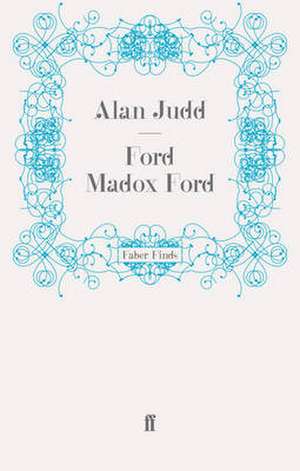
Ford Madox Ford
en Limba Engleză Paperback – 15 apr 2011
Graham Greene once strikingly pronounced, 'There is no novelist of this century more likely to live than Ford Madox Ford.' Even if that is debatable there is no denying his importance in the literary firmament of the first thirty years of the twentieth-century. He founded the English Review which can claim to have discovered D. H. Lawrence, Ezra Pound and Wyndham Lewis. In the 1920s he founded the Transatlantic Review which published work by James Joyce, Ezra Pound, e.e. cummings, Gertrude Stein and Jean Rhys.
Two of Ford Madox Ford's passions were conversation and women. It is often said he only seduced the latter to carry on the former!
Alan Judd's biography is a brilliant rehabilitation of a literary figure who has still not been accorded his rightful place. On first publication it received dazzling reviews.
'It is a marvellous book, intelligent, sympathetic, comprehensive, worthy of Ford.' Allan Massie, Sunday Telegraph
'Mr Judd never bores. He is shrewd about the novel in general and Ford in particular.' Gore Vidal, Times Literary Supplement
'Indulgent, energetic, and immensely readable.' Richard Holmes, The Times
'Alan Judd has been drawn into Ford's embattlement and defends him staunchly and imaginatively.' A. S. Byatt, Guardian
'What Judd rightly emphasises is that Ford was a giver, believing that the preservation and furtherance of artistic talent was his permanent responsibility.' Frank Kermode, London Review of Books
Preț: 266.18 lei
Puncte Express: 399
Carte tipărită la comandă
Livrare economică 19-25 noiembrie
Livrare prin curier în România Termenul estimat este afișat lângă disponibilitate.
Transport gratuit de la 400.00 lei Plată online sau ramburs, în funcție de opțiunile comenzii.
Retur gratuit în 14 zile Comandă securizată și suport în română.
Specificații
ISBN-13: 9780571256020
ISBN-10: 0571256023
Pagini: 498
Dimensiuni: 126 x 198 x 35 mm
Greutate: 0.58 kg
Editura: FABER AND FABER LTD
ISBN-10: 0571256023
Pagini: 498
Dimensiuni: 126 x 198 x 35 mm
Greutate: 0.58 kg
Editura: FABER AND FABER LTD
V-ar putea interesa
-
 Speaking to You: Contemporary Poetry and Public AddressNatalie Pollard-31%Preț: 977.03 lei1423.32 lei
 -
 English as a Vocation: The 'Scrutiny' MovementChristopher Hilliard-31%Preț: 899.87 lei1313.00 lei
 -
 Novelists in the New Millennium: Conversations with WritersProfessor Vanessa GuigneryPreț: 204.85 lei
 -
 Vladimir NabokovD. RamptonPreț: 390.09 lei
 -
 Preț: 208.03 lei
 -
 Ford Madox Ford and the Misfit ModernsR. HawkesPreț: 387.73 lei
 -
 Preț: 383.62 lei
 -
 Iris MurdochA. Rowe-15%Preț: 664.10 lei781.30 lei
 -
 Modernism and Market FantasyC. MickalitesPreț: 391.06 lei
 -
 Modernist ImpersonalitiesR. RivesPreț: 388.17 lei
 -
 Possessed of a PastJohn Banville-28%Preț: 80.79 lei112.57 lei
 -
 Introducing JoyceDavid NorrisPreț: 63.46 lei
 -
 Ender's World: Fresh Perspectives on the SF Classic Ender's GameOrson Scott Card-12%Preț: 80.33 lei90.83 lei
Notă biografică
Alan Judd, born in 1946, was a soldier and diplomat before becoming a full-time writer. He has written several novels drawing on his military and diplomatic experience, and in addition to Ford Madox Ford he has written the authorized biography of Mansfield Cumming, founder of MI6, The Quest for C.
Cuprins
Max SAUNDERS: General Editor’s Preface
Andrzej GASIOREK and Daniel MOORE: Introduction: Transitions, Continuities, Networks, Nuclei
John ATTRIDGE: ‘We Will Listen to None but Specialists’: Ford, the Rise of Specialization, and the English Review
Rob HAWKES: Personalities of Paper: Characterisation in A Call and The Good Soldier
Colm TÓIBÍN: Outsiders in England and the Art of Being Found Out
Andrzej GASIOREK: ‘Content to be Superseded’?: Ford in the Great London Vortex
Alan MUNTON: The Insane Subject: Ford and Wyndham Lewis in the War and Post-War
David TROTTER: Ford Against Lewis and Joyce
Max SAUNDERS: Ford and Impressionism
Nick HUBBLE: The Origins of Intermodernism in Ford Madox Ford’s Parallax View
Isabelle BRASME: Between Impressionism and Modernism: Some Do Not . . ., a poetics of the Entre-deux
Andrew FRAYN: ‘This Battle Was not Over’: Parade’s End as a Transitional Text in the Development of ‘Disenchanted’ First World War Literature
Zinovy ZINIK: Ford Madox Ford: Mentors, Disciples, and a Ring of Mail Conspirators
David JAMES: By Thrifty Design: Ford’s Bequest and Coetzee’s Homage
Contributors
Abstracts
Abbreviations
Andrzej GASIOREK and Daniel MOORE: Introduction: Transitions, Continuities, Networks, Nuclei
John ATTRIDGE: ‘We Will Listen to None but Specialists’: Ford, the Rise of Specialization, and the English Review
Rob HAWKES: Personalities of Paper: Characterisation in A Call and The Good Soldier
Colm TÓIBÍN: Outsiders in England and the Art of Being Found Out
Andrzej GASIOREK: ‘Content to be Superseded’?: Ford in the Great London Vortex
Alan MUNTON: The Insane Subject: Ford and Wyndham Lewis in the War and Post-War
David TROTTER: Ford Against Lewis and Joyce
Max SAUNDERS: Ford and Impressionism
Nick HUBBLE: The Origins of Intermodernism in Ford Madox Ford’s Parallax View
Isabelle BRASME: Between Impressionism and Modernism: Some Do Not . . ., a poetics of the Entre-deux
Andrew FRAYN: ‘This Battle Was not Over’: Parade’s End as a Transitional Text in the Development of ‘Disenchanted’ First World War Literature
Zinovy ZINIK: Ford Madox Ford: Mentors, Disciples, and a Ring of Mail Conspirators
David JAMES: By Thrifty Design: Ford’s Bequest and Coetzee’s Homage
Contributors
Abstracts
Abbreviations
Descriere
Descriere de la o altă ediție sau format:
The controversial British writer Ford Madox Ford (1873-1939) is increasingly recognized as a major presence in early twentieth-century literature. This series of International Ford Madox Ford Studies was founded to reflect the recent resurgence of interest in him. Each volume is based upon a particular theme or issue; and relates aspects of Ford’s work, life, and contacts, to broader concerns of his time. The present book is part of a large-scale reassessment of his roles in literary history.
Ford is best-known for his fiction, especially The Good Soldier, long considered a modernist masterpiece; and Parade’s End, which Anthony Burgess described as ‘the finest novel about the First World War’; and Samuel Hynes has called ‘the greatest war novel ever written by an Englishman’. In these, as in most of his books, Ford renders and analyses the crucial transformations in modern society and culture. One of the most striking features of his career is his close involvement with so many of the major international literary groupings of his time. In the South-East of England at the fin-de-siècle, he collaborated for a decade with Joseph Conrad, and befriended Henry James and H. G. Wells. In Edwardian London he founded the English Review, publishing these writers alongside his new discoveries, Ezra Pound, D. H. Lawrence, and Wyndham Lewis. After the war he moved to France, founding the transatlantic review in Paris, taking on Hemingway as a sub-editor, discovering another generation of Modernists such as Jean Rhys and Basil Bunting, and publishing them alongside Joyce and Gertrude Stein. Besides his role as contributor and enabler to various versions of Modernism, Ford was also one of its most entertaining chroniclers.
This volume includes twelve new essays on Ford’s engagement with the literary networks and cultural shifts of his era, by leading experts and younger scholars of Ford and Modernism. Two of the essays are by well-known creative writers: the novelist Colm Tóibín, and the novelist and cultural commentator Zinovy Zinik.
The controversial British writer Ford Madox Ford (1873-1939) is increasingly recognized as a major presence in early twentieth-century literature. This series of International Ford Madox Ford Studies was founded to reflect the recent resurgence of interest in him. Each volume is based upon a particular theme or issue; and relates aspects of Ford’s work, life, and contacts, to broader concerns of his time. The present book is part of a large-scale reassessment of his roles in literary history.
Ford is best-known for his fiction, especially The Good Soldier, long considered a modernist masterpiece; and Parade’s End, which Anthony Burgess described as ‘the finest novel about the First World War’; and Samuel Hynes has called ‘the greatest war novel ever written by an Englishman’. In these, as in most of his books, Ford renders and analyses the crucial transformations in modern society and culture. One of the most striking features of his career is his close involvement with so many of the major international literary groupings of his time. In the South-East of England at the fin-de-siècle, he collaborated for a decade with Joseph Conrad, and befriended Henry James and H. G. Wells. In Edwardian London he founded the English Review, publishing these writers alongside his new discoveries, Ezra Pound, D. H. Lawrence, and Wyndham Lewis. After the war he moved to France, founding the transatlantic review in Paris, taking on Hemingway as a sub-editor, discovering another generation of Modernists such as Jean Rhys and Basil Bunting, and publishing them alongside Joyce and Gertrude Stein. Besides his role as contributor and enabler to various versions of Modernism, Ford was also one of its most entertaining chroniclers.
This volume includes twelve new essays on Ford’s engagement with the literary networks and cultural shifts of his era, by leading experts and younger scholars of Ford and Modernism. Two of the essays are by well-known creative writers: the novelist Colm Tóibín, and the novelist and cultural commentator Zinovy Zinik.